


Governor Choo Mi-ae Proposes Joint Use of Industrial Complex Allocations Among 14 Overconcentration Restriction Zone Cities
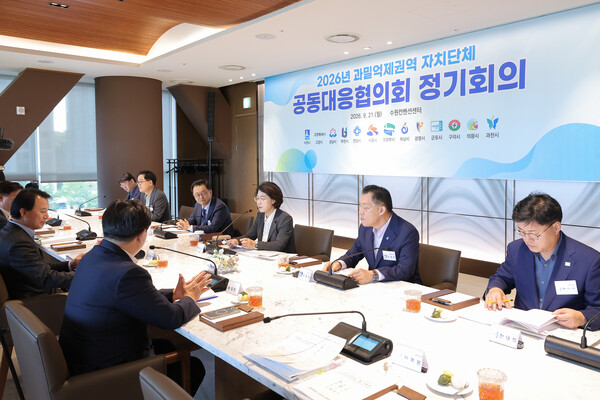
Gyeonggi Province Governor Choo Mi-ae has proposed joint utilization of industrial complex allocations among 14 cities in the overconcentration restriction zone to ensure that regions with business investment demand can secure necessary industrial complex land in a timely manner.
The proposal aims to cooperate in establishing a 'Gyeonggi Province Total Account for Industrial Complexes in Overconcentration Restriction Zones,' through which the province would consolidate allocations that individual cities have no immediate plans to use and redistribute them to areas in need.
The 14 cities in the overconcentration restriction zone within Gyeonggi Province are Suwon, Goyang, Seongnam, Bucheon, Namyangju, Anyang, Siheung, Uijeongbu, Hanam, Gwangmyeong, Gunpo, Guri, Uiwang, and Gwacheon.
Governor Choo participated in a meeting of the 'Overconcentration Restriction Zone Local Government Joint Response Council' with representatives from the 14 cities at the Suwon Convention Center on the 21st, stating, "We are now in an era of hyper-connectivity. To secure global competitiveness, we are trying to address these issues through peace economy special zones and free economic zones, but regulations from the construction and development era some 40 years ago are hampering our efforts." She explained the necessity of the provincial total account system.
"Gyeonggi Province needs to guide industrial complex allocations from a macro-level industrial vision, but we are bound by regulations that prevent this," Governor Choo said. "First, we will implement the industrial complex provincial total account, and if results are promising, we plan to urge the government to grant us authority to manage total allocations. We have great expectations for the outcome," she added.
On this day, Gyeonggi Province requested that each city review the current status and future utilization plans of areas designated as industrial zones but currently used for other purposes such as rivers and parks, or areas not currently in use, in coordination with the province. The aim is for the province to actively cooperate in utilizing allocations that cities have no independent plans for, in regions where there is business investment demand.
By the end of this year, Gyeonggi Province plans to consult with the 14 cities to finalize the industrial complex allocations to be managed by the province and establish objective distribution standards. The province will consider prioritizing secured allocations for projects with high policy necessity, such as developing returned U.S. military installations and expanding industrial and job-creation infrastructure in the third-phase new cities.
The overconcentration restriction zone is a region designated to prevent excessive concentration of population and industry in the Seoul metropolitan area, and there are restrictions on expanding industrial zones.
The issue is that industrial conditions vary significantly by region. When industrial zone regulations were formally applied in 1994, regions that already had many factories retained relatively large allocations, while other regions face difficulties in attracting businesses or developing industrial complexes due to insufficient usable allocations.
Currently, inter-city relocation of industrial zone locations is possible within the scope of not increasing the total industrial area in Gyeonggi Province. However, due to differing interests among cities, actual relocations within Gyeonggi Province have been limited to only four cases to date, and even these were mostly carried out according to the needs of central government ministries.
The 'Industrial Complex Gyeonggi Province Total Account' promoted by Gyeonggi Province is a mechanism to resolve such inter-regional imbalances. Among allocations assigned to each city, the province would consolidate allocations that are not actually used as industrial zones or for which cities have no future utilization plans, manage them, and redistribute them to regions with business investment or industrial location demand.
Gyeonggi Province emphasized that the total account system is not a mechanism for unilaterally taking industrial allocations from a specific city. The province prioritizes respecting each city's development plans and future demand, and includes allocations in the total account only after sufficient consultation with the city regarding those that have no independent utilization plans or are difficult to utilize for actual industrial purposes. The province will also establish a mutually beneficial approach that fairly evaluates the contribution of cities providing allocations and allows sharing of outcomes from business investment and job creation.
Separately, Governor Choo proposed that the 14 cities jointly respond to improvements in metropolitan area regulations that fail to adequately reflect changed industrial and urban conditions.
The province plans to pursue a 'Joint Cooperation Declaration for Overconcentration Restriction Zones' or memorandums of understanding through existing consultation bodies such as province-local government policy cooperation committees, and will work together with the cities on rational utilization of industrial zones, discovery of regulatory improvement tasks, and joint recommendations to the government and National Assembly.