


"When will you do this again?"...Citizens Create Autumn Night at Dongtan Lake Park
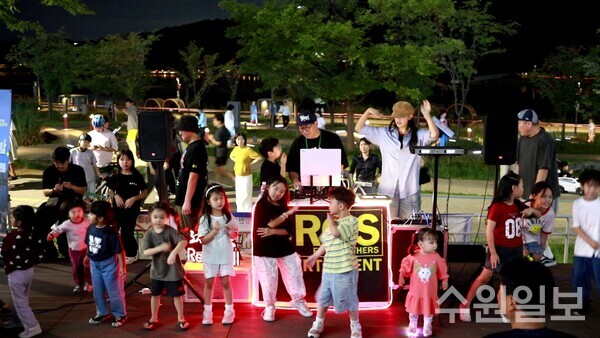
"When will you do this again?"
This was the most common question organizers heard from citizens after the 'Our Neighborhood Festival IN Dongtan Lake Park' concluded on the 19th at Dongtan Lake Park.
There were no celebrity guest performers or large-scale stages. Instead, music chosen directly by citizens, spontaneous singing and dancing, and the autumn scenery of the lake filled the stage.
The 'Our Neighborhood Festival IN Dongtan Lake Park' held on the 19th by regional cultural planning organization 5BROS_ENT at the parking tower busking zone in Dongtan Lake Park concluded with enthusiastic citizen participation.
With the concept of 'an open-form music picnic by the lake that we create together,' the event departed from the traditional festival format of passively viewing scheduled performances, instead offering a community-oriented cultural event created together through citizen song requests and on-site participation.
◇ From a 40-Something Dad's Rock Ballad to a Middle School Student's Choice of "Red Sunset"
The fun of the event stemmed from the unknown: "Who will come out and what music will they bring?"
A 40-something resident of Dongtan was pushed by friends to prepare a DJ set.
His theme was "Top 10 Rock Ballads I Want to Sing at Karaoke."
As rock ballads that people of the same generation naturally sang along to played, the audience's response naturally grew.
Notably, the DJ even brought his son to the DJ box. Watching father and son spontaneously sing together to the father's selected music created an unexpected scene that drew applause and laughter from citizens.
Another DJ was a middle school girl.
She had carefully chosen music fitting for autumn, and just as her final song played, the sky over Dongtan Lake Park began to turn red.
The song was BIGBANG's "Red Sunset."
As the actual sunset descending over the lake perfectly aligned with the music, one of the day's most symbolic moments was created.
Citizens of different generations shared music in one space and enjoyed each other's selections, naturally demonstrating the intent of the event.
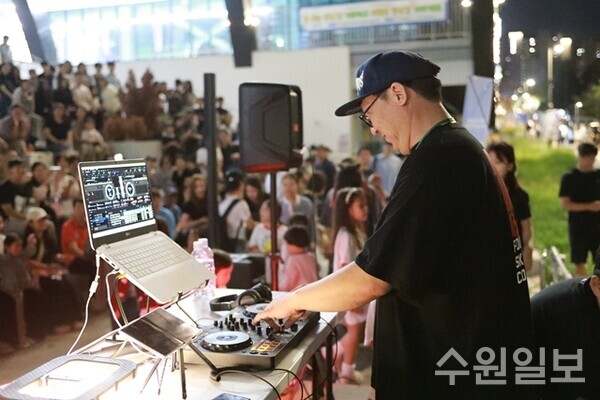
◇ From 80s-90s Music to Latest K-POP...Dance Time Created by Uncle DJ
As the atmosphere warmed up, the venue transformed into a full-fledged outdoor dance space.
Uncle Silver (uncle_silver), who had previously worked with diverse audiences through 'Multi Dance Busking,' took over the DJ box, playing dance remixes spanning from 80s-90s hits to the latest K-POP.
Rather than simply playing popular songs in sequence, the DJ skillfully connected songs and adjusted the music flow based on audience response, naturally prompting citizens to stand from their seats.
Children, teenagers, and middle-aged people reacted whenever their familiar songs appeared, and gradually the boundary between audience and stage blurred.
It was not an event where only good dancers came forward.
Swaying to good music, singing along to familiar songs, and applauding others' dancing were enough.
◇ Dancing, Singing...Instant Requests Become Performances
Unexpected scenes unfolded throughout.
Beyond prepared programs, spontaneous requests made on site became actual performances, naturally turning citizens' dancing and singing into part of the stage.
Someone requested music, another responded by dancing, and a citizen encouraged by the atmosphere sang directly. The structure allowed anyone present at that moment to become part of the event, rather than clearly dividing 'performers' and 'spectators.'
It was not all upbeat music.
Lyrical songs suited to the autumn scenery and lake were strategically placed throughout. When gentle music flowed as the sun set, citizens gazed at the lake or conversed with family and friends, enjoying the music in their own ways.
Moments of dancing and singing naturally alternated with times of listening to music while viewing the autumn lake.
"Please do this regularly."
During the event, citizens spread blankets and listened to music or shared food prepared nearby. Some participated actively from beginning to end, while others were drawn by the music while taking walks and paused briefly.
But the responses at the end of the event were similar.
"When will you do this again?"
"Please do events like this regularly."
"I hope you do this again next time."
The organizers' original concept of an 'open-form music picnic completed by citizens' was actually realized through on-site citizen participation.
5BROS_ENT CEO Lee Young-joo stated, "We started this event with the idea of turning on good music and having our neighborhood people enjoy ourselves comfortably together while looking at the autumn lake," adding "Once we started, it was impressive to see everyone from young students to parents bringing their favorite music and enjoying each other's selections."
She continued, "Rather than people just watching a prepared performance and leaving, citizens made requests, sang, and danced, continuously creating unexpected moments," and "I was most pleased to hear so many people ask 'when will you do this again?' after the event ended."
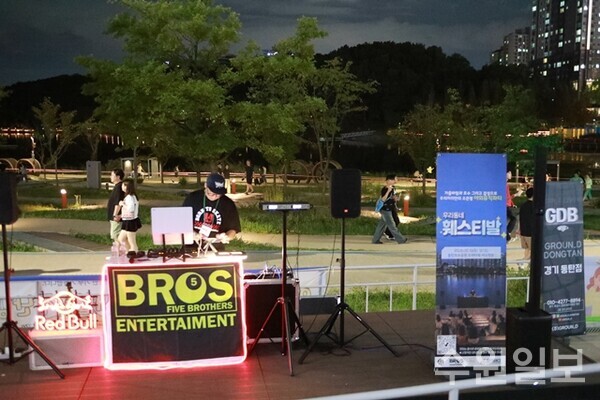
◇ Small Cultural Experiment Created by Businesses, Educational Institutions, and Community Groups
The event proceeded through private cooperation, where regional members shared their own equipment, personnel, experience, and networks, rather than relying on large-scale budgets or celebrity performers.
Centered around 5BROS_ENT, support and cooperation came from Samjeong High-Speed Tourism, Joy Dance Music Academy, Korea Cyber University, Baik In-hoe, Hwaseong City Full-Time Bus Representative Council, Youth Drug Elimination Movement Headquarters, Gyeonggi-do Tourism Association, and Graundi Dongtan branch.
Another characteristic of the event was that businesses, institutions, and organizations from different sectors—including cultural planning, performance, education, tourism, transportation, regional service, and youth activities—pooled their efforts for one community cultural event.
5BROS_ENT plans to review citizen responses and operational experience from this event and examine ways to develop 'Our Neighborhood Festival' into sustainable regional cultural content.
These were not people gathered to see a famous singer.
A 40-something dad living in Dongtan became a DJ, and his son sang beside him. Music chosen by a middle school student perfectly met the red sunset spreading over the lake. When adults responded to 80s-90s music, children and teenagers moved to the latest K-POP moments later. And unscheduled citizen dancing and singing became new performances.
Thus, people of different generations and preferences spent the autumn night together at Dongtan Lake Park with music between them.
And after the event ended, citizens asked again.
"When will you do this again?"
Perhaps that single question is the clearest outcome left by the first experiment of 'Our Neighborhood Festival.'