Gyeonggi Province Suicide Prevention TF Strengthens Life Safety Networks in Economic and Youth Sectors
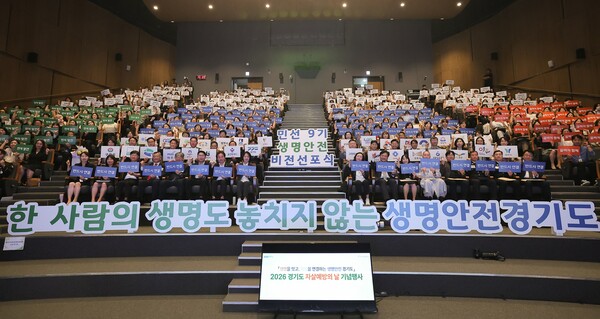
Gyeonggi Province is strengthening community life safety networks through the 'Gyeonggi Province Suicide Prevention Task Force (TF)' by promoting mutual education between economic institutions and suicide prevention centers and establishing youth life safety protocols.
The Gyeonggi Province Suicide Prevention Task Force, which began operations in December last year, is chaired by Kim Sung-joong, First Vice Governor of Administration (Suicide Prevention Manager), and comprises executive departments, Gyeonggi Province Office of Education, public institutions, related agencies, and experts. The task force is advancing Gyeonggi Province's suicide prevention measures through four divisions: △economic △youth △depression △research and statistical analysis.
The Economic Division, considering the connection between economic hardship and mental health and suicide crises, has promoted mutual education between suicide prevention centers and economic-related institutions including Gyeonggi Welfare Foundation, Savings Bank Promotion Agency, and Credit Recovery Committee over 10 sessions, and strengthened inter-agency collaboration systems.
Through these efforts, financial consultation sites have become 'early detection windows for suicide risk' by enhancing the capability of economic institution workers to identify crisis signals, enabling the discovery and support of economic difficulties such as debt before they lead to suicide crises.
Additionally, to respond to the complex life crises of middle-aged and older residents, Gyeonggi Province established a one-stop support platform 'Gyeonggi Province 4060 Mind Plus+' and created a support system where information on policies and services in nine sectors—employment, finance, law, housing, education, family, livelihood, medical care, and mental health—can be accessed in one place. Going forward, the province plans to continuously supplement service information by reflecting usage patterns and on-site opinions, and strengthen collaboration with suicide prevention agencies to develop into substantial crisis support.
The Youth Division worked with experts from 12 institutions to develop the 'Gyeonggi Province Youth Linkage Protocol: LIFE LINK,' which clarifies the roles and linkage procedures for each institution from crisis detection to risk assessment for youth, professional agency coordination, and ongoing counseling and monitoring for practical application in the field.
The 'LIFE LINK' protocol organically links the roles and functions of various youth contact institutions inside and outside schools and suicide prevention and mental health-related agencies, enabling rapid connection to necessary institutions based on youth crisis situations and risk levels.

In particular, institutions responsible for youth's daily life and crisis response—schools (Wee Project), youth counseling and welfare centers, out-of-school and out-of-home youth support centers, Infinite Care Centers, family centers, mental health welfare centers and suicide prevention centers, Life and Love Crisis Response Centers, and police and fire departments—were categorized by main function into consultation and discovery, mental health and suicide crisis, family care and protection, and self-reliance and support areas, and inter-agency roles and linkage procedures were systematized.
Additionally, an integrated response algorithm and inter-agency collaboration system were developed to ensure that whenever youth crisis signals are detected by any institution, they can be appropriately connected to relevant institutions in a timely manner based on risk level and circumstances. Through this, information gaps and role discontinuity between institutions have been reduced, strengthening a community-based integrated response system that enables youth to rapidly receive necessary support in crisis situations and continue to receive protection and assistance.
Gyeonggi Province plans to continuously supplement linkage procedures and inter-agency roles by reflecting on-site application results of the protocol and opinions from related institutions, and develop them into an effective youth suicide crisis response system tailored to regional conditions.
Eom Won-ja, Director of the Mental Health Division of Gyeonggi Province, said, "Going forward, Gyeonggi Province will continue to discover cooperation tasks by sector through the Suicide Prevention Task Force, strengthen collaboration between the province, 31 cities and counties, and related institutions, and make efforts to implement 'Gyeonggi Province that does not lose a single life in pursuing life safety.'"
Meanwhile, Gyeonggi Province Governor Choo Mi-ae announced the 9th elected government's life safety vision at the '2026 Suicide Prevention Day Commemoration Event' on September 14, setting a goal to lower the suicide rate by 20% by 2030.