Candidates' 'Rosy Pledges'... Can They Be Kept?
"I will introduce a primary physician system for one million citizens."
"I will attract 4,000 IT and software companies."
"I will create a city free from atopy, disabilities, and radiation."
These are pledges announced by candidates for mayor and county governor from the Gyeonggi region who ran in the June 4 local elections.
This election, too, saw free welfare pledges and vote-conscious populist "let's do it and see" promises. The absence of specific funding procurement methods and vague commitments remain unchanged from the past. ★See table
Democratic Party candidate Lee Jae-myung, Seongnam mayor, promised the implementation of a primary physician system for one million citizens, achieving $50,000 per capita citizen income, and reaching the world's top 10 most livable cities by 2020.
The cost of implementing these pledges reached 2.4834 trillion won, exceeding Seongnam's annual budget of 2.2311 trillion won this year, but the candidate only stated they would secure funds through internal reserves and self-generated revenue.
Rival candidate Shin Young-su from the Saenuri Party promised to construct a tram by attracting 1.1068 trillion won in private investment.
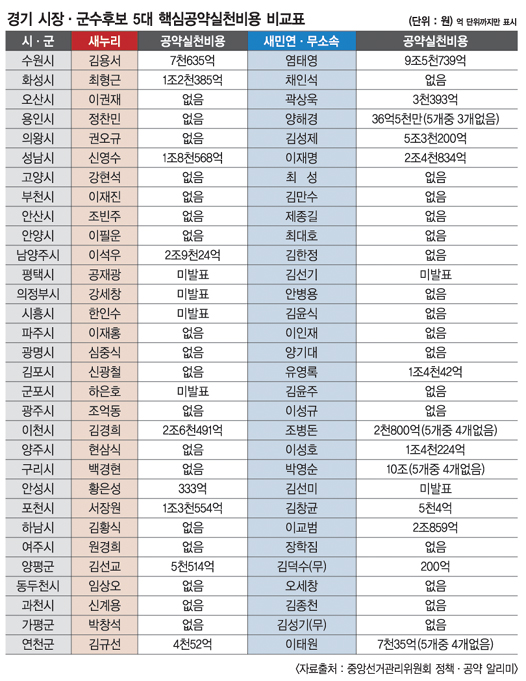
Democratic Party candidate Yum Tae-young, Suwon mayor, promised to attract 1.05 trillion won in private capital to pursue railway network projects including the extension of the Shinbundang Line and construction of the Shin-Suwon Line. Additionally, with an investment of 120 billion won, he promised to create the city of "5-free city," free from atopy, asbestos, fine dust, disabilities, and radiation.
Candidate Yum's pledge implementation costs reached 9.57396 trillion won, more than four times Suwon's entire annual budget of 1.9616 trillion won this year.
Saenuri Party candidate Kim Yong-seo, Suwon mayor, promised to invest 33 billion won in national treasury funds and 77 billion won in municipal funds to perfectly restore the UNESCO World Heritage site Hwaseong Fortress and establish world-class tourism infrastructure. He also pledged to construct a citizen safety integrated support center with 50 billion won in investment.
Unified Progressive Party candidate Lim Mi-sook, Suwon mayor, promised to raise wages for employees below the living wage standard among Suwon-affiliated organizations and commissioned agencies with an investment of 5 billion won.
Justice Party candidate Kim Kyou-hwa, Suwon mayor, promised to establish Suwon City Public Nursing Hospital and Suwon City Public Postpartum Care Center.
Democratic Party candidate Yang Ki-dae, Gwangmyeong mayor, promised to create a smart new deal cluster on 600,000 pyeong of the Gwangmyeong-Siheung Bogeumjari housing project (1.98 million square meters) and attract 4,000 IT and software companies to create 20,000 jobs.
Saenuri Party candidate Cho Eok-dong, Gwangju mayor, promised to construct a railway connecting Gwangju's Opo to Gangnam's Seonsa. Democratic Party candidate Lee Sung-gyu, Gwangju mayor, promised free school meals for middle and high school students and comprehensive free medical care for preschool children (age 6 and under).
Democratic Party candidate Kim Sung-je, Uiwang mayor, promised to secure the entire 2.92 trillion won cost of pledge implementation, including 550 billion won for the "Cheonggyesan Intelligent Town" development project, through private investment, with the remaining 2.4 trillion won to be covered by national treasury funds. This is over 20 times the city's entire annual budget of 271.9 billion won this year.
Saenuri Party candidate Kim Gyeong-hee, Icheon mayor, promised to attract 10 million tourists, while Democratic Party candidate Park Young-soon, Guri mayor, pledged to introduce a system in which scouts escort women home late at night to their doorsteps.
Saenuri Party candidate Kim Kyou-seon, Yeoncheon County governor, unveiled a pledge to establish a unified economic special zone during his term, while independent candidate Kim Sung-gi, Gapyeong County governor, proposed pledges including nurturing 100 "super-rich farmers" who can become wealthy while farming, promoting allowances for the elderly (enacting filial piety allowance ordinances), and expanding provision of foot massages and tai chi exercises for the elderly and expanded medication support.
Saenuri Party candidate Kang Se-chang, Uijeongbu mayor, pledged to support college entrance fees for third children. Democratic Party candidate Ahn Byung-yong promised to underground the Uijeongbu Line 1 subway and create a Pororo-themed land. Candidate Ahn also pledged to introduce a primary physician system for the elderly.
New Political Union candidate Kim Han-jeong, Namyangju mayor, proposed initiatives including half-price municipal language institutes and stroller walkways.
As described above, most candidates' pledges are filled with trillions of won in rosy promises without specific revenue-raising measures and only free welfare benefits.
Experts emphasize that citizens should not be swayed by flashy pledges. Promises without budgets are merely worthless checks.
Fortunately, voters' awareness has improved.
Voter Lee Mo (31, Youngtong-gu, Suwon) said, "Candidates focus only on visuals and designs that look impressive, trying to win hearts with sweet nothings bordering on honeyed words. Even though the times have changed and citizens' level of understanding is different from the past, candidates seem to think they can still deceive citizens," he pointed out.
Voter Jeong Mo (72, female, Gwonseon-gu, Suwon) said, "Long life experience has given me the wisdom to judge people. Young people may not understand, but by carefully observing the faces, expressions, and eyes of truly sincere people, one can make a judgment," expounding a theory of physiognomy.
In a conversation with Suwon Ilbo, Lee Gwang-jae, secretary general of the Korea Manifesto Implementing Association, said, "The absence of specific revenue-raising methods means the pledge is not a promise but merely a 'collection of wishes.' Voters must carefully examine whether the pledge is truly necessary for the region or whether it is aimed at luring voters for votes," he said.