


The Garden of Literature Kim Ae-ran's Short Story Collection 'Goodbye' Selected as Grand Prize Winner of the 41st Manhae Literary Award
Kim Ae-ran's short story collection 'Goodbye' has been selected as the grand prize winner of this year's 41st Manhae Literary Award. The special prize goes to 'Awakening from Long Sleep,' a work by the late Professor Jung Byung-ho, an emeritus professor at Hanyang University and cultural anthropologist who passed away in 2024.
Changbi announced on the 2nd that it had determined the winners of the 41st Manhae Literary Award after preliminary screening and two rounds of final deliberation.
Lives of Ordinary People Before Capital and Privilege…Kim Ae-ran "Achieves Dense Realism"
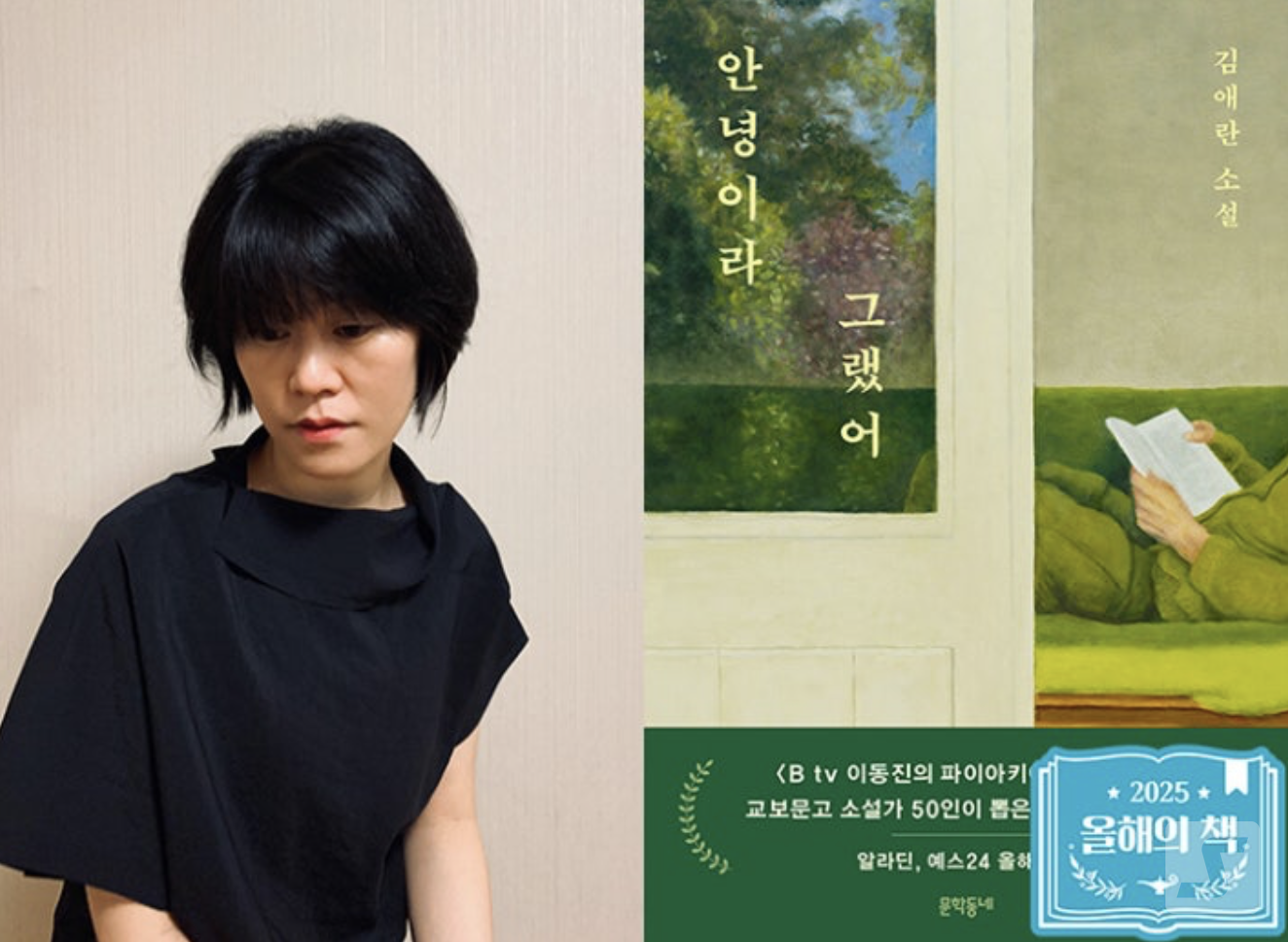
Kim Ae-ran's grand prize-winning work 'Goodbye' was praised as a realist narrative that sharply captures problematic situations in everyday Korean society. The judging panel (Kang Gyeong-seok, Kim Haeng-suk, Cheon Un-yeong, and Han Ki-uk) stated, "This is a work that vividly shows how the common people collapse and how they can stand firm before the power of the privileged class that monopolizes money and real estate," adding "It achieves excellent realism by meticulously tracing the moment of spiritual awakening where a character's heart is tested and recovered amid hardship."
Kim Ae-ran began her literary career in 2002 with the short story "A House Without Knocking." She has since published short story collections including 'Run, Father' and 'Outside is Summer,' and the novel 'Heartbeat, My Life,' establishing herself as a representative figure in Korean letters. With this award, she adds another major literary prize to her achievements, following the Han Mu-suk Literary Award, Yi Sang Literary Award, and Dongin Literary Award.
From Bones to Solidarity…Late Professor Jung Byung-ho "A Record of East Asian Solidarity Awakening Historical Memory"
Late Professor Jung Byung-ho's 'Awakening from Long Sleep,' selected as the special prize winner, is a book in which the public anthropologist documents the process of excavating the remains of victims of forced labor during Japanese colonial rule. Beginning in 1997, the author led remains excavation efforts in places such as Hokkaido and spearheaded the repatriation of the remains of 115 victims in 2015.
The judging panel remarked, "Beginning from a single bone buried in the ground and tracing the victim's life through to their return home, the process of young people from Korea and Japan and local communities communicating to transcend the rigid framework of perpetrator and victim is deeply moving," describing it as "a vivid, full-length narrative in which the dead awakened from historical oblivion build a new community with the living."
Competition Among 11 Finalist Works…Awards Ceremony in Late November
The deliberation process selected six finalists for the final round from 11 works (four poetry collections, four novels, and three other works) advanced to final deliberation in the preliminary screening, then determined the ultimate winners through a second round of deliberation. The grand prize carries an award of 30 million won and the special prize 10 million won respectively, with the awards ceremony scheduled for late November.
Meanwhile, the Manhae Literary Award was established by Changbi in 1973 to commemorate the achievements of Master Manhae Han Yong-un (1879–1944), a resistance poet, independence activist, and Buddhist monk who preserved the nation's dignity during Japanese colonial rule, and to inherit his literary spirit. Manhae's literature, represented by the poetry collection 'Your Silence,' embodied fierce historical consciousness and popular sentiment that refused to compromise with the constraints and limitations of its dark era. Inheriting this spirit, the Manhae Literary Award rigorously judges Korean literary achievements published in the past two years by writers with more than 10 years of literary activity (or equivalent experience), and has become a leading literary award that guides Korean literature's realism and progressive values.