


Suwon City Hall and District Offices Require QR Code Authentication for Entry
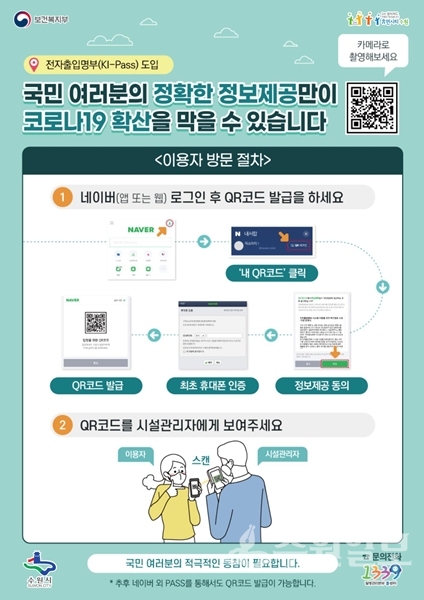
[Suwon Ilbo=Reporter Seo Dong-young] From now on, visitors to Suwon City Hall and the four district offices must scan their personal QR codes before entering.
Suwon City announced on the 15th that it will pilot the electronic entry log (KI-Pass) at the main office and four district offices.
The electronic entry log uses personal QR codes. Users can obtain one by logging into the 'Naver' app (web) on their smartphone. Visitors must wear masks, sanitize their hands, scan their personal QR codes or fill out a visit log before entering the city hall (district office).
However, to minimize inconvenience to citizens, handwritten visitor logs will also be operated in parallel.
A city official stated, "We decided to pilot the electronic entry log at city hall and district offices to accurately manage visitor information and respond quickly when infectious diseases occur," and added, "We will comprehensively review efficiency and consider expanding adoption prioritizing institutions with high visitor traffic."
Meanwhile, since the 10th, the electronic entry log has been implemented at high-risk facilities nationwide (mandatory subjects), and high-risk facilities in Suwon must also scan personal QR codes before entry.
High-risk facilities where entry is possible after scanning QR codes include hunting pojangmacha, sensibility bars, entertainment bars, single-room bars, cola teks, noraebang (singing rooms), indoor group exercise facilities (Zumba, Tae Bo, spinning, etc.), indoor standing concert venues, academies, PC bangs and 10 other business types in total.
There are 5,294 target facilities across 8 business types in Suwon. Suwon has no sensibility bars or indoor standing concert venues.
Managers of high-risk facilities must download the 'Electronic Entry Log' app (Ministry of Health and Welfare), create an account, register as a business owner, and then scan visitors' QR codes to record visit history. However, information from users who refuse QR codes or do not have smartphones must be recorded in a ledger.
Only the minimum personal information necessary for disease prevention is encrypted and collected, with collected visitor personal information managed separately by the QR code issuing company and visit records by the Social Security Information Service. Collected information is automatically deleted after four weeks.
The government plans to conduct rapid epidemiological investigations by analyzing visitor information based on collected data when confirmed COVID-19 cases occur at high-risk facilities.