Gyeonggi Province Health and Environment Research Institute Detects Excessive Pesticide Residues in 115 Cases out of 9,919 Agricultural Products Last Year
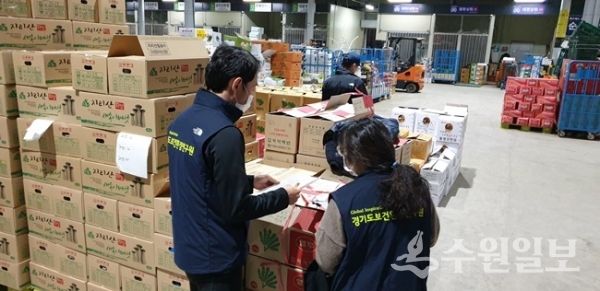
[Suwon Ilbo=Park No-hun Reporter] The Gyeonggi Province Health and Environment Research Institute announced on the 25th that from January to December last year, it investigated pesticide residues in 9,919 agricultural products in the province and detected pesticide residues exceeding allowable standards in 115 cases across 32 items, taking measures such as seizure and disposal.
The investigation targeted 6,067 auction agricultural products from four major public wholesale markets in the province (Suwon, Guri, Anyang, and Ansan) and 3,852 distributed agricultural products from small, medium, and large retailers, investigating the presence of 341 types of pesticide residues.
Among these, the number of test cases for fresh food in online markets, which have seen increased sales due to COVID-19 and other factors, was increased by 68% compared to 2019, reaching 239 cases.
Test results showed that excessive pesticide residues exceeding standards were detected in a total of 32 items and 115 cases: ▲18 leafy vegetable items (lettuce 15 cases, Korean spikenard 13 cases, spinach 11 cases, crown daisy 10 cases, radish greens 9 cases, bok choy 8 cases, mizuna 5 cases, perilla leaves 4 cases, etc.) ▲4 leafy stem items (Chinese chives 2 cases, celery 2 cases, green onions 2 cases, immature garlic 1 case) ▲5 herb items (cilantro leaves 2 cases, mint 2 cases, rosemary 1 case), etc. Among these, 4 herb items in online fresh food were deemed non-compliant.
Looking at the detected components, insecticide components were most prevalent at 77 cases (diazinon 25 cases, etofenprox 10 cases, flubendiamide 4 cases, etc.), followed by fungicide components at 34 cases (chlorothalonil 8 cases, procymidone 8 cases, fluquinconazole 5 cases, etc.), and herbicide components at 10 cases (methabenthiazuron 5 cases, pendimethalin 2 cases, etc.).
The Gyeonggi Province Health and Environment Research Institute seized and disposed of agricultural products deemed non-compliant, imposed a one-month import ban from wholesale markets on the producers of the relevant agricultural products, and notified the results to the cities and counties of origin so that administrative measures could be taken.
Oh Jo-gyo, director of the Gyeonggi Province Health and Environment Research Institute, said, "We will do our best to conduct continuous inspections for advance screening of harmful agricultural products and safe distribution of agricultural products."