Suwon Establishes itself as 'Environmental Capital' by Prioritizing Eco-Friendly Transportation and Ecological Conservation
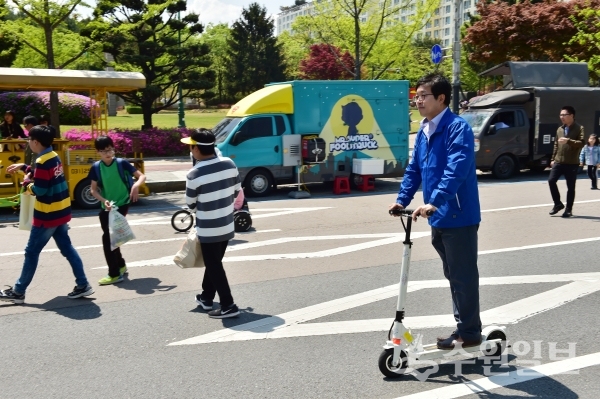
[Suwon Ilbo=Reporter Seo Dong-young] The café street in Haengung-dong, Suwon, known as 'Haengryedan-gil,' has gained fame as a tourist attraction spanning all ages and generations. Additionally, the Suwon tree frog, an endangered species, has become a symbol of Suwon. These achievements are supported by Suwon City's environmental policies befitting an 'environmental capital,' centered on 'eco-friendly transportation' and 'ecological conservation.'
▲ Haengung-dong Evolves into an Eco-Friendly Transportation Village through Eco-Friendly Transportation Suwon 2013
In 2013, a special experiment began in Haengung-dong. It was 'a life without automobiles,' specifically 'Eco-Friendly Transportation Suwon 2013.'
This event was planned as an 'eco-friendly' centered initiative to find a future path in preparation for global warming and the depletion of fossil fuels. For the month of September, automobiles disappeared from Haengung-dong in Suwon.
Haengung-dong's roads were improved with a focus on pedestrians. Ssam-ji parks were created on vacant land, resulting in functional changes and aesthetic improvements as spaces for residents to rest briefly.
During the festival period, people who visited Haengung-dong using public transportation rode bicycle buses in the plaza and explored alleys on eco-friendly transportation such as unique bicycles, couple bicycles, and Segways, which were still unfamiliar at that time.
One million domestic and international visitors came to Haengung-dong during the festival period. It was evaluated as having created a successful model of environmental policy for responding to climate change.
Seven years later in 2020, Haengung-dong became a representative eco-friendly transportation village and a pillar of 'Environmental City Suwon.'
Since 2015, resident organizations have continuously held car-free street events annually in the Haengung-dong craft street and around the Shinpung-ro to Hwaseo-mun-ro areas, creating sustainable transportation, urban, and environmental models.
Haengung-dong, which has transformed from a dilapidated urban area into a village preparing for an eco-friendly future, is spreading the possibilities of eco-friendly transportation to tourists visiting from all over the country.
In particular, the Eco-Friendly Transportation Village Community Center has become the center for expanding eco-friendly transportation.
Through the 'Eco-Friendly Transportation Suwon 2013 Project Field Experience Tour' program, village guides inform visitors about road dieting, landscape projects, and rainwater storage tank operations.
Approximately 12,500 people visited the community center, and a total of approximately 3,500 visitors experienced the changes brought about by eco-friendly transportation through the experience tours.
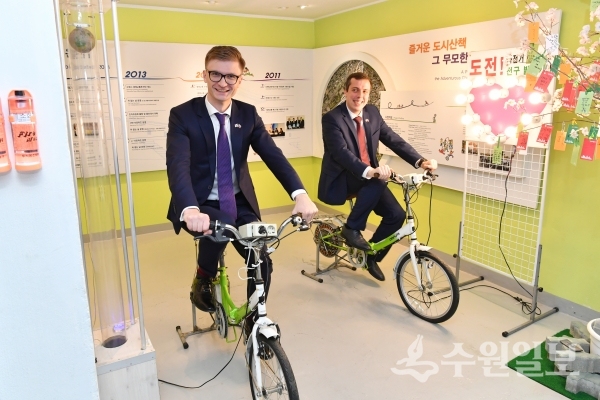
▲ 'Suwon-style Car-Free Days' Change Citizens' Lives
After Eco-Friendly Transportation 2013, 'car-free days' spread throughout Suwon.
The 'Suwon-style Car-Free Days' to reduce automobile use and create an eco-friendly transportation city centered on citizens was expanded from the following year.
After a total of 18 car-free day events were held in four villages—Jeongja-dong, Younghwa-dong, Geumho-dong, and Youngtong 1-dong—in 2014, a total of 300 car-free day events were held, including ▲51 events in 8 regions in 2015 ▲46 events in 10 regions in 2016 ▲56 events in 11 regions in 2017 ▲61 events in 13 regions in 2018 ▲55 events in 18 regions in 2019.
'Car-free days' allow residents to see changes in their lives in a city without automobiles.
For example, the residents' representative council of Hyundai Colon Apartments in Jeongja-dong, Jangan-gu blocked Manseok-ro 68-gil in Jangan-gu from the front entrance of the apartment complex to the Dongshin Elementary School intersection five times between May and November last year and restricted vehicle traffic for approximately 4 to 5 hours.
Eco-friendly transportation experiences such as unique bicycles took place on the vacant street. Experience booths were set up to promote various environmental issues, and residents actively participated in flea markets and talent sharing.
In spring and autumn, air bounces and street cultural performances were held for neighborhood children, and in summer, water pools and singing contests added excitement.
In cooperation with nearby high schools to provide opportunities for students, residents enjoyed pleasant daily life on car-free streets.
The city is currently conducting recruitment procedures to hold Suwon-style car-free days in 15 regions this year as well.
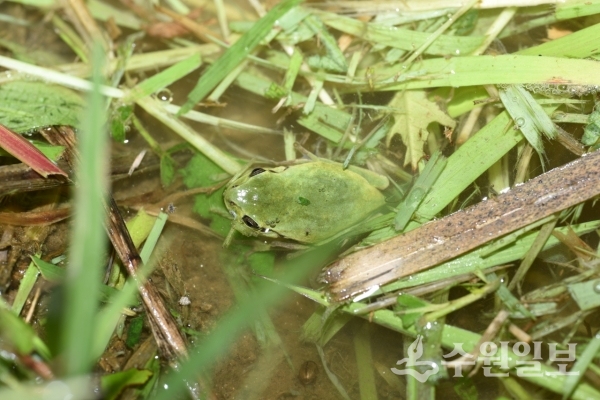
▲ Suwon Tree Frog and Ecological Conservation including Flagship Species Protection
'Environmental Capital' Suwon City is paying special attention to ecological conservation.
Efforts to revive the Suwon tree frog and Cheilosa speciosa, regional endemic species, are at the center of promoting biodiversity.
First, the Suwon tree frog, the mascot of Suwon, was first discovered in Suwon in 1977 and was named the 'Suwon tree frog' in 1980. Subsequently, the population declined sharply as wetlands decreased due to urban development and agricultural environments changed, leading to its designation as an endangered species grade 1 by the Ministry of Environment in 2012.
In response, the city is making efforts to preserve it by creating a conservation habitat within Irwol Reservoir and a natural habitat in farmland in the Pyeongdong area of Gwonseon-gu.
In particular, the city has established a 'Suwon Tree Frog Conservation and Promotion Plan' and is pursuing four major tasks and nine detailed projects by 2021: ▲strengthening the habitat foundation for Suwon tree frogs ▲habitat conservation ▲improving public awareness ▲private-public external cooperation.
Additionally, in July 2019, the city signed a memorandum of understanding with the National Institute of Ecology, committing to cooperation in conserving endangered wildlife including the Suwon tree frog and protecting their habitats.
The city operates specialized experts and citizen monitoring teams for amphibian and reptile life history exploration, and has also planned to introduce habitat population enhancement through artificial breeding and release by 2022.
At the same time, the habitat of Cheilosa speciosa, an endangered wildlife species grade 2, is managed by designating it as a wildlife protection area.
Cheilosa speciosa, a perennial herbaceous plant of the Liliaceae family, was first discovered in Chilbo Mountain in Suwon in 1968, earning its name, but subsequently disappeared from Chilbo Mountain over time.
In response, the city began restoration in 2016 and signed a 'Memorandum of Understanding for Wild Plant Resource Development and Cheilosa Speciosa Restoration' with the National Institute of Biological Resources in May 2017.
The city received approximately 1,500 Cheilosa speciosa plants that the National Institute of Biological Resources cultivated from seeds collected at wild sites in Namhae between 2017 and 2018, transplanted them to Chilbo Mountain wetlands, and confirmed the possibility of stabilization when approximately 200 individuals bloomed last year.
Suwon Mayor Yeom Tae-young stated, "Since Eco-Friendly Transportation Suwon 2013, Suwon City has created a successful model of environmental policy for urban regeneration and climate change response," and added, "The city's efforts to conserve its ecology will serve as an opportunity to increase regional value and restore community."