Groundwater User Companies Under Intensive Investigation...Violations Including Use of Non-Compliant Drinking Water Detected
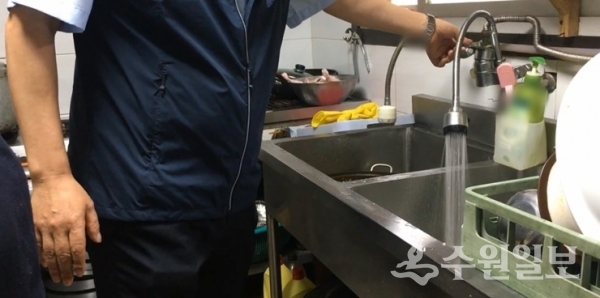
[Suwon Ilbo=Reporter Park No-hun] Food service establishments using groundwater without conducting quality tests to confirm suitability for drinking purposes, or storing expired foods alongside normal products without labels indicating "disposal" or "educational use," have been detected in large numbers.
The Gyeonggi Province Special Judicial Police announced on the 13th that they conducted intensive investigations of 30 groundwater-using businesses in the Suwon, Hwaseong, Yongin, and Anseong areas from June 17-26, detecting a total of 17 violations of the Food Sanitation Act at 14 locations.
The violations included ▲Failure to conduct groundwater quality tests within required timeframes (7 cases) ▲Violations of sanitary handling standards (7 cases) ▲Storage of expired foods (3 cases).
The province plans to refer the violating businesses to prosecutors and request administrative measures from relevant cities and counties for businesses subject to fines.
Key cases include an Anseong general restaurant that was caught using groundwater of unconfirmed suitability for drinking water and food preparation and cleaning without conducting required annual groundwater quality tests since January 2017. According to the Food Sanitation Act Enforcement Decree, groundwater other than tap water must undergo annual drinking water suitability tests at a water quality testing agency before being used for drinking or food preparation and cleaning.
A Hwaseong contract foodservice provider was caught having failed to maintain backup food samples for three years and five months from January 2017 to June 2020, when the business began operations. According to the Food Sanitation Act, foodservice providers must store one serving of prepared food at minus 18 degrees Celsius or lower for at least 144 hours to identify the cause when foodborne illness occurs.
A Suwon general restaurant was caught leaving decomposed food and maintaining poor cleanliness in the cooking area. A Hwaseong general restaurant was caught storing expired foods such as sauces, oils, and fish cakes without "disposal" labels, alongside normal products.
Under the Food Sanitation Act, failing to conduct groundwater quality tests within required timeframes, storing expired foods without separate labeling, or failing to store backup food samples for the required duration can result in imprisonment of up to three years or fines up to 30 million won. Violations of sanitary handling standards incur fines up to 5 million won.
In Chikwon, head of Gyeonggi Province's Special Judicial Police, said "Though a one-strike-out system that immediately revokes licenses and closes establishments using non-compliant groundwater for food use has been in place since January 2017, many businesses still fail to comply," and added "We plan to expand investigations targeting establishments using non-compliant groundwater to prevent foodborne illness."