Yongin to Invest 452.1 Billion Won in Roads and Railways in New Year…Establishing Metropolitan-Level Transportation Network
[Suwon Ilbo=Ki-ho Choi, Reporter] Yongin Special City is investing a total of 452.196 billion won in road and railway network construction projects in the new year, establishing a dense transportation network to create an urban structure at the level of a metropolitan city.
The city announced on the 2nd that as the 8th term administration of Yongin, which has emerged as a semiconductor-centered city, has laid institutional foundations to maintain the ultracompetitive edge of South Korea's semiconductor industry through smooth development of the Yongin Advanced System Semiconductor National Industrial Complex through last year, it will focus this year on expanding an organic road and railway network to improve mobility for advanced IT talent, logistics movement, and 1.1 million Yongin citizens.
To this end, the city has allocated 196.954 billion won for roads, 48.307 billion won for urban railways, and 206.935 billion won for other sectors including public transportation and logistics. This represents a 5.39% increase compared to last year's total of 429.055 billion won.
■ Denser and Wider…Organic Connection of Expressways, National Routes, and Provincial Roads
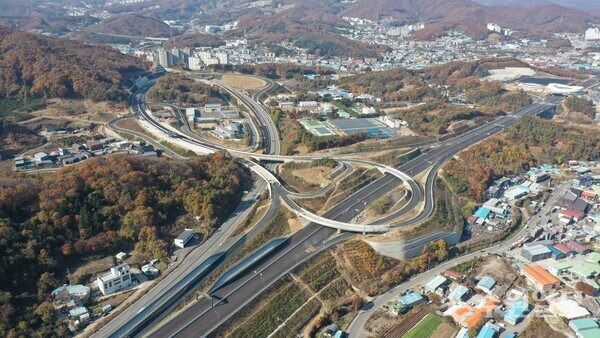
The Sejong-Pocheon Expressway (Anseong-Yongin-Guri section), a metropolitan transportation network connecting Yongin north and south along with the Gyeongbu Expressway, opened on New Year's Day, making travel convenient to Seoul and northern Gyeonggi Province to the north and Chungcheong region to the south.
The Yongin section spans 26km, allowing travel from the Yongin Junction (Yangji) via the Yeongdong Expressway toward Incheon and Gangneung, and from the North Yongin Junction (Pogok) via the Seoul Metropolitan Area 2nd Outer Ring Line toward the western Gyeonggi region including Osan and Hwaseong.
The city plans to open the provincial road 321 Maesang-Ilsan section (2.32km) connected to the North Yongin IC (Hyocheon) entrance/exit by year's end for convenient access, and continuously proposes to Gyeonggi Province to accelerate design of the Uyun-Maesang section (3.7km) with completion targeted for 2026 and to reflect expansion plans for the Maesang 4-ri Entrance-Maesang Intersection section (2.3km).
The Gyeongbu Underground Expressway project, which will tunnel the Gyeongbu Expressway section from Gihung IC to Yangje IC (26.1km) underground, passed the Ministry of Strategy and Finance's preliminary feasibility study in August last year, brightening prospects for the city's "L-shaped 3-axis road network plan" that is being promoted.
The city's "L-shaped 3-axis road network plan" consists of the semiconductor expressway axis (L1) and two semiconductor inland road axes (L2, L3), with the L1 axis being a route connecting the Gyeongbu Underground Expressway and the semiconductor expressway (Hwaseong Yanggam-Yongin Namsa, Idong-Anseong Ilchuk).
The city anticipates that when the Gyeongbu Underground Expressway project proceeds, it will not only resolve congestion on the heavily trafficked Gyeongbu Expressway but also facilitate logistics movement between semiconductor companies concentrated in Yongin, further strengthening the city's semiconductor ecosystem.
The Ministry of Land, Infrastructure and Transport plans to invest approximately 3.7879 trillion won in this road, complete follow-up procedures including feasibility study and basic design this year, and commence construction in 2027 with completion scheduled for 2032.
The Yongin-Seongnam Expressway, one of the L3 axes, is currently undergoing KDI private sector feasibility study that the Ministry of Land, Infrastructure and Transport requested in December last year. The Yongin-Seongnam Expressway is a project proposed to the Ministry of Land, Infrastructure and Transport by a private operator in early last year, connecting the Yeongdong Expressway and Seoul Metropolitan Area 1st Outer Ring Expressway. The city views this road as significantly helping distribute north-south traffic in the city.
With the establishment of the new Dongbaek IC (tentative name) on the Yeongdong Expressway, a long-held wish of Gihung residents, confirmed, the city plans to sign an agreement with Korea Land and Housing Corporation (LH) in the first half of this year sharing total project costs in a 70.5-to-29.5 ratio. The Korea Expressway Corporation will begin basic design in the first half of this year and conduct construction from 2027 to 2029.
Major semiconductor industrial complex peripheral road construction for semiconductor industry activation is also being promoted.
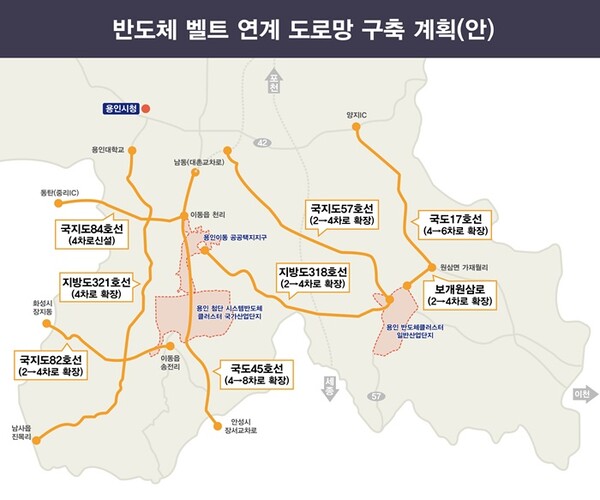
First, as the central government exempted preliminary feasibility studies for roads, electricity, and water supply for smooth development of the Yongin Advanced System Semiconductor National Industrial Complex, the chronic congestion project of National Route 45 (Daechen Intersection in Namhyeup-gu to Jangseo Intersection in Yangseong-myeon, Anseong, 12.5km) to expand from 4 lanes to 8 lanes is proceeding with full national funding, targeting completion in 2030, three or more years earlier than originally planned.
Additionally, the section from Changri in Namsa-myeon, Cheoein-gu to Jangji-dong, Hwaseong on local road 82 spanning 6.8km is being expanded to 4 lanes. After being reflected in the 4th National and Local Road 5-Year Plan in 2016, it stalled due to retesting of feasibility, but with the city's efforts, the retesting was withdrawn and the road was included in connected transportation measures following last year's national industrial complex designation, gaining momentum.
The provincial road 321 expansion project from Bongmyeong-ri to Agok-ri in Namsa-myeon, 5.3km to 4 lanes, is also planned for completion by 2030 with 156.8 billion won invested as a connected transportation measure for the national industrial complex.
The project to expand 4.6km from Wanjang-ri in Namsa-myeon to Seori in Idong-myeon to 4 lanes, reflected in the 3rd Gyeonggi Province Road Construction Plan, began design in November last year and is proceeding with design completion targeted for 2026.
The National Route 17 section from Yangji IC to Pyeongchang Intersection (3.08km) expansion from 4 lanes to 6 lanes is under way with completion targeted for 2030 under the Seoul Regional Road Office, and the city continues proposing to extend the expansion section to Pyeongchang Intersection-Bogae Wonsam-ro (4.2km), since the road leads to the Yongin Semiconductor Cluster where SK Hynix is investing 122 trillion won to construct 4 semiconductor fabs on 1.26 million pyeong in the Wonsam-myeon area.
With the Yongin Semiconductor Cluster's first fab construction beginning in March this year, the city plans to expand the main access road, Bogae Wonsam-ro start and end points, from 2 lanes to 3 lanes to prevent congestion in surrounding areas. The start and end points are each 50-70m sections connecting National Route 17 and the industrial complex access point. The entire Bogae Wonsam-ro 4-lane expansion project (1.88km) is scheduled for completion within the year.
The provincial road 315 underground intersection construction project to resolve chronic congestion in the Bora-dong area of Gihung-gu is also planned for completion within the year. This is where the 8th term Yongin Special City administration of the local government conveyed an idea to the Ministry of Land, Infrastructure and Transport to raise the underground intersection entrance/exit longitudinal slope to 5%, changing the underground road design guidelines, finally realizing the underground intersection construction in 2023 as residents wished. Korea Land and Housing Corporation is proceeding with 102.9 billion won in total project cost, with 20 billion won invested from the city budget.
■ Essential Infrastructure for Semiconductor Ecosystem Expansion…Building Metropolitan Railway Network
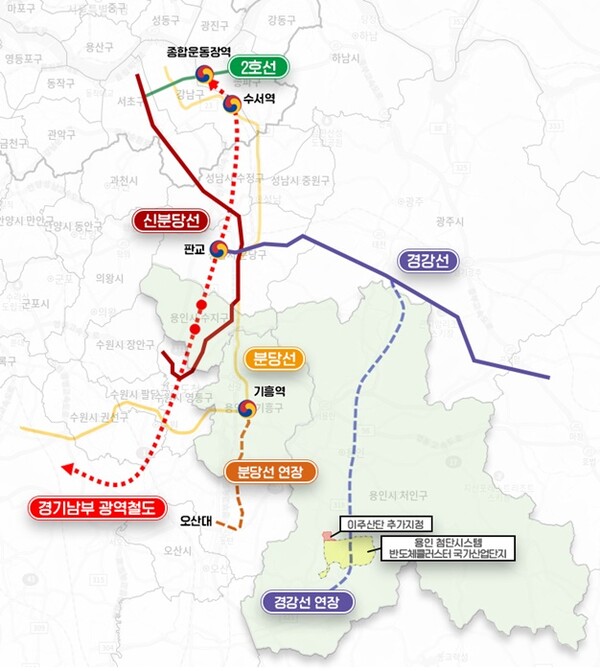
Regarding railway network construction, three projects are being promoted for inclusion in the Ministry of Land, Infrastructure and Transport's 5th National Railway Construction Plan: ▲Gyeonggang Line Extension Project (Gwangju, Gyeonggi-Idong/Namsa, Yongin, 37.97km, total project cost 2.3154 trillion won) ▲Gyeonggi Southern Metropolitan Railway Project (Seoul Olympic Stadium Station-Seoser Station-Pangyo, Seongnam-Sinbong/Seongbok-dong, Yongin-Gwanggyo, Suwon-Bongdam, Hwaseong, 50.7km, total project cost 5.275 trillion won) ▲Gyeonggi Southern East-West Trunk Line (Dongtan Station-Idong-Wonsam-Bubal, Icheon, 40.6km, total project cost 1.1701 trillion won).
The Gyeonggang Line Extension Project is a route connecting Gwangju Station in Gyeonggi, Everland, Cheongnee, Idong public housing complex, the Yongin Advanced System Semiconductor National Industrial Complex in Idong and Namsa-myeon, Yongin, and Namsa-myeon. The city foresees that when this railway is constructed, it will interconnect with the Sudogwon Inland Line, Seoser-Gwangju Line, Wiryae Samdeong Line, Shinbundang Line, GTX, and Wolgot Pangyo Line, enabling citizens to easily travel to Seoul, the Gyeonggi region, and Chungcheong region.
The Gyeonggi Southern Metropolitan Railway Project is a metropolitan railway line jointly promoted by four cities—Yongin, Suwon, Seongnam, and Hwaseong—for the transportation convenience of 4.2 million citizens, serving as a fundamental metropolitan transportation improvement measure to resolve the severe congestion on the Yongseo Expressway during rush hours.
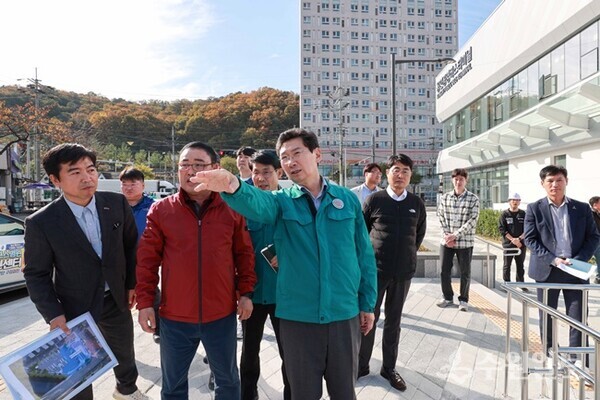
Mayor Sang-il Lee met with Minister of Land, Infrastructure and Transport Park Sang-woo on December 26 last year, requesting the Ministry's support for Yongin's railway infrastructure expansion and delivered related materials and letters regarding these projects.
The mayor recently sent a letter to Minister Park in November last year regarding Gyeonggi Province's proposal to the Ministry prioritizing only "GTX Plus 3 projects" while deferring the "Gyeonggi Southern Metropolitan Railway Project" in the 5th National Railway Construction Plan priorities, appealing: "When the Ministry of Land, Infrastructure and Transport establishes the 5th National Railway Construction Plan, please rigorously compare and objectively evaluate the cost-benefit (B/C) ratio and other objective criteria for the 'Gyeonggi Southern Metropolitan Railway Project' jointly promoted by Yongin, Suwon, Seongnam, and Hwaseong cities and the 'GTX Plus 3 projects' promoted by Gyeonggi Province Governor Kim Dong-yeon, and make a rational decision."
The Bundang Line Extension Project (Gihung Station-Osan University Station, 16.9km, total project cost 1.6015 trillion won), which was confirmed and announced as a new project in the 4th National Railway Construction Plan in 2021, is advancing as the Korea Railroad Corporation's preliminary feasibility study completed recently and the Ministry of Land, Infrastructure and Transport has recently applied to the Ministry of Strategy and Finance to review whether to conduct a preliminary feasibility study.
The city views the Bundang Line extension as becoming a key axis connecting major economic bases including the Yongin Advanced System Semiconductor National Industrial Complex, Platform City, and Samsung Electronics Future Research Center (Gihung Campus), and continues to coordinate with related organizations including the Ministry of Land, Infrastructure and Transport, Korea Railroad Corporation, and Hwaseong and Osan cities, emphasizing that railway demand and project economic viability will further increase.
The Indeokwon-Dongtan Line double-track railway passing through the city's western region is already under construction in the Yongin section. Of the approximately 4.2127 trillion won in total project cost, the city's share is approximately 199.6 billion won, with 39.932 billion won to be invested this year. Full section completion is scheduled for 2029.
When the Indeokwon-Dongtan Line is completed, it will efficiently connect five cities including Anyang, Uiwang, Suwon, and Hwaseong with Yongin, and is expected to serve as an alternative to alleviate road congestion in southern Gyeonggi Province.
■ Intersection System Improvements, 20% Increase in Bus Operation Rate, etc. Enhancing Traffic Convenience
The city is investing 1.1 billion won to improve the traffic system at 7 major intersections in the city including Myeongji Intersection, Kyunghee University Intersection, and Jeil Intersection, which cause congestion due to bottleneck phenomena, establishing a convenient and safe traffic environment.
Rather than constructing new roads requiring large-scale construction or approval procedures, this is aimed at resolving congestion and reducing traffic accident rates through customized traffic system improvements such as intersection consolidation, roundabout installation, traffic island separation, and lane creation using public land.
The city is investing 46.3 billion won to create three public parking lots totaling 352 spaces in areas with poor parking environments such as residential and commercial districts. These include the Towol Public Parking Lot in Pungdeokcheon-dong, Suji-gu (2,880㎡, 113 spaces), Yeokbuk District Public Parking Lot in Cheoein-gu (4,791㎡, 125 spaces), and Anmaeul Public Parking Lot in Gugal-dong, Gihung-gu (2,196㎡, 114 spaces).
The Yongin Public Bus Terminal, which opened in 1994, is being pleasantly renovated and scheduled for completion in February this year. Currently operating provisionally. The city's new Yongin Public Bus Terminal, with a basement level and 2 stories above ground (total floor area 2,881.7㎡), will feature neatly renovated bus boarding platforms, commercial facilities, rest facilities and accommodations for transportation workers, and rest space for female workers.
To improve citizens' bus usage convenience, the city is investing 720 million won in city budget to increase city and village bus operation rates by 20% or higher. This provides treatment improvement allowances to new and long-term transportation workers to prevent instances where buses cannot operate due to insufficient transportation workers despite buses being available at depots.
For citizens waiting for buses, the city is investing 400 million won to install closed shelters at 5 metropolitan bus transfer stops including Kangnam University Station and Kangnam University Entrance stops. Photo zones featuring the city character "Jo-ah Yong," bus information terminals, and warm/cool seats will be provided.