Kim Dong-yeon Secures First Chinese Enterprise Investment in 8th Civilian Administration Term
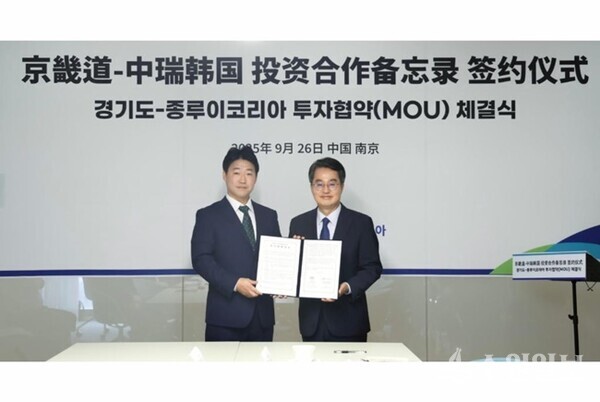
[Suwon Ilbo=Reporter Kim Gap-dong] The first investment success with a Chinese enterprise in the 8th civilian administration term has been achieved.
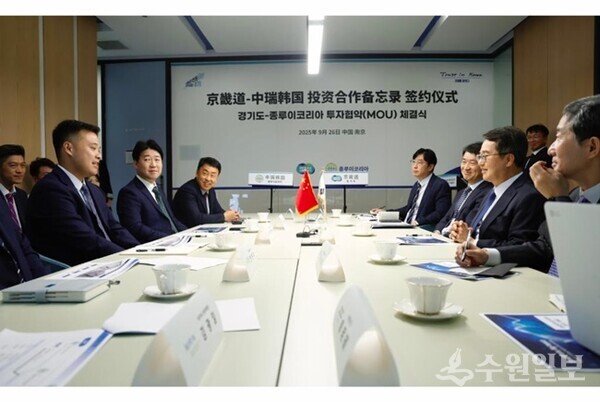
Gyeonggi Province Governor Kim Dong-yeon signed a 60 billion won secondary battery investment agreement with Zhongrui Korea on the 26th in Nanjing, Jiangsu Province, China.
The agreement covers Zhongrui Korea's establishment of a secondary battery component production facility worth 600 billion won on approximately 21,200 square meters of land in the Pyeongtaek Oseong Foreign Investment Zone.
Zhongrui Korea is a joint venture established by Zhongrui Electronics, a Chinese secondary battery component manufacturer, and K&S, a Korean secondary battery automation equipment manufacturer. Chinese Zhongrui Electronics invested 70% and Korean K&S invested 30%.
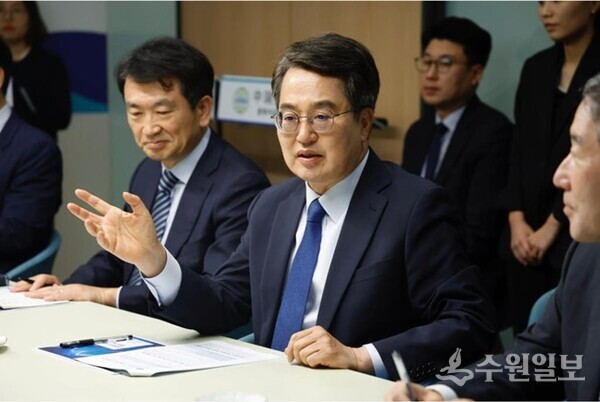
Governor Kim stated, "I pledged to attract 100 trillion won in investment during my term, which is expected to be achieved around next month. While capital from the United States, Japan, and Europe has flowed in significantly, this is the first Chinese investment. It is meaningful that the first capital is entering the advanced secondary battery industry," and added, "Gyeonggi Province will provide maximum support and assistance for business activities."
Yan Tingzhou, Vice President of Zhongrui Electronics (headquarters), said, "The investment of Zhongrui Korea is just the beginning," and "We plan to continue with more investments in the future," adding, "We will do our best to improve our cooperative relationship with Governor Kim Dong-yeon and Gyeonggi Province."
Qian Zheng, Vice President of Sales at Zhongrui Electronics (headquarters), stated, "Today's agreement signing ceremony is an important step beyond a simple MOU signing, leading economic cooperation in the secondary battery industry," and expressed, "We look forward to closely cooperating with Gyeonggi Province and achieving growth together."
This investment agreement signing is likely to serve as a signal for Chinese investment in South Korea.
Over the past three years of the Yoon Suk-yeol administration, investment from China had been difficult due to tensions in Korea-China relations and increased global uncertainty. However, following the launch of the Lee Jae-myung's Citizens' Sovereignty government, bilateral relations between the two countries have returned to normal tracks.
◇Effects of Zhongrui Korea Investment
Following the agreement signing, the secondary battery component production facility in the Pyeongtaek Oseong Foreign Investment Zone is scheduled to begin construction as early as the beginning of next year and be completed by the end of that year.
Secondary batteries are rechargeable batteries that can be reused after discharge, and their demand is rapidly increasing as they are widely used from mobile and IT devices to electric vehicles and energy storage systems.
The facility will produce 'Topcap Assembly,' a secondary battery component. As its name suggests, the topcap assembly that forms the upper part of a battery is a critical component that ensures electrical connectivity and prevents explosions.
With this investment agreement signing, the creation of 150 new jobs and production capacity capable of generating 50 billion won in annual sales are expected. Major clients include LG Energy Solution and global electric vehicle companies.
◇Gyeonggi Province, 'the Center of the Republic of Korea,' and the Secondary Battery Industry
The Province is the center of South Korea's secondary battery industry. Based on 2023 Statistics Korea data, there are 1,073 secondary battery-related business establishments in Gyeonggi Province (32.6% of the nation), and the number of employees alone is 30,854, accounting for 18.7% of the nation. Both the number of business establishments and employees rank first nationwide.
Amid growing uncertainty regarding global supply chains, the expansion of the domestic secondary battery component supply chain by Korean and Chinese enterprises is considered significant.
It is hoped that this agreement signing will serve as a stepping stone for Gyeonggi Province to advance to an international hub for the secondary battery industry from the center of the Republic of Korea.