Yongin Special City to Conduct Feasibility Study on Dongbaek-Shinbong Line Construction and Yongin Line Extension
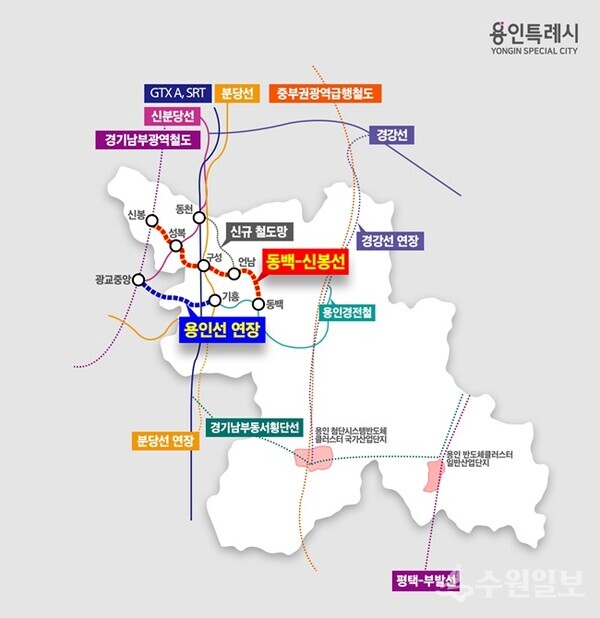
[Suwon Ilbo=Reporter Choi Ki-ho] Yongin Special City announced on the 12th that it plans to reflect feasibility study costs for the construction of the Dongbaek-Shinbong Line urban railroad and the extension of the Yongin Line (Yongin Light Rail Gwanggyo Extension) in the first supplementary budget scheduled for April.
With the approval of the Ministry of Land, Infrastructure and Transport on December 12 last year, the Dongbaek-Shinbong Line construction and Yongin Line extension were finally reflected in the 2nd Gyeonggi Province Urban Railway Network Construction Plan. The city plans to expedite these projects.
The Dongbaek-Shinbong Line is a 14.7 km route connecting the Shibong-dong area of Suji-gu to major transfer hubs including Seongbok Station (Shinbundang Line), Guseong Station (GTX-A/Suin-Bundang Line), and Dongbaek Station (Light Rail). The line passes through Shibong-dong and Seongbok-dong and connects to Platform City around Guseong Station, where semiconductor materials, components, and equipment (materials and parts) companies and artificial intelligence (AI) and bio-industry research and development (R&D) centers are located, along with hotel and convention facilities.
The Yongin Line extension is a project that connects the Yongin Light Rail from Heungdeok Station through Heungdeok to Gwanggyo Central Station, spanning 6.8 km.
In the preliminary feasibility study, the city plans to calculate transportation demand that includes development of the Eonnam district (former Police University site) and changes to the Platform City urban development project, which were not reflected in previous studies.
The city plans to select the optimal route by reflecting the calculated future transportation demand and also examine the technical feasibility of the route.
The city will also examine changing conditions based on whether the Gyeonggi Southern Metropolitan Railway, a 50.7 km metropolitan railway construction project connecting Seoul Sports Complex, Pangyo in Seongnam, Shinbong-dong and Seongbok-dong in Suji-gu, Gyeonggi Province, Gwanggyo in Suwon, and Bongdam in Hwaseong, is reflected in the 5th National Railroad Network Construction Plan, and whether the Gyeonggang Line extension, which connects Gwangju City in Gyeonggi Province to Idong and Namsa-eup in Cheoin-gu, Yongin, is included in the plan.
The city will also review through the study any scenarios in which the Central Region Metropolitan Railway (JTX), a private investment project connecting Seoul Jamsil and Cheongju Airport and including portions of the Gyeonggang Line extension, passes the private investment viability assessment. The JTX, proposed as a private investment project, is a 135 km railroad construction project that includes sections of the Gyeonggang Line extension and portions of the Metropolitan Inland Line (Dongtan in Hwaseong to Anseong to Jincheon in North Chungcheong to Cheongju Airport).
Last year, the Korea Development Institute (KDI) conducted a private investment viability assessment at the request of the Ministry of Land, Infrastructure and Transport. When the JTX opens and connects to Yongin Central Market Station, travelers will be able to travel from Yongin Central Market Station to Seoul Jamsil and Cheongju Airport in less than 30 minutes each.
The city plans to include in this study the new railroad line (Dongcheon-Jukjeon-Mabuk-Eonnam) that Yongin City decided to pursue at the end of last year. This route is an alternative to the Shinbundang Line/Bundang Line direct extension, which was concluded to be difficult due to technical issues and insufficient business feasibility, and is an urban railroad line with a length of 6.87 km.
As a result of a feasibility review conducted on the premise of connection with the Dongbaek-Shinbong Line construction, the Dongcheon-Eonnam urban railroad line showed a cost-benefit (B/C) ratio of 1.23. The projected daily average usage demand was estimated at 31,461 people.
The city will diagnose the economic viability of the Dongcheon-Eonnam new railroad line, which it plans to promote on the premise of Dongbaek-Shinbong Line construction.
Mayor Lee Sang-il said, "Since the Dongbaek-Shinbong Line construction project has finally been reflected in the 2nd Gyeonggi Province Urban Railway Network Construction Plan, we have decided to conduct a preliminary feasibility study to accelerate project implementation," and added, "Since citizens have high expectations for the Yongin Line extension, we will work through the study to find ways to realize it."
The mayor stated, "Citizens are also making petitions requesting that the preliminary feasibility study be expedited for smooth project progress, so we will make efforts to meet citizens' expectations."
Mayor Lee Sang-il said, "We will concentrate our administrative capabilities on expeditiously promoting efforts to enhance the feasibility and economic viability of railroad projects," and added, "Even if railroad construction projects are reflected in national and urban railway network construction plans, it typically takes 7 to 10 years of tedious processes until the start of construction. However, we will work together with citizens to strengthen the city's implementation power."