Gwangmyeong City and Gunpo City Join Forces for Nation's First 'Mutually Beneficial Waste Incineration'
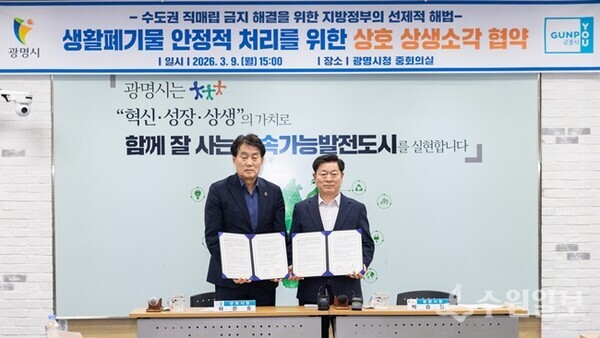
[Suwon Ilbo=Reporter Yu Je-sung] Gwangmyeong City will be the first in the nation to implement a 'mutually beneficial incineration' model in which it jointly uses household waste incineration facilities with Gunpo City.
Mayor Park Seung-won of Gwangmyeong signed the 'Mutual Reciprocal Incineration Agreement for Stable Household Waste Treatment' with Mayor Ha Eun-ho of Gunpo on the 9th in the main conference room of City Hall, establishing a cooperation system for jointly utilizing household waste incineration facilities.
The key aspect of the agreement signed on this day is that when the resource recovery facilities of the two local governments face difficulties in operation due to regular inspections, modernization projects, or emergency situations, they will mutually deliver each other's household waste within available capacity ranges for proper incineration treatment.
In accordance with the agreement, the regular major overhaul periods that each incineration plant must undergo at least twice a year will be cross-scheduled alternately, and a total annual 1,000 tons of waste generated during operational shutdowns will be mutually commissioned for treatment on a one-to-one basis.
This cooperation was realized as a preemptive response to the 'Metropolitan Area Household Waste Direct Landfill Ban' measure that went into full effect this year, which Gwangmyeong City proposed and Gunpo City enthusiastically supported.
An official from Gwangmyeong City explained that the cooperation was pursued based on the observation that the two cities have similar residential-centered urban structures and waste generation patterns.
Through this cooperation, a 'cost-free and mutual benefit' structure is expected to be established that can reduce waste treatment gaps when incineration facility operations are suspended and enhance operational stability without additional financial burden.
Additionally, by diversifying household waste treatment routes from their previous reliance on long-distance private outsourcing to within the region, budget savings are anticipated along with reduced environmental burden from transportation processes.
Mayor Park Seung-won of Gwangmyeong stated, "This is a meaningful case where we have created solutions through inter-local government cooperation amid the major environmental policy change of the Metropolitan Area Direct Landfill Ban," and added, "Going forward, Gwangmyeong City will pursue resource circulation policies that protect citizens' environmental rights while reducing financial burden, creating a sustainable city model."