'Yi Sun-sin's Time' Written by Martial Artist and Humanist Choi Hyung-guk
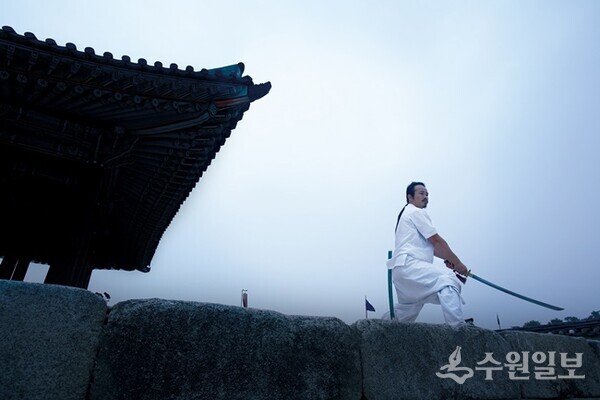
[Suwon Ilbo=Reporter Lee Min-jung] April 28 marks the 481st anniversary of General Yi Sun-sin's birth. Even centuries later, he is called a 'heroic sage' and an 'undefeated hero'. Was this hero of the turbulent era who led the Joseon army to victory a fully accomplished commander from the beginning?
The new book 'An Evolving Commander, Admiral Yi Sun-sin' (published by Minsokwon) begins with this question. Author Choi Hyung-guk (51) is the permanent director of the Suwon Municipal Performing Arts Company's 24 Martial Arts Demonstration Group and the director of the Korean Traditional Martial Arts Research Institute.
He is also a history doctorate holder who has translated 'Muyedobotongji' and published about 10 books including 'King Jeongjo's Martial Arts Ideology and Jangnyongnyeong' (2015) and more than 40 papers on military history and martial arts history. Having restored history on stage and in the field beyond the research office, he views Yi Sun-sin not as a 'hero of results' but as a 'commander formed through the process'.
The book turns its gaze not to Myeongyang and Hansan Island during the Japanese Invasion of 1592, which are familiar to us, but to the northern frontier where Yi Sun-sin first entered military service. 'Donggubiho' (蕫仇非堡), where he took office as a rank-9 military official. Though only the name remained and its exact location had been unclear, the author pinpointed this place concretely through cross-verification of historical records, maps, and satellite data.
Through an interview, the author stated, "Many people do not know exactly where General Yi Sun-sin's first appointment was," and expressed his desire to reconfirm his 'starting point'.
What he restored was not merely a place name. Northern battles against the Jurchen, the process of becoming familiar with the sea during his time as naval commander at Balpo, and even Nokdun Island, which is no longer an island today. It follows how Yi Sun-sin grew into a 'person preparing for war' through the accumulation of space and experience.
This perspective also aligns with the author's background. He is a director who has trained in the 24 martial arts recorded in 'Muyedobotongji', the Joseon era military training manual, for about 30 years and has recreated them on the modern stage. Just as Jangnyongnyeong soldiers learned martial arts based on 'Muyedobotongji', compiled in 1790 by royal command of King Jeongjo, today's 24 Martial Arts Demonstration Group similarly carries on this spirit through martial arts demonstrations with the national spirit against the backdrop of Hwaseong Palace.
The sense of combat and command learned through the body naturally leads to interpretation regarding Yi Sun-sin. The author expressed, "From the perspective of a military officer, war cannot be understood only through records," and added, "There are things that become visible only when directly felt through the body".
Yi Sun-sin in the book is depicted not as a simple strategist, but as an entity encompassing the 'human struggles of a commanding officer' who had to establish military discipline and lead soldiers.
This interpretation also aligns with King Jeongjo's perspective. King Jeongjo established 'Jangnyongnyeong', a personal security force, to strengthen royal authority and reorganized military order centered on Hwaseong Fortress. In the process, Yi Sun-sin was the figure called forth as the most ideal exemplar of a commander.
The author explained, "While dreaming of national wealth and military strength, King Jeongjo, who was placed in various political situations, needed a commander devoted to the nation like Yi Sun-sin." King Jeongjo's act of posthumously promoting him to Prime Minister and personally leaving an inscription on his monument is read as an attempt to establish a 'type of human that the nation needed'.
Another axis running through the book is the author's personal experience. During the writing process, he experienced the painful time of losing his mother. The author stated, "Looking at the Nanjung Ilgi, that sadness became more real," and said he felt deep empathy with Yi Sun-sin, who saw his mother off during the time of serving in white clothes as a commoner. Times when he lost his office, had his armor as a commander forcibly taken away, and went to the battlefield; moments when he had to return to the battlefield before even completing his mother's funeral rites. The author reads these as 'emotions of a human being'. At the same time, he says that the pain of having to send subordinates to the battlefield as a commanding officer also resonates with his own life.
This book does not stop at battle records and strategic analysis. It diachronically traces how Yi Sun-sin was 'remembered and reconstructed' through the late Joseon period after the Japanese Invasion of 1592 and the Japanese colonial period.
The author emphasizes, "The significance of Yi Sun-sin remains valid even in today's era." He adds, "The world is still in conflict and war, and we live in a state of armistice. Yi Sun-sin's spirit will continue to be needed as long as this land exists." Choi Hyung-guk has brought forth 'Commander Yi Sun-sin, who was great not because of perfection but because he trained himself until the end' to the forefront of history once again.