78% of Gyeonggi Province Residents Say "Real Estate Illegal Activities Are Serious," Demand Stronger Enforcement
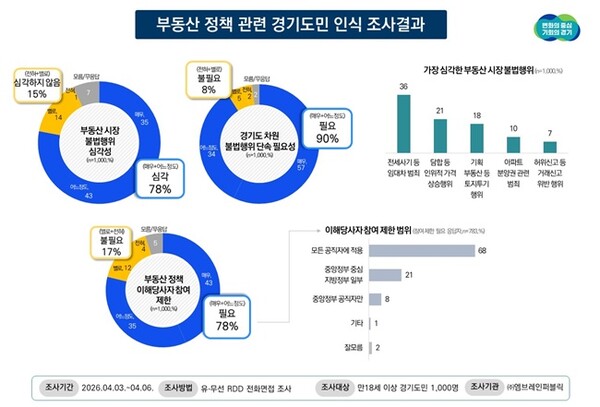
[Suwon Ilbo=Reporter Kim Gap-dong] A survey has revealed that 78% of Gyeonggi Province residents perceive current illegal activities in the real estate market as serious, and 90% of residents agree on the need for stronger enforcement at the provincial level.
Gyeonggi Province announced on the 20th that according to the results of a 'perception survey on real estate policies' conducted from the 3rd to 6th on 1,000 residents, 78% view illegal activities in the real estate market as 'serious,' with 'rental-related crimes including jeonse fraud (36%)' identified as the biggest problem.
Concerns about illegal practices varied by age group. Among those aged 18-29, 60% viewed jeonse fraud as the most serious problem, while for those in their 50s, 'artificial price increases such as house price collusion' accounted for 30%, the highest proportion.
Regarding illegal activities, 90% of respondents stated that 'stronger enforcement by Gyeonggi Province is necessary.'
Gyeonggi Province is currently operating joint special investigations between the province and city/county governments and a reward system for reports (up to 500 million won) centered on its Special Task Force for Real Estate Market Disruption, continuing enforcement activities including detecting and prosecuting house price collusion cases.
The province is also developing the 'Gyeonggi Real Estate Transaction Safety Network (GRTS)' platform, which uses artificial intelligence (AI) to analyze registry records and market prices by simply entering a home address and provides transaction risk guidance. As a preventive system where AI monitors the entire process from pre-contract risk diagnosis to alerts on registry changes after the contract, the province plans to conduct pilot operations in the second half of 2026 before full implementation.
The top priority task for housing market stabilization was 'strengthening property taxes on multi-property owners (29%).' 'Expanding housing supply (21%),' 'Reducing housing cost burden (21%),' and 'Financial regulation management (20%)' were surveyed at similar levels.
In a survey on receptiveness to public housing policies, 78% supported 'expanding supply to include the middle class' and 74% supported 'expanding medium and large-sized floor plans.' 80% agreed with the need to introduce 'equity-accumulating housing' with reduced initial burden.
This demand aligns with the policy direction of 'Gyeonggi-type public housing' being pursued by the province. The province is promoting the supply of diverse floor plans and equity-accumulating housing taking into account housing demand.
The survey also confirmed demands for fairness in real estate policies. 78% supported restricting policy participation by public officials holding multi-properties or high-value properties, and among them, 68% answered that this should be applied without distinguishing between central and local government.
Son Im-seong, Director of Urban Housing at Gyeonggi Province, said, "It has been confirmed that residents' demands for establishing real estate market order and housing stability are high," and added, "We will pursue effective policies through strengthening enforcement against jeonse fraud, introducing an AI-based prevention system, and expanding public housing supply."
The survey was conducted by Embrain Public on behalf of Gyeonggi Province using wired and wireless RDD telephone interview methods, with a sampling error of ±3.1%p at a 95% confidence level.