Governor Choo Mi-ae Cries "Fiscal Crisis," Demands 5% Corporate Tax (National Tax)
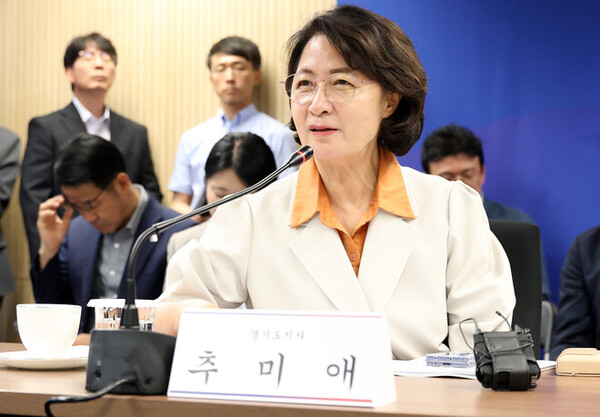
Governor Choo Mi-ae of Gyeonggi Province has recently put forward a "joint tax source framework" plan to address the province's fiscal crisis by redistributing corporate local income taxes among cities and counties following her inauguration. Now, she has officially proposed to the government a plan to distribute a portion of the national corporate tax to metropolitan local authorities.
According to Gyeonggi Province and other sources on the 26th, Governor Choo attended the 10th Central-Local Cooperation Conference held at the presidential office that day and presented a "local-led growth success strategy" at the government level, proposing measures including an increase in the local consumption tax rate and distribution of a portion of the national corporate tax to metropolitan authorities.
The conference, chaired by President Lee Jae-myung, was attended by the Prime Minister, relevant cabinet ministers, and provincial governors from across the country to discuss central-local cooperation measures and regional-led growth initiatives for the 9th private sector administration.
Among the tax reform proposals presented by Governor Choo that day, one stands out: a proposal to establish a system for distributing 5% of the national corporate tax to metropolitan authorities.
Governor Choo assessed that while increased tax revenue from the semiconductor and advanced industry boom accrues to the national government and basic local units, the financial burden of industrial complex development and infrastructure expansion falls on metropolitan authorities. She argued that a new revenue structure is needed in which the national government directly distributes a portion of the corporate tax it collects to metropolitan authorities.
In fact, individuals involved in Gyeonggi Province's fiscal discussions have pointed out that "metropolitan authorities' finances are invested in infrastructure development such as roads, water supply, and power to support business activities, but even if industries and companies grow through this, there is no pathway for the increased tax revenue to return to metropolitan authorities."
This proposal differs in its tax source from the "joint tax source framework for corporate local income tax" that Governor Choo put forward after taking office.
After taking office in July, Governor Choo presented as a major fiscal reform task a plan to create a joint tax source from a portion of corporate local income taxes attributed to cities and counties based on corporate income, which would be divided between the province and municipalities. The aim was to redistribute corporate tax revenue concentrated in specific areas to reduce fiscal disparities among cities and counties.
However, opposition has continued mainly from cities and counties with high corporate local income tax collections. Their reasoning is that while attracting large-scale industrial complexes brings traffic and environmental problems and infrastructure expansion costs to the region, sharing only the tax revenue with other areas could infringe on local fiscal autonomy.
The Gyeonggi Province Fiscal Innovation Task Force also failed to reach a conclusion on the joint tax source framework. The task force announced its findings mid-month, diagnosing Gyeonggi Province's revenue structure and fiscal problems, but did not include the joint tax source framework for corporate local income tax in its final proposal. Opinions on the joint tax source framework could not be unified.
In this context, Governor Choo introduced a new card at the Central-Local Cooperation Conference: not the corporate local income tax collected by cities and counties, but the national corporate tax collected by the central government.
If the existing joint tax source framework was a plan to redistribute Gyeonggi Province's municipal tax revenue between the province and municipalities, this new proposal is to transfer a portion of the central government's tax revenue to metropolitan authorities. The target of securing tax sources for Gyeonggi Province's fiscal expansion has expanded from cities and counties to the central government itself.
Governor Choo also proposed raising the local consumption tax rate from the current 25.3% to 40%. The aim is to realize the national policy goal of a 7-to-3 ratio between national and local taxes while improving the revenue structure, which is sensitive to real estate market conditions and centered on acquisition tax, to a consumption-based local consumption tax structure.
She also proposed converting the sunset-scheduled tobacco surcharge for local education tax into a "regional resource facility tax for firefighting." The reasoning is that although firefighting officials were converted to national employees in 2020, national government support for firefighting personnel costs remains at only 6-9%, with the province covering the rest through its general account.
Governor Choo stated, "The fiscal reality of Gyeonggi Province that I faced after taking office was very grave. On the surface, the budget scale exceeds 40 trillion won and appears sufficient, but in reality, fiscal deficits of 1-2 trillion won have accumulated over several years, and we face structural limitations that are difficult to overcome with self-directed efforts alone."
However, the fact that Governor Choo requested distribution of the national corporate tax does not mean she has abandoned the existing policy of joint tax source framework for corporate local income tax. The joint tax source framework is being reviewed as a separate matter, according to Gyeonggi Province.
A Gyeonggi Province official said, "(The corporate local income tax joint tax source framework) section has not been separately determined and is still under review. This time, (the governor) mentioned the national tax portion (corporate tax) to the central government."