


This Is a Cultural Era Nepal's Massive Floods Are Not a Natural Disaster—They Are a 'Climate Catastrophe'
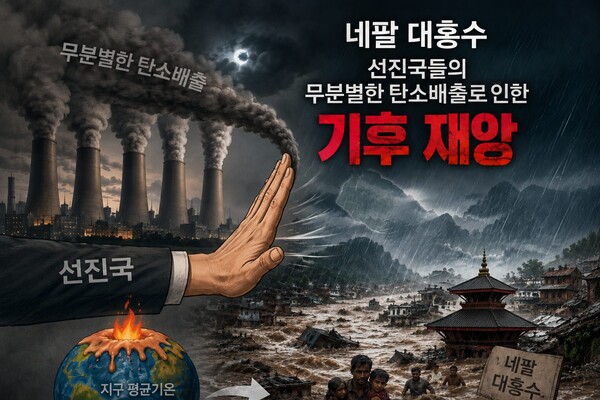
Nepal's catastrophic flooding that shattered the serenity of the Himalayas is not merely a natural disaster—it is a terrifying warning of climate catastrophe brought about by the reckless carbon emissions of developed nations. Like the one-eyed giant Cyclops from the Odyssey bellowing in fury, collapsed glaciers and massive debris flows swallowed entire villages. While it appears on the surface to be nature's wild rampage, a closer look reveals it to be the result of an unequal economic barbarism created by humanity's unbridled desires.
One cannot help but ask: what carbon emissions did these people, who humbly eked out a living in the high mountains of the Himalayas, contribute to increasing the Earth's greenhouse gases? It was Western developed nations that had burned fossil fuels for centuries since the Industrial Revolution, reaping the wealth of economic growth. The reality is starkly divided between those who pop champagne bottles of prosperity and enjoy happiness, and those who bear the full brunt of climate disaster resulting from it. This is the cruel reality of 'Climate Inequality' that we have long turned a blind eye to.
The greater problem is that we have little time left. If the global average temperature rises more than 1.5 degrees above pre-industrial levels, unpredictable catastrophes such as extreme heat waves, torrential rains, and droughts will become commonplace, and the Earth's ecosystem faces the risk of collapse. The 'Climate Crisis Clock' that scientists warn about, indicating the time remaining until this tipping point, now gasps at merely just over 2 years remaining.
The abundance we have built in the name of economic development is ultimately nothing but a result obtained by sacrificing someone else's right to survival. The carbon footprint left by developed nations is returning as tragedy—drought, torrential rains, and rising sea levels in climate-vulnerable countries. We must now face squarely this deformed contradiction hidden behind the ornate rhetoric of solidarity and shared prosperity.
The age of sweet rhetoric has ended. Active participation and bold support from developed nations in recovering from Nepal's massive floods and addressing climate disaster sites is not a choice but an obligation. It is only natural that they take responsibility for and repair the catastrophe they have caused using their economic power.
Voluntary aid disbursed with an air of charity cannot stop the massive wave approaching. Compensation for the losses and damages suffered by underdeveloped countries is not a favor—it is a 'Climate Debt' that must be settled. Developed nations must mandate contributions to legal and institutional climate funds proportional to greenhouse gas emissions, and unconditionally transfer early warning systems and earthquake and flood-resistant infrastructure technology to mountainous regions and island nations vulnerable to disasters.
The brutal history of development that destroys ecosystems in developing countries under the logic of capital must also come to an end. An urgent reform toward Green Official Development Assistance (Green ODA) that preserves local nature and supports self-reliance is imperative. Of course, the prerequisite for all these alternatives is that developed nations themselves demonstrate their promise of carbon neutrality by 2050 through practical action, not mere words.
Climate knows no borders, and tragedy observes no order. If one believes that only a comfortable ark for developed nations will remain where the Himalayas' glaciers have completely melted, that is mere fantasy. On a planet whose ecosystem's tipping point has collapsed, there exists no safe haven for anyone.
Developed nations must now remove the mask of climate complacency. If they do not immediately undertake concrete and bold fulfillment of responsibility, the ending of this epic that began with Nepal's Himalayan tears will be none other than the tragic conclusion of humanity's mutual destruction.