Gyeonggi Province Outlines Three-Pronged Strategy to Overcome 'Fiscal Crisis': Structural Adjustment, Revenue Expansion, and Tax Reform
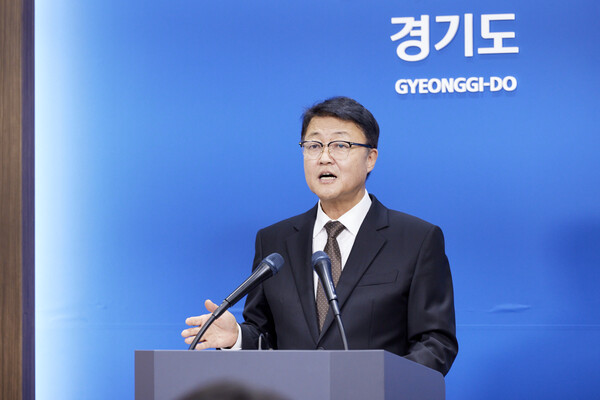
On the 31st, Gyeonggi Province announced the results of the "Fiscal Crisis Overcome Strategy Task Force," which was activated following Governor Choo Mi-ae's declaration of a "fiscal emergency" for Gyeonggi Province on the 5th of last month.
Vice Governor for Economy Ju Hyung-chul, who heads the Task Force, stated on the day, "The consolidated fiscal balance of Gyeonggi Province—calculated by subtracting pure fiscal expenditures from pure fiscal revenues—has recorded a deficit exceeding 1 trillion won annually since 2022, and considering revenue forecasts and expenditure levels, the deficit is expected to widen further next year."
The vice governor presented three major measures: △complete restructuring of the 2027 budget through projects being reviewed from scratch, including phase-outs of overlapping projects △securing an additional 1 trillion won or more in revenue during the 9th civilian administration term △pursuing four major tax reforms, including raising the local consumption tax rate, as three pillar strategies.
◇ Reviewing 2027 Budget from Scratch Through Sunset of Duplicate Projects and Strengthened Evaluation Feedback
First, as core criteria for the "2027 main budget compilation direction," the province presented six standards: △reviewing projects that have continued for three or more years from scratch △in principle, phasing out projects that are duplicated between departments or overlap with city and county projects △comprehensive review of large-scale project implementation methods △focusing on "metropolitan" unique tasks △actively reflecting evaluation results—including financial project assessments, subsidy project assessments, and investment project reviews—in budget compilation, and pursuing reduction or sunset of low-scoring projects △mandatory submission of financing plans when pursuing new projects.
Vice Governor Ju emphasized, "Concentrating on residents' safety and livelihood strengthening, and budget compilation that secures minimum future opportunities—saving where possible and spending better where needed—this is the direction of fiscal restructuring that Gyeonggi Province pursues," and added, "We will continue to discover projects that can expand policy effects without major financial investments, by converting direct financial support methods into non-budgetary projects utilizing administrative and network capabilities."
◇ Targeting 1 Trillion Won Increase in Revenue by 2030 Through Tax Collection and New Tax Source Development
The Task Force presented measures for securing local taxes and non-tax revenues: △strengthening tax collection management to realize tax justice △actively developing new tax sources such as attracting rental vehicle registrations △pursuing stable dividend payments from public enterprises funded by residents' taxes.
Vice Governor Ju stated, "These three measures can be implemented through the province's administrative capacity alone without additional legislative amendments," and added, "We will definitely achieve the target, and will continue to explore additional revenue securing measures including asset sales."
◇ Presenting Tax Reform Tasks in Line with National Policy Goal of 7:3 Ratio of National to Local Taxes
Vice Governor for Economy Ju Hyung-chul emphasized, "The fundamental cause of Gyeonggi Province's fiscal crisis is an outdated fiscal structure stuck in the development era, and reforming this old structure is both urgent and imperative," and stated, "The central government has already announced a national project to raise the ratio of national to local taxes to 7:3, and the Task Force has prepared tax reform plans in line with this."
The specific institutional improvement measures proposed by the province are as follows:
△raising the "local consumption tax" rate, a relatively stable tax source compared to acquisition tax, to 40 percent within the current term △converting the portion of local education tax scheduled for sunset within cigarette consumption tax to a regional resource facility tax, to be used as a resource for fire and safety-related expenditures △adjusting 5 percent of corporate tax as a metropolitan local government resource △adjusting the province's standard fiscal demand and standard fiscal revenue to be calculated in line with reality so that the province can receive ordinary transfer payments
Vice Governor Ju stated, "All four are difficult tasks, but they are necessary to stably take responsibility for residents' safety and livelihood and to prepare for Gyeonggi Province's future," and added, "However, most require legislative amendments and cannot be achieved through the province's efforts alone. We will mobilize all of the province's capacity by coordinating with the Provincial Assembly, 31 cities and counties within the province, the National Association of Mayors and Governors, and closely consulting with the National Assembly and central government."
◇ Establishing Implementation System and Local Finance Cooperation Council with Provincial Assembly for Full-scale Promotion
The Task Force plans to construct an implementation system centered on two axes—revenue securing promotion task force and expenditure restructuring promotion task force—to continue implementation and monitoring according to the strategies compiled by the Task Force. The province also plans to establish a "Local Finance Cooperation Council" with the Provincial Assembly to continuously cooperate closely on the province's fiscal normalization measures.
Additionally, the province announced it will strengthen regular communication so that residents can understand this process in detail, and will provide explanation opportunities at important junctures.
Vice Governor Ju, in his closing remarks, once again emphasized that "the important principle of the province is to boldly reorganize budgets for unnecessary and customary projects or projects showing minimal outcomes relative to invested resources, and reinvest them in projects that residents can actually feel," and stated, "True balanced growth is not growth with Gyeonggi Province left out, but growth where Yeongnam, Honam, Gangwon, Chungcheong and other regions grow together with Gyeonggi Province in synergy," appealing to the central government and National Assembly that concrete local fiscal decentralization roadmaps must be promptly established for the success of balanced development and local-led growth emphasized by the current administration.
Meanwhile, the Gyeonggi Province Fiscal Crisis Overcome Strategy Task Force, headed by Vice Governor for Economy Ju Hyung-chul, comprises the director of the Planning and Coordination Office, heads of divisions and departments, researchers from Gyeonggi Research Institute, and external experts, and conducted intensive discussions over seven sessions spanning three weeks, beginning with the first meeting on the 10th.