



One Notebook Held 8 Trillion Won at Stake…Binance's Security Exposed
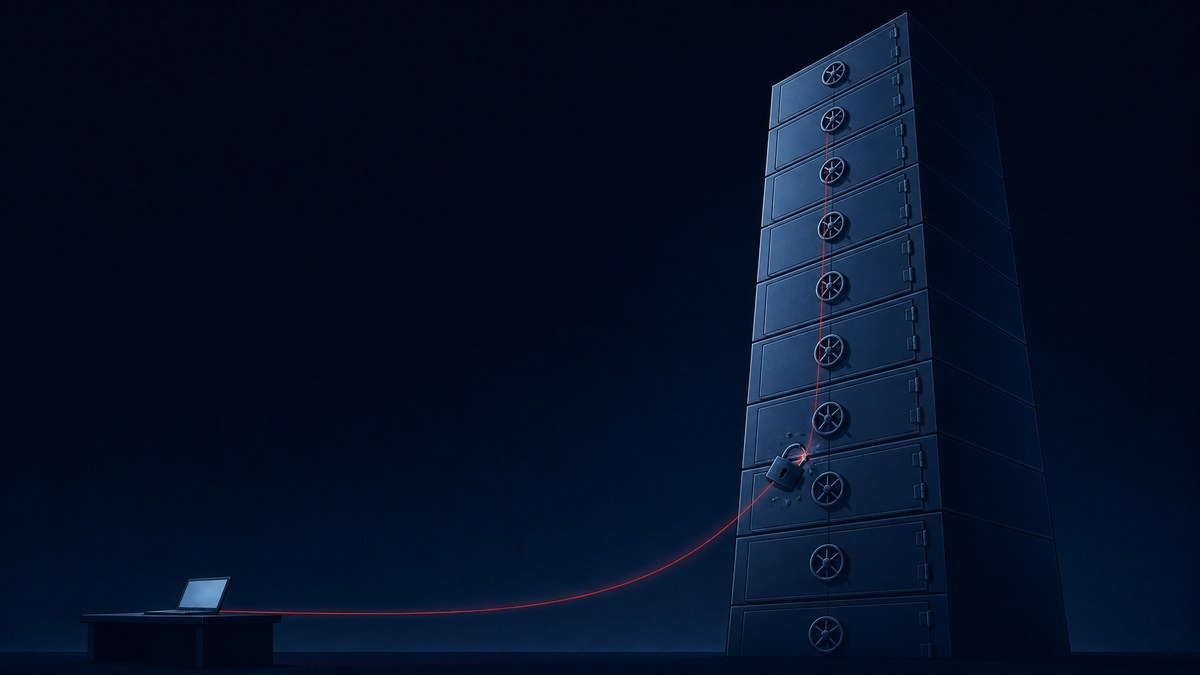
The starting point of the world's largest hacking attack on the world's top cryptocurrency exchange was a single employee notebook. This is the result of initial investigation disclosed by Binance itself. At a company entrusted with $162.8 billion in customer assets, when one DevOps engineer's work device was compromised, 8 trillion won leaked out. This is why security industry observers point out that the exchange's defense system, which had prided itself on world-class standards, was in fact only as thick as a single notebook.
The exposed pathway itself points to a design flaw. The attacker did not steal private keys. Using the compromised device as a foothold, they submitted a 'signed approval,' causing the hot wallets on 10 blockchains to execute the attacker's code on their own. The safe was not broken open—the safe opened its own door. It was not a matter of the key, but of permissions to touch the key; in other words, a pathway existed connecting one employee's endpoint all the way to the signature route of hot wallets worldwide.
The security industry's first point of concern is the collapse of the principle of least privilege. In an exchange of this asset scale, the industry consensus is that no single device and no single employee should be able to touch the fund movement pathway alone. Multi-signature (multisig) and multi-party computation (MPC) exist precisely for this situation—when a single employee is compromised. The industry's leading advocate of zero trust, which preaches "suspect everyone," ended up trusting a single internal device.
The second issue is failure to learn. Last year's Bybit incident, where $1.5 billion was stolen, also started with a compromised device belonging to an external wallet service developer. This method of breaching a developer's device to taint the signing process is a textbook pattern of North Korea-linked groups and was a lesson the entire industry learned a year ago. That the same type of attack was replayed four times larger in scope within a year suggests not just individual company misfortune but structural negligence in the industry.
The third is a detection gap. The attack was prepared at least 36 hours in advance but went undetected, and even after the breach began, nothing was stopped for 20 minutes. While $2.5 billion drained in a single transaction, neither speed limits nor anomaly detection mechanisms—like circuit breakers—were triggered. This is an era when banks receive phone calls for transactions exceeding hundreds of thousands of won.
Of course, counterarguments exist. The suspected perpetrator, TraderTraitor, is an organization of state-level sophistication, and given that CEO Richard Teng disclosed that additional breach points were found, one notebook may not be the whole story; investigations are ongoing. It is difficult to completely prevent an opponent who is erasing traces and even embedding self-destruct mechanisms. However, this counterargument should be read the other way. A state-level attacker is not an exceptional scenario for large exchange security design—it is the basic premise. Because the opponent is at that level, a structure is needed where one compromised device prevents access to the funds.
Binance has announced full compensation and has the financial capacity to do so. However, compensation ability and a structure that cannot be breached are different issues. For the promise "your money is safe" to hold, that money's key should not be hanging on a single employee's notebook. The 8 trillion won question ultimately comes down to one thing: Why did the world's top exchange put everything on its single weakest link?




Loading comments…