



Gyeonggi Office of Education Earmarks 24.7772 Trillion Won for 2027 Main Budget...Focused Investment on 5 Key Tasks for 'Gyeonggi Education Transformation'
[Education] Gyeonggi Office of Education Earmarks 24.7772 Trillion Won for 2027 Main Budget...Focused Investment on 5 Key Tasks for 'Gyeonggi Education Transformation'
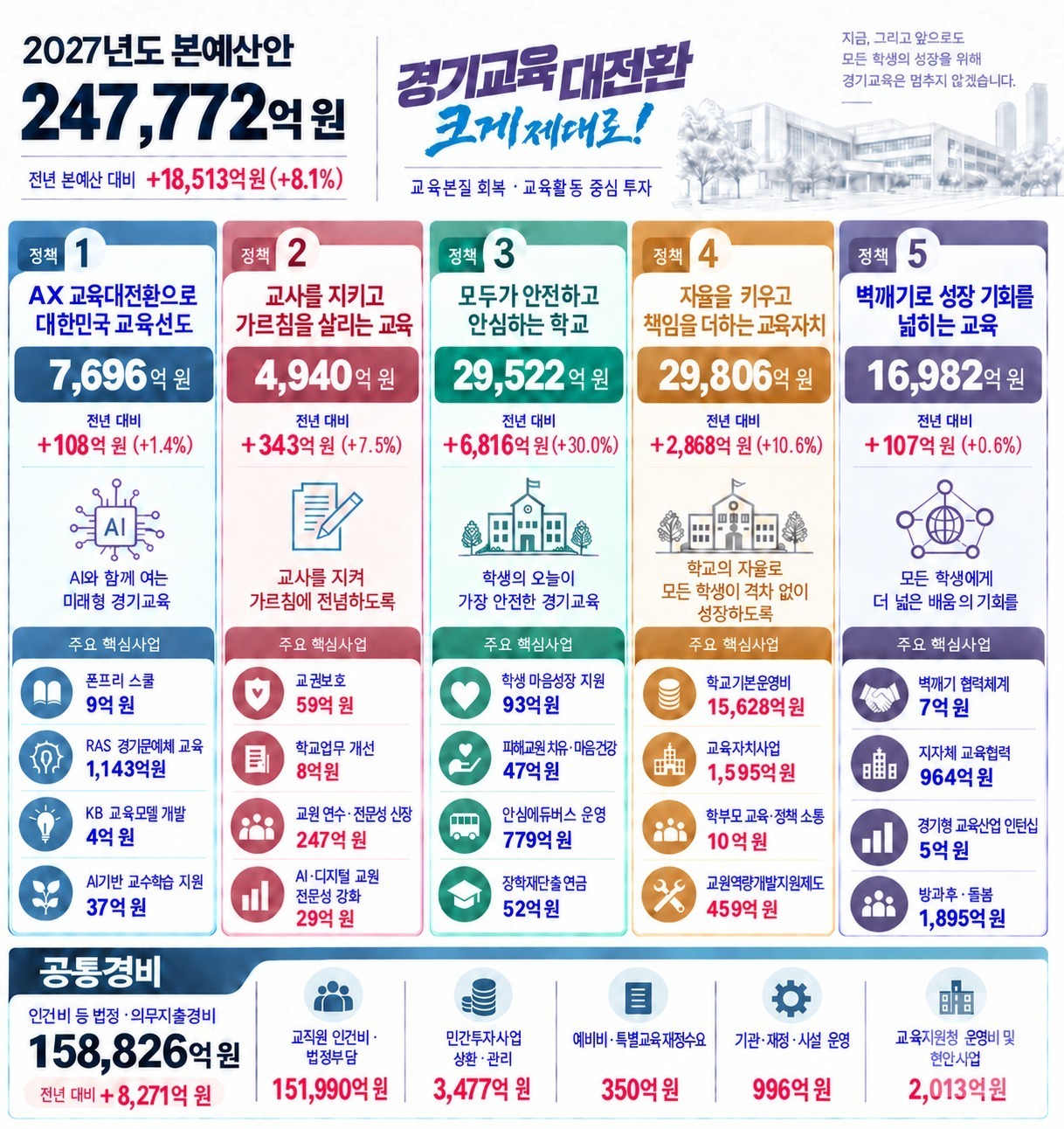
The Gyeonggi Office of Education (Superintendent An Min-seok) submitted to the Gyeonggi Provincial Assembly on November 2 a main budget of 24.7772 trillion won for the 2027 Gyeonggi Education Special Account, centering on recovery of educational fundamentals and strengthened support for student educational activities.
This budget proposal is 1.8513 trillion won (8.1%) larger than the 2026 main budget (22.9259 trillion won). However, the education office explained that compared to the 2026 first supplementary budget (24.8927 trillion won) that supplemented the shortfall from the previous year when some essential project costs were not reflected due to worsening revenue conditions, the actual budget is reduced by 115.5 billion won (0.5%).
Enhancing fiscal efficiency through 'intensive expenditure structural reform' amid shrinking available resources
Next year's revenue sources consist of 19.8745 trillion won from central government transfers, 3.7525 trillion won from local government transfers, and 731 billion won from self-generated income and other sources. While general grants increased by 1.5133 trillion won compared to the previous year's main budget, the actual available resources were reduced due to shrinkage in national funding for tuition-free high schools and decreased fund reserves. Meanwhile, personnel cost increases (3.9% up) and mandatory statutory expenditures continuously grew, adding to the fiscal management burden.
In response, the provincial education office implemented intensive expenditure structural reform. It first reduced operational expenses across the board by 20% and cut facility rental costs entirely (34.5 billion won), while boldly eliminating 50 underperforming, redundant, or short-term one-time projects (154 billion won).
Additionally, project funding was reduced by more than half and redirected to total-amount transfer projects and standard education expenses, while increasing the education support offices' education autonomy project budgets to significantly expand the education superintendent's budget authority. In parallel, the office ensured maximum allocation for school basic operating funds reflecting inflation, accommodation-type experiential learning expenses, and after-school program infant health snack costs to prevent gaps in field support.
Concentrated investment of 8.8 trillion won in 5 core policies for Gyeonggi Education Transformation
The provincial education office will channel resources generated through structural reform into 5 core policies (total 8.8946 trillion won) for the 'Gyeonggi Education Transformation'.
First, 769.6 billion won was allocated to AI education transformation. Through AI-based teaching and learning support (3.7 billion won), phone-free school operations (900 million won), RAS Gyeonggi Arts, Sports and Culture Education centered on reading, arts, and sports (114.3 billion won), and Korean Baccalaureate (KB) education model development (400 million won), the office supports customized future education for students.
Teacher rights protection and educational activity support received 494 billion won. Through teacher rights protection (5.9 billion won), teacher training and professional development (24.7 billion won), AI and digital teacher expertise enhancement (2.9 billion won), and school operations improvement support (800 million won), the office lays the groundwork for teachers to fully dedicate themselves to educational activities.
Construction of a safe and secure school environment receives 2.9522 trillion won in investment. Through student mindfulness development support (9.3 billion won), healing and mental health support for affected teachers (4.7 billion won), and safe education bus operations (77.9 billion won), a comprehensive safety net is established.
Education autonomy and overcrowded classroom resolution receives 2.9806 trillion won. Through school basic operating funds (1.5628 trillion won), education support office education autonomy projects (159.5 billion won), and new school and kindergarten establishment (814.7 billion won), locally customized autonomy is further strengthened.
Finally, 'breaking barriers' cooperation projects linking with local communities and industry receive a total of 1.6982 trillion won, including Nuri Curriculum and tuition-free education (1.1416 trillion won), seamless after-school and childcare programs (189.5 billion won), local government education cooperation (96.4 billion won), and Gyeonggi-type educational industry internships (500 million won). Additionally, 15.8826 trillion won is allocated as common expenses including employee personnel costs, statutory contributions, and institutional operation costs.
Yoon So-young, director of the Planning and Coordination Division at the Gyeonggi Office of Education, stated: "Despite the difficult circumstances with tight available resources, we boldly eliminated customary expenditures and concentrated the saved resources on focused investment in AI education transformation, teacher rights protection, and arts, sports and culture education to develop students' future competencies. We will continue to strengthen both fiscal efficiency and fiscal soundness so that students and schools, the ultimate beneficiaries of the budget, can dedicate themselves to education with conviction in the field."
Meanwhile, the 2027 main budget proposal will be finalized through deliberation and voting at the 395th regular session of the Gyeonggi Provincial Assembly to be held in the future.
Loading comments…