Suwon City Resident Participation Budget and Resident Tax Reallocation - Good Example of Collaborative Governance
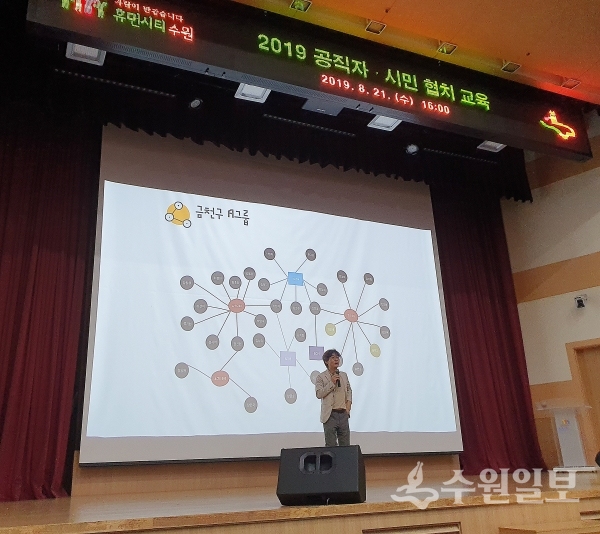
[Suwon Ilbo=Reporter Seo Dong-young] On the 21st, Suwon City held "2019 Public Officials and Citizen Collaborative Governance Education for Strengthening Collaborative Governance Capacity" at City Hall for approximately 200 people including members of resident autonomous associations, resident autonomous committees, and public officials.
Professor Yu Chang-bok from Sungkonghoe University, who served as the lecturer, stated, "If resident autonomous associations are activated, collaborative governance will naturally be realized." Professor Yu Chang-bok is a public-private collaborative governance (governance) expert who has served as the Seoul Metropolitan City Collaborative Governance Advisor, Co-Chairman of the Korean Village Support Center Council, and Director of the Seoul Metropolitan City Village Community Comprehensive Support Center.
Professor Yu stated, "As the times change, the necessity for public-private collaboration to solve complex social problems is growing," and explained, "The answer to promoting public-private collaboration is autonomous activities where citizens take the lead in participating in policy decisions and community projects." He cited Suwon City's resident participation budget and resident tax reallocation projects as good examples of activated governance.
Beginning this year, the city is conducting a pilot operation of resident autonomous associations that add 'community development' and 'welfare' functions to the resident autonomous functions of the existing resident autonomous committees. In 8 pilot districts including Song-juk, Yul-cheon, Seo-dun, Homae-sil, Haengung, Ingyae, Maetan 2, and Gwanggyo 1-dong resident autonomous associations, 240 committee members are active. Resident autonomous association members are responsible for ▲promoting the Resident Tax Smile Project (resident tax reallocation project) ▲holding general resident assemblies ▲establishing community autonomous plans ▲establishing resident participation budget plans.