


Newly Renovated Suwon Agricultural and Fishery Products Wholesale Market...Fruit and Seafood Auctions to Begin on the 31st
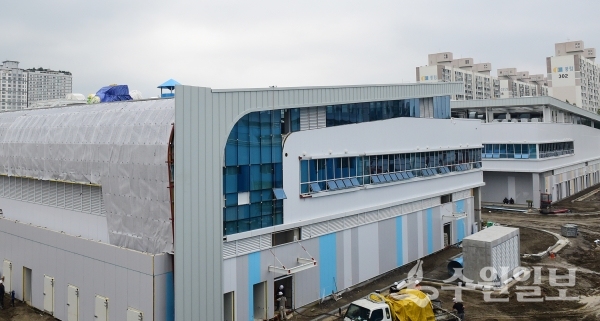
[Suwon Ilbo=Reporter Suh Dong-young] The Suwon Agricultural and Fishery Products Wholesale Market (located in Gwonseon-dong, Gwonseon-gu), which has supplied safe and fresh food to Suwon citizens for the past 28 years, has completed its renovation and will open at the end of this month.
The Suwon City government is preparing to begin auctions in the new facility starting on the 31st as Phase 2 of the facility modernization project, which is proceeding through a stepwise circulating development method. The city is currently in the final stages of preparations.
▲ Fruit and Seafood Buildings Equipped with State-of-the-Art Facilities to Begin Auctions on the 31st
The city announced that it has completed the new construction of the Fruit Building and Seafood Building in Phase 2 of the Suwon Agricultural and Fishery Products Wholesale Market facility modernization project, with merchants set to relocate starting on the 21st.
The Fruit Building will house 54 shops, each approximately 22 square meters in size, where fruit wholesalers from three wholesale corporations will begin trading in a clean and modernized market environment. The Seafood Building, of similar scale, will accommodate 60 shops from two wholesale corporations to serve customers.
The interior of the newly built market features organized shops, bright lighting, and spacious aisles, allowing citizens using the market to shop safely and comfortably.
In addition to the improvement of existing facilities such as the cooperative office, merchant lounges, and banking services, the new building is equipped with a low-temperature storage vault in the basement of the Fruit Building, a freezer and seawater tank in the basement of the Seafood Building, and a second-floor restaurant for loading freight—all designed to keep agricultural and fishery products fresh.
The city is preparing for the first auction at the newly constructed facility to commence on the 31st of this month following a ten-day relocation period beginning on the 21st.
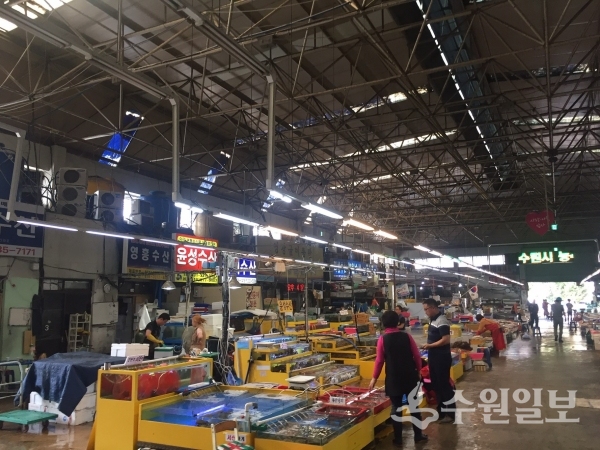
▲ Modernization of a Representative Wholesale Market in Southern Gyeonggi for 28 Years
The Suwon Agricultural and Fishery Products Wholesale Market, located on a site of 56,925 square meters, opened in February 1993. Currently, five corporations operate the market with 52 fruit shops, 92 vegetable shops, and 60 seafood shops serving as distributors.
For over 20 years, it has led the distribution of agricultural and fishery products in Suwon as a local wholesale market and has become a representative market in the southern Gyeonggi region, distributing an average of 318 tons and 548 million won worth of agricultural and fishery products daily.
However, the facilities have progressively deteriorated, and the addition of temporary auction venues and prefabricated structures has made the cramped space even more inconvenient. Moreover, insufficient power capacity led to frequent fire accidents caused by electrical leakage. The aging facilities have caused consumers to turn away, putting the market at risk of decline.
To address this, the city initially pursued relocation to Gogbanjung-dong. However, when the project faced difficulties due to real estate market slumps and other issues, the city found a breakthrough through the "circulating redevelopment" method. Since the issue directly affects merchants' livelihoods, the approach maintains business operations while enabling smooth management and facility improvements with swift functional recovery.
Subsequently, in June 2013, the city applied for and was selected in the facility modernization project public competition overseen by the Ministry of Agriculture, Food and Rural Affairs, opening the way to receive 30% of the total project cost of 106.1 billion won in national funding. The project gained momentum after passing the central investment and financing review in 2016.
▲ Three-Phase Circulating Redevelopment Method
The facility modernization project for the Agricultural and Fishery Products Wholesale Market proceeds through three phases, improving facilities in stages without interrupting market operations.
Phase 1 involved creating an alternative site (1234-1 Gwonseon-dong, 1229 Gwonseon-dong) near the current location to serve as a temporary venue for the Vegetable Building. Starting Phase 1 construction in November 2017 across from the current site, over 90 vegetable shops relocated in June 2018. The remaining dilapidated buildings were demolished.
Phase 2, which will be completed at the end of this month, involved constructing new Fruit and Seafood Buildings on the vacated Vegetable Building site beginning in March 2019. Merchants previously operating in the existing Fruit and Seafood Buildings will relocate to this new facility, making them the first tenants of a permanent building constructed on the original site.
In particular, the city prioritized the construction of environmental facilities and mechanical and electrical equipment in Phase 2 to ensure no inconvenience when all relocations are eventually completed, focusing on essential infrastructure work.
The final Phase 3 involves demolishing the old Fruit and Seafood Buildings vacated by merchants and constructing new buildings on the site where temporary building merchants currently operating in the Vegetable Building will relocate. An administrative building with other sales facilities, a management office, and a food hygiene inspection center will also be newly constructed.
The city plans to complete Phase 3 construction by the end of 2021 to enable the market to function as a hub wholesale market.
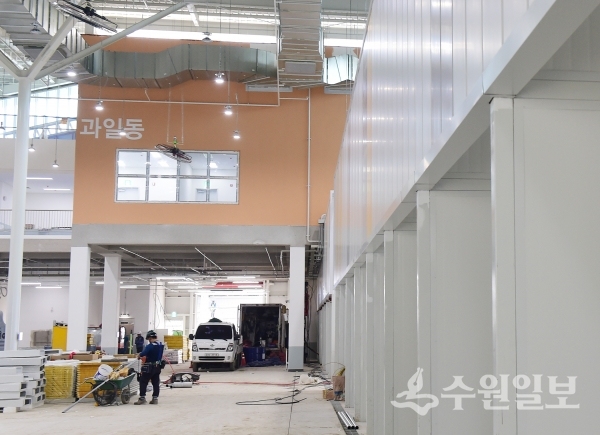
▲ Enhancing User Convenience through Active Communication with Merchants
What the city considered most important during the Agricultural and Fishery Products Wholesale Market facility modernization project was communication with corporations and merchants. The goal was to minimize inconvenience for users whose livelihoods depend on the market.
The city conducted a total of 82 consultations over three years to review various requests from corporations and distributors belonging to the Vegetable, Fruit, and Seafood Buildings. Of the 63 requests raised during consultations, 45 were fully reflected and 13 were partially reflected, demonstrating the city's commitment to communication-oriented administration incorporating user feedback.
As a result, measures to address garbage facility odors by separating traffic flows were incorporated into the design, as were fish byproduct freezers and deodorization equipment, distributor convenience facilities such as water supply and drainage systems and wall installations, and shop layout arrangements reflecting request items.
The city noted that cooperation from Koolon Global Co., Ltd., the construction contractor, and the construction project management unit (site management and supervision) also contributed significantly to accommodating these requests.
A city official stated, "Thanks to cooperation and understanding from not only market workers but also local residents, we have been able to proceed smoothly with the project through the circulating redevelopment method. We will safely complete Phase 2 and promptly proceed with Phase 3 construction to minimize inconvenience for market workers."
▲ Merchants Awaiting Relocation Hold "Expectations" for Market Revitalization
Merchants awaiting relocation have high expectations for market revitalization.
Distributors are strengthening their resolve to seek new business opportunities through new facilities and new business approaches.
Jung Jae-geun, 60, union chairman of distributors for Gyeonggi South Fisheries Cooperative, who has operated at the Suwon Agricultural and Fishery Products Wholesale Market for decades since its opening, emphasized that efforts from distributors are also necessary for market revitalization.
Merchants must seek opportunities through origin labeling and scales to build trust, avoiding touting and providing friendly service to enable citizens to use the market conveniently.
Merchants shared the opinion that while parking facilities are not yet fully secured ahead of moving into the new building, causing anticipated parking inconvenience, they should maintain cooperation with administrative authorities to improve user convenience.
Chairman Jung conveyed, "When Phase 3 construction is ultimately completed, all market sectors including fresh produce, vegetables, and seafood will operate in one location to create synergy effects. We will also make our own efforts to revitalize the market."