Yongin City: "Be Cautious of Tick-Borne Infectious Diseases from June to September as Outdoor Activities Increase"
 \r\n
\r\n[Suwon Ilbo=Park No-hun] Yongin City has urged residents to be cautious of tick-borne infectious diseases as outdoor activities increase from June to September.
\r\n\r\nSevere fever with thrombocytopenia syndrome (SFTS), scrub typhus, Lyme disease, and tick-borne encephalitis are representative tick-borne infectious diseases transmitted through tick bites. These diseases begin in spring each year and occur most frequently from June to September when outdoor activities increase.
\r\n\r\nSFTS initially presents with unexplained fever, fatigue, loss of appetite, vomiting, diarrhea, and abdominal pain, primarily gastrointestinal symptoms.
\r\n\r\nIf the decrease in platelets and white blood cells is severe, bleeding may not stop, and it can lead to death due to kidney function failure and multiple organ dysfunction, requiring particular caution.
\r\n\r\nScrub typhus typically manifests symptoms after an incubation period of approximately 10 to 12 days following a tick bite.
\r\n\r\nFever, sweating, headache, and conjunctival injection appear, and a characteristic feature is the development of an ulcer with a scab at the site where tick larvae attach to the skin and feed on blood.
\r\n\r\nLyme disease presents with fever, headache, and fatigue 3 to 23 days after a tick bite, accompanied by erythema migrans on the skin (a skin condition characterized by redness at the edges and a pale appearance in the center).
\r\n\r\nIf diagnosis is delayed or if the patient is immunocompromised, complications can develop, making early treatment particularly important.
\r\n\r\nTick-borne encephalitis develops central nervous system symptoms such as fever, headache, sensory disturbances, and paralysis after an incubation period of approximately eight days.
\r\n\r\nAlthough no patient cases have been reported in Korea yet, the disease occurs in China, Japan, Russia, Germany, and Switzerland, so preventive measures against tick bites should be taken when traveling to these regions.
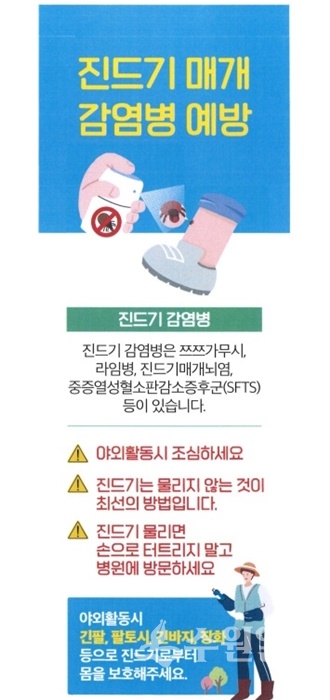
\r\n\r\nTo prevent tick-borne infectious diseases, minimize skin exposure during agricultural work and outdoor activities such as hiking in mountains or fields, and apply tick repellent to exposed skin.
\r\n\r\nAfter outdoor activities, wash the clothes you wore, check for any bite marks, and then shower.
\r\n\r\nMost importantly, if bitten by a tick, do not crush or pull off the tick with your hands. Instead, immediately visit a nearby hospital to have it removed and receive treatment.
\r\n\r\nA city official stated, "When doing agricultural work or outdoor activities, you should wear long sleeves, long pants, and boots to protect your body from ticks," adding, "Since there is no separate preventive vaccine, it is important not to be bitten by ticks."
\r\n