Retired Suwon Civil Servants Share Vivid Story of Urban Transformation
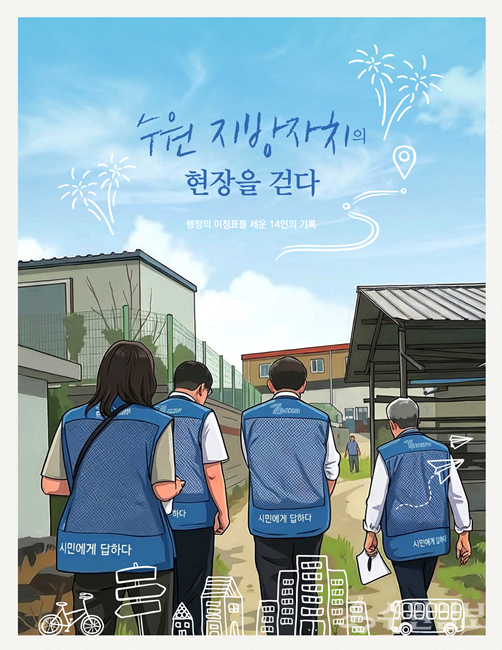
[Suwon Ilbo=Reporter Lee Min-jeong] The Suwon Studies Research Center of the Suwon Policy Research Institute (Director Kim Sung-jin) has published the Suwon Studies Planning Series 'Walking Through the Field of Suwon Local Autonomy: Records of 14 People Who Set the Milestones of Administration.'
The book records the modern history of Suwon administration through the voices of public officials, commemorating the 30th anniversary of civilian-led local autonomy in Suwon Special Status City.
Beyond Numbers and Reports, Restoring the Context of Administration that Blooms in the 'Field'
This book differs from existing administrative records that focused on numbers or official reports. It focused on the 'people' who are the subjects of administration. Fourteen retired civil servants who were at the center of Suwon City administration from the appointed official period through the seventh civilian-led administration participated as oral history narrators, and the book contains vivid field experiences collected over approximately 100 hours.
The book three-dimensionally depicts experiences of civil servants who started as 'dong secretaries' (junior officials at neighborhood offices, now administrative welfare centers) in the 1960s, including ▲changes in organizational culture ▲the reality and limitations of local administration during the appointed official period ▲policy coordination and implementation processes during the civilian-led period ▲hidden conflicts and clues to resolution behind large-scale projects such as Suwon Stream restoration and urban development.
'Administrative Wisdom' Forged Through Innovation
The book is organized into five parts by theme and is evaluated as having "compiled Suwon's urban development history and administrative know-how."
Part 1, 'Suwon's Administration Recorded in Oral History,' surveys the overall flow of administrative change and deeply examines the academic and practical value of oral history records.
Part 2, 'The Administrative Framework Built Through Planning, Autonomy, and Practice,' addresses the design process of autonomous administration and the reality of leadership through oral testimonies from Yun Kun-mo, Kim Young-kyoo, Kwon In-taek, and Song Young-wan.
Part 3, 'Urban Planning and Spatial Policy, Planning Tomorrow's Suwon,' unravels various stories hidden behind Suwon Stream restoration and new city design based on testimony from Kim Choong-young and Joo Yang-won.
Part 4, 'Culture and Regional Development, Expanding Publicness in Daily Life,' contains detailed accounts from Park Hwan-ui, Kim Jung-bok, Park Jong-soo, and Park Heung-sik of the process of preserving the UNESCO World Cultural Heritage Suwon Hwaseong Fortress and leading innovation in everyday administration.
Finally, Part 5, 'Sports, Welfare, and Women: Forming the Foundation of Citizens' Lives,' records the journey of establishing the foundation for sports city branding and citizen welfare system construction through the voices of Yun Tae-hun, Choi Hee-soon, and Park Rae-hun.
'Living Administrative Guidebook' for Future Generation Public Officials
The oral history narrators unanimously emphasize that "the realization and sustainability of policies depend on the expertise and dedication of practical civil servants."
Kim Sung-jin, director of the Suwon Policy Research Institute, stated: "This publication is a work that proves Suwon is a city where policies and practices have accumulated, transcending the image of a city remembered only through discourse. I hope this record becomes a milestone for future generation civil servants to reflect on the essence of administration and an opportunity for citizens to feel pride in their city."
Yoo Hyun-hee, director of the Suwon Studies Research Center, who oversaw the publication, said: "On the occasion of the 30th anniversary of the 'civilian-led era' that began with the amendment to the Local Autonomy Act in 1995, this is a meaningful result of systematically organizing over two years the experiences of retired civil servants who directly designed and implemented policies as Suwon grew into a metropolitan city of 1.2 million people."