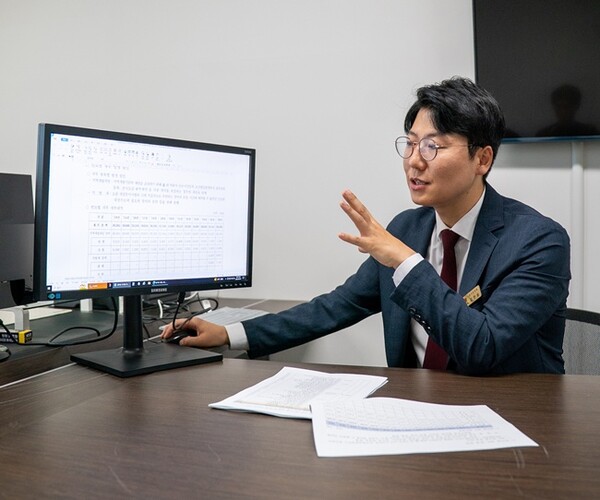
[Interview] ‘Gyeonggi Province Debt Map’ Kim Han-seul: “I thought what I was curious about would be what Gyeonggi residents are also curious about”
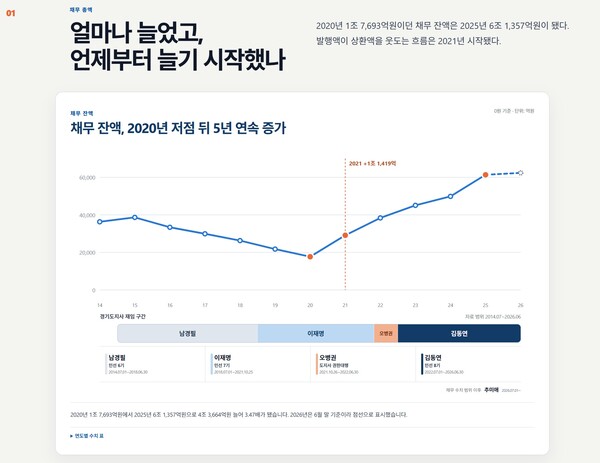
As controversy over Gyeonggi Province's finances spreads following Governor Choo Mi-ae's declaration of a ‘virtual bankruptcy,’ a so-called ‘Gyeonggi Province Debt Map (debt.ggdata.kr)’ that organizes the province's debt information for viewing at a glance has been released.
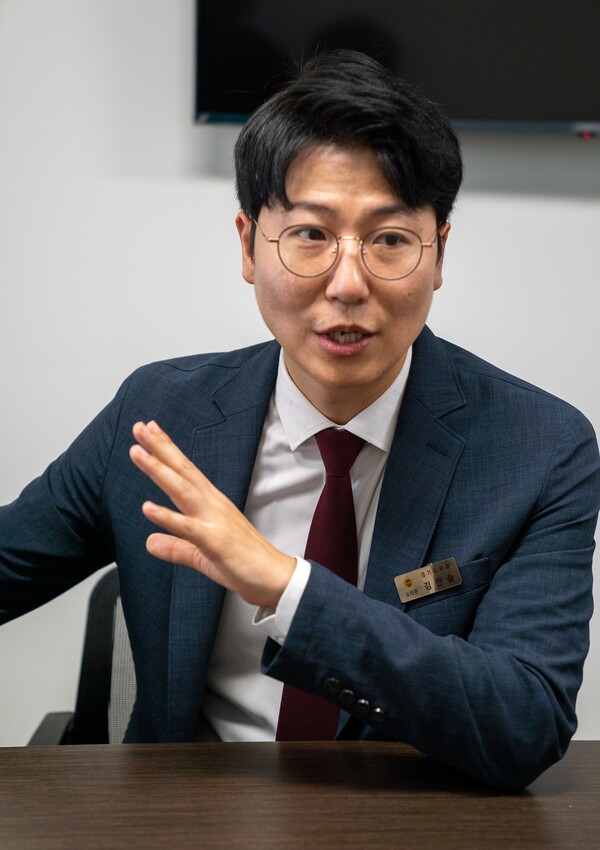
It is a website that Gyeonggi Provincial Council member Kim Han-seul (People Power Party·proportional representation) built by directly requesting data from Gyeonggi Province and utilizing artificial intelligence (AI). It brings together the debt changes during the 6th to 8th popularly elected administrations, fund loan projects, and the issuance and use records of local government bonds.
Kim did not create the website from the outset to respond to Governor Choo's fiscal emergency declaration. She had requested the relevant data during the provincial council session and was building the website after the session ended, and while reviewing it with an expert advisor, she heard the news of Governor Choo's emergency press conference and moved up the release date.
Kim said, “On the day I was reviewing it, Governor Choo Mi-ae suddenly announced an emergency press conference, and when I looked at the content, it was the content I had been analyzing,” adding, “So I judged that I should release it right away, and released it immediately.”
Gyeonggi Province already discloses debt-related data through fiscal disclosures. Regarding why she created a separate website nonetheless, Kim cited the accessibility and readability of the existing data.
She said, “Even if the data is disclosed on the website, it is hard to know unless you look for it with interest, and the content is difficult,” adding, “Even if the governor says the debt exceeds 7 trillion won and that it is almost in a state of bankruptcy, I thought it would be extremely difficult for residents to find all the existing fiscal disclosures, compare which items are being referred to, and understand it.”
Another reason for gathering the data together was to verify the timing of the fiscal deterioration and where responsibility lies. Following the 7th popularly elected administration (then-Governor Lee Jae-myung) and the 8th administration (then-Governor Kim Dong-yeon), Governor Choo, who is a member of the same Democratic Party, took issue with the fiscal management of the previous administrations right after taking office, so Kim saw a need to compare these with the same data.
Kim said, “Since Governor Choo Mi-ae, a member of the same Democratic Party, claims the fiscal condition is serious, I wanted to look at exactly who is responsible as objectively as possible based on data,” adding, “I am examining, using the data, whether it can be claimed that this problem arose because the previous and the administration before that executed excessive debt or budgets.”
While organizing the data, she also confirmed that the fiscal management method currently under controversy had been repeatedly raised in the past. Issues such as using new funds to repay existing debt, or the reduction of usable resources actually available due to fund transfers between funds, remained in the provincial council's meeting minutes.
She said, “There had already been pointed out the so-called 'robbing Peter to pay Paul' of borrowing anew to repay existing debt,” adding, “The content that the amount actually usable becomes small after lending from a fund here and there was also confirmed in last year's meeting minutes.”
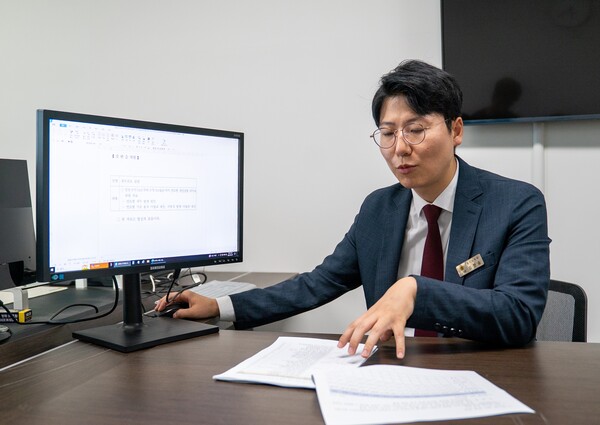
Kim also pointed out that such data is scattered across multiple years and documents. Even if individual data is disclosed, to grasp long-term changes or connections, users must find, gather, and connect the data themselves.
She said, “When information is fragmented, it is hard for anyone who is not truly interested to bundle it all together and make a judgment,” adding, “I think of it as a process of attaching the parts of interest one by one.”
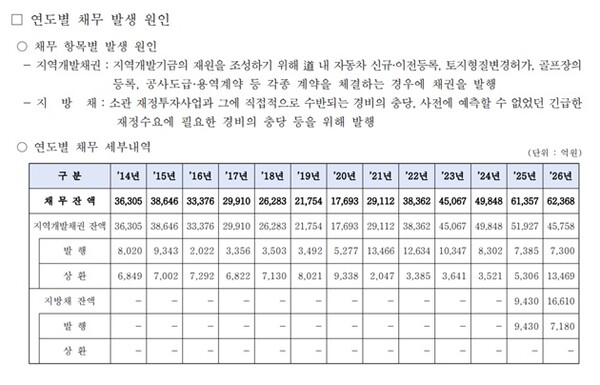
What Kim paid particular attention to in the data was general local government bonds. According to the data submitted by Gyeonggi Province, general local government bonds separate from regional development bonds had not appeared before but were issued last year.
Kim said, “There were no local government bonds other than regional development bonds at all,” adding, “General local government bonds, which take on debt to carry out projects, did not exist but began to newly appear starting last year.”
She also analyzed where the local government bonds were used. According to Kim, in 2025 there were many relatively large-scale projects such as road and river maintenance, but in 2026 local government bonds were injected even into relatively small-scale projects.
She said, “If it is a truly essential project, isn't it healthy to have a structure where it can be covered by the province's own budget from the original main budget?” adding, “The part where even minor projects worth less than 1 billion won must be carried out by issuing local government bonds needs to be examined.”
However, she drew a line at directly linking the debt increase to the responsibility of a particular administration. She explained that the website, too, was composed centering on the submitted data and excluded separate political assessments as much as possible.
Kim said, “The purpose itself is not merely to say ‘the Democratic Party did wrong’ or ‘it is all Lee Jae-myung's fault,’” adding, “I think the moment it comes across that way, the objectivity of the data analysis is lost and there is room for it to be read as political criticism.”
To that end, she plans to compare the ‘debt in the 7 trillion won range’ presented by Governor Choo with the past by the same standard. The figures currently reflected in the debt map are data that Gyeonggi Province submitted as official debt, but Kim understands that the roughly 7 trillion won amount presented by Governor Choo broadly includes not only local government bonds but also the regional development fund and interest. She said, “We must look at who is responsible even when the entire past is examined by the amount standard the governor expresses,” adding, “If, even when analyzed by exactly the same standard as now, it increased from a certain point in time, then the location of responsibility becomes clear at that point.”
Accordingly, Kim requested that Gyeonggi Province recalculate the past 12 years' worth of data by the same standard as the method Governor Choo presented. This is to compare the difference between the existing official debt and the ‘debt in the 7 trillion won range’ that Governor Choo mentioned. She said, “Since the standard of the content Governor Choo announced is not clearly confirmed down to the details, currently only the large figure can be confirmed,” adding, “I think that when comparable data comes in, showing it integrated with the existing data is necessary to accurately grasp the matter.”
Regarding Gyeonggi Province emphasizing the revenue structure as the cause of the fiscal deterioration, her position is that expenditures must be examined together. Apart from the fact that tax revenue decreased, whether the scale of spending was adjusted accordingly must also be verified. Kim said, “Gyeonggi Province's fiscal problem did not arise in a single moment one day, but has been continuously accumulated,” adding, “Talking about only the revenue side is fallacious; if revenue is insufficient, one must adjust expenditures accordingly while also pointing out the revenue problem.”
The ‘Gyeonggi Province Debt Map’ is set to be supplemented and revamped as additional data comes in. Kim has additionally requested from Gyeonggi Province the interest on local government bonds, the issuance timing, and detailed issuance records. She said, “I requested all the interest details, and we must also confirm to whom the local government bonds were issued, whether they were issued at a particular time, and whether they had a particular purpose,” adding, “Once I receive the data, I am reflecting it on the website and also exploring ways for residents to directly participate and discuss.”
Kim emphasized that the purpose of disclosing the fiscal data was not to lead to a particular conclusion. She said, “If it is truly in a serious state, then we must all tighten our belts together,” adding, “If it is not that, but was a political act to push Governor Choo's own projects, then I will thoroughly monitor and check it so that residents suffer no harm.”
The starting point for creating the ‘Gyeonggi Province Debt Map’ was the same reason. Kim said, “I thought that what I was curious about would be what residents are also curious about,” adding, “I will continue working so that residents can more easily examine the content I have verified firsthand.”