



Governor Choo Mi-ae Issues Third Administrative Guidance to Samsung and SK on Semiconductor Effluent—Reconfirming Intent to Tighten Regulations
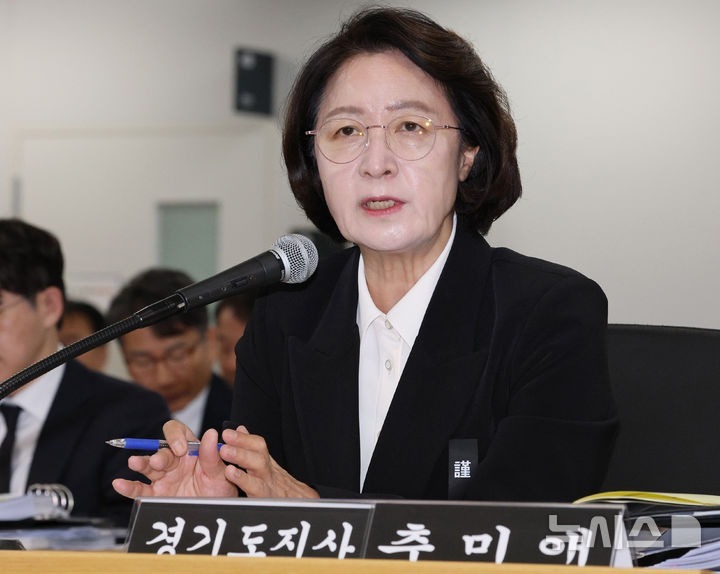
Gyeonggi Province Governor Choo Mi-ae issued a third round of administrative guidance to Samsung Electronics and SK Hynix demanding improved water quality in semiconductor factory effluent, reconfirming her commitment to strengthening environmental regulations on the semiconductor industry.
According to Gyeonggi Province on the 28th, the province sent administrative guidance documents to Samsung Electronics and SK Hynix on that day instructing them to establish independent management standards and reduction measures to lower the concentration of chloride ions and sulfate ions in their effluent.
This marks the third measure following recommendations in July to increase recycled process water usage rates and in August to reduce wastewater discharge. While the previous two measures focused on water usage and discharge volumes, this time the province expanded the scope of management to include the concentration of specific substances contained in the effluent.
Governor Choo expressed her position through social media on the 7th that management of water quality, not just quantity, in semiconductor industrial complex wastewater is necessary. On the 27th, the day before, she held a meeting on semiconductor industry-related issues and ordered preemptive water quality management measures to minimize impacts on surrounding streams and agricultural water.
The basis for this administrative guidance is the investigation results of the stream receiving SK Hynix effluent in Icheon, announced by the Gyeonggi Province Institute of Health and Environment on the 5th.
The institute conducted water quality surveys of Jukdang Stream in Icheon on three occasions—August 26, and September 2 and 3. As a result, 731㎎/L of chloride ions and 1,561㎎/L of sulfate ions were detected at a point 0.4㎞ downstream of the discharge outlet, exceeding the recommended levels of the United Nations Food and Agriculture Organization (FAO) for agricultural water.
However, in the survey at that time, all nine items subject to domestic river water quality standards were met. Only the concentrations of chloride ions and sulfate ions, which have no separate standards, appeared elevated, and no actual impact on agricultural water intake points or crops was confirmed.
At the time, the Gyeonggi Province Institute of Health and Environment acknowledged that survey points were not selected based on actual agricultural water intake facilities, and that it is difficult to assess long-term water quality impacts based on only three surveys. The institute also had not obtained separate comparative survey results for Samsung Electronics' business sites.
This administrative guidance is also an extension of the trend toward strengthening regulations. The province recommended that companies establish independent management standards for chlorine compounds and sulfur and its compounds and prepare reduction measures before the government establishes permitted discharge standards.
However, administrative guidance constitutes non-binding recommendations without legal force. Under the Administrative Procedures Act, companies cannot be disadvantaged solely for failing to comply. For actual regulatory strengthening to occur, separate institutional measures such as government-level establishment of discharge standards are necessary.
A provincial official stated, "Since Anseonggosam Reservoir, which will receive effluent from Yongin SK Hynix's semiconductor cluster, is used for agricultural purposes, management from a preventive perspective is necessary," adding "We plan to confirm the government's establishment of discharge standards in the future and continue water quality surveys of surrounding streams and reservoirs."
Ultimately, while Gyeonggi Province's commitment to strengthening management of semiconductor effluent has become clearer through this measure, the extent to which scientific verification of actual environmental damage and objective evidence for regulatory necessity can be secured is expected to become a key issue going forward.

Loading comments…