



Debate over 'Preferential Multicultural Policy' Heats Up...Government Reconsiders Standards, Gyeonggi Province Reorganizes
President Lee Jae-myung has publicly questioned the necessity of preferential systems for multicultural families, and Gyeonggi Province is pursuing the abolition of the Immigration and Society Bureau, signaling shifts in immigration and multicultural policies at both the central and local government levels.
According to the Presidential Office and Gyeonggi Province on the 29th, the government is reconsidering the criteria for giving multicultural family mothers priority access to public postpartum care facilities, while Gyeonggi Province is pushing ahead with organizational restructuring to abolish the Immigration and Society Bureau and integrate its functions into other departments.
While the two measures differ in their backgrounds and purposes, it is noteworthy that both the preferential system for multicultural families and the dedicated immigration and society organization have come under review.
The Presidential Office announced through a statement issued in the name of Im Ho-geun, Presidential Secretary for Population Policy, that it would "consider amending the enforcement ordinance of the Maternal and Child Health Act to ensure the benefits of the postpartum care facility priority use system are directed first to mothers who have greater need."
Earlier, President Lee shared an online community post to his social media account, raising the need for reconsideration regarding multicultural family mothers and mothers of national veterans being classified in the same second priority for reservations at Seoul-type Reliable Postpartum Care Centers.
President Lee stated that the government would consult with local governments and review whether it is necessary to provide preferential treatment beyond protecting multicultural families from discrimination, whether it is necessary to abolish the preferential system, and would consider this alongside amendments to the executive order.
The current Maternal and Child Health Act enforcement ordinance designates multicultural family mothers as priority users or targets for discounted fees at public postpartum care facilities, along with national veterans and recipients of basic livelihood assistance.
Equity concerns are also being raised in the process of daycare center admission. Under the current Early Childhood Care and Education Act, children from multicultural families are included as first-priority targets for daycare center admission, together with children from dual-income families, multi-child households, and recipients of basic livelihood assistance.
The core of the controversy is that no separate income requirements are applied to the multicultural family qualification, meaning families can become priority admission targets regardless of their economic circumstances.
The Presidential Office drew a line, saying this review is not intended to eliminate support for multicultural families itself.
Secretary Im explained that the current postpartum care facility priority use criteria were established in June 2016, and noted that as policy support for multicultural families has since been expanded, a review of existing regulations is necessary.
Secretary Im stated, "While carefully observing the difficulties multicultural families may still face in Korean society, we will provide thorough support to ensure there are no blind spots."
While the government reviews equity in multicultural family support, Gyeonggi Province is facing ongoing controversy over the existence of the dedicated immigration and society organization.
The first organizational restructuring plan for the ninth term of local elections, prepared after Governor Choo Mi-ae took office, includes abolishing the Immigration and Society Bureau and integrating it with the functions of the Women and Family Bureau into the Gender Equality and Family Bureau.
On the 20th, the province announced a restructuring plan reducing the main office from 30 bureaus and 151 divisions to 25 bureaus and 141 divisions, and held legislative notice from the 21st to the 26th. The province explains the restructuring as intended to adjust functions between organizations and enhance administrative efficiency.
The Immigration and Society Bureau was established in July 2024 during the tenure of former Governor Kim Dong-yeon, becoming the first independent bureau-level organization dedicated to immigrant policy among metropolitan autonomous governments. It now faces abolition less than two years and three months after its launch.
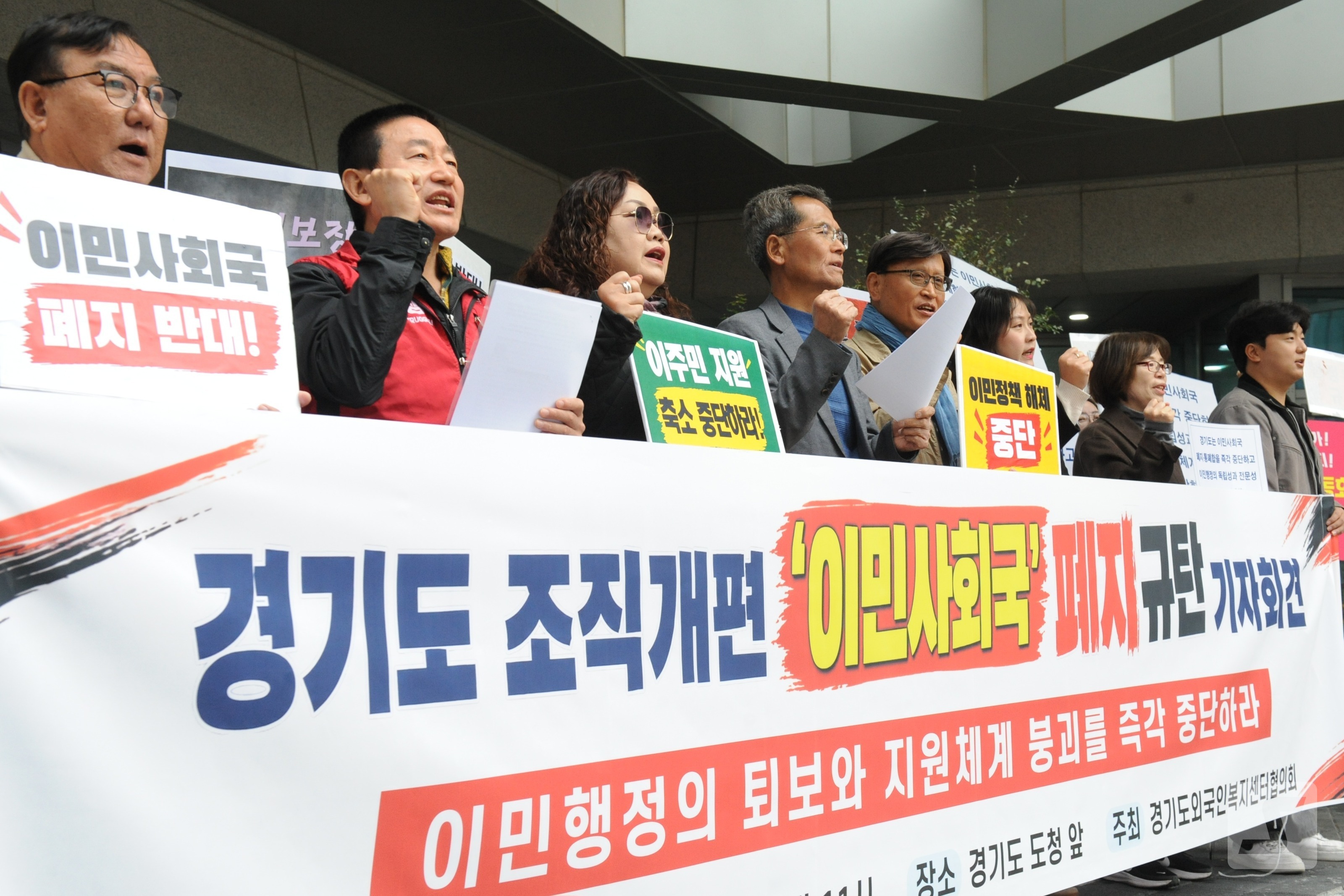
However, immigrant, labor, and human rights organizations are opposing the move, arguing that the disappearance of an independent dedicated organization could weaken expertise and continuity in related policies such as protection of migrant workers and support for multicultural families.
The Gyeonggi Province Foreign Resident Welfare Center Council held a press conference at 11 a.m. on the 29th in front of the Open Citizen Complaint Room at the provincial government, demanding the withdrawal of the plan to abolish the Immigration and Society Bureau.
In the Gyeonggi Provincial Assembly, there have also been concerns raised about administrative gaps resulting from the Immigration and Society Bureau restructuring. Kim Yong-sung, chairperson of the Gyeonggi Provincial Assembly's Committee on Women, Family, and Lifelong Education, held a discussion session with immigrant support organization officials on the 26th and listened to views on the organizational restructuring.
Following the opposition, Governor Choo instructed on the 27th that opinions submitted during the legislative notice period be thoroughly reviewed and that re-legislative notice be conducted if necessary. The province plans to submit the final organizational restructuring plan in November after gathering opinions and consulting with the provincial assembly.


Loading comments…