



Kim Woo-young's Gwanggyo Column Hwaseong Research Society's "The Essence of Our Sounds" Special Lecture... I Realized I'm an "Korean Classical Music Illiterate"
I am not a member of many organizations. I belong only to a couple of literary circles, the Hwaseong Research Society, and a few civic organizations where I simply pay membership dues.
Among them, the organization I love most is the Hwaseong Research Society, a registered civic organization that will celebrate its 30th anniversary next year. The Hwaseong Research Society has continuously conducted research, promotion, and education on Hwaseong Fortress and its fortifications.
I am a founding member of the Hwaseong Research Society, which started in 1997 under the name 'Hwaseong Love Circle.' This means I have been involved with this organization for nearly 30 years.
In December 1997, the year Suwon Hwaseong was designated as a UNESCO World Heritage Site, those who had a deep interest in the fortress gathered to tour Hwaseong and discuss preservation and utilization strategies. As more people joined out of empathy for their passion, the organization was officially registered as a civic organization in May 2001.
The Hwaseong Research Society currently consists of approximately 190 experts and citizens from various fields. They preserve and research Hwaseong while honoring King Jeongjo, who built the fortress, as well as Chae Je-gong, Jo Shim-tae, Jeong Yak-yong, and the craftsmen and citizens who participated in the construction.
To properly promote and publicize Hwaseong, the Hwaseong Research Society continuously holds special lectures each year such as "People of the Jeongjo Era," "Re-reading Joseon's True Landscape," and "Suwon Studies Lectures."
Currently, the special lecture series "The Essence of Our Sounds" is being held.
This lecture series, held every Tuesday from June 13th to July 11th at 6 p.m. at the Suwon Hwaseong Museum, is a very meaningful program jointly conducted by the Hwaseong Research Society and the Jeongjo Humanities and Arts Foundation.
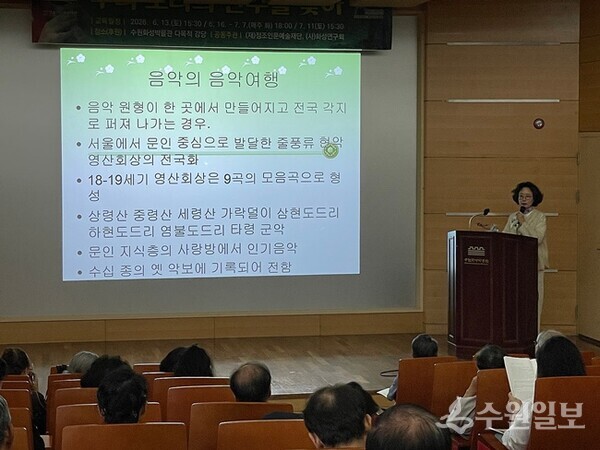
Two sessions have already been held—"A Musical Journey Through the Joseon Dynasty" (June 13th, Song Ji-won, Director of the Institute of Music Humanities) and "Korean Pansori" (June 16th, Kim Su-mi, Lecturer at Kyungpook National University)—and the audiences have responded enthusiastically.
The remaining sessions include: △Session 3 "Gayok·Gasa·Sijo—Fascinated by the Three Colors of Jeongga" (June 23rd, 6 p.m., Moon Hyun, Korea Research Institute of Classical Studies), △Session 4 "The Greatest Hit Song of the Korean Empire—Japga" (June 30th, 6 p.m., Song Eun-ju, Ph.D. in Korean Music), △Session 5 "The Oldest Comfort, Gut—Untangling Hearts Through the Sounds and Wit of Seoul Gut" (July 7th, 6 p.m., Choi Su-jung, Associate Professor at Dongguk University), △Session 6 "The Curved and Rotating Sounds of Gyeonggi Province and Arirang" (July 11th, 3:30 p.m., Kang Hyo-ju, Professor at Ewha Womans University). Those interested are encouraged to attend.
In 1998, Kwon Young-bin, a columnist for the JoongAng Ilbo, lamented in his history column titled "The Rise of Historical Illiteracy":
"Korean classical music and Korean history both carry the soul and spirit of the nation; they are the same Korean studies. While Korean history was neglected, Korean classical music was scorned. It is ironic that Korean music has become reverse-imported from abroad as Korean artists gained international recognition through their tireless overseas activities. Without the cultural circles of progressive student movements, the popularization of Korean classical music would have been impossible," he wrote.
He then advised, "Though it is late, I hope for the revitalization of systematic Korean classical music education now. To truly know ourselves, we must study our history and listen to the sounds of our nation."
Reading this article and attending the two sessions of "Finding the Essence of Our Sounds" lecture series, I felt deep shame about my ignorance and indifference toward Korean classical music. I also reflected on myself.
Song Ji-won, who led the first lecture, is a Korean classical music expert who has long hosted "Song Ji-won's Korean Classical Music Walk" on FM 99.1 Korean Classical Radio. He introduced Joseon Dynasty music through four themes: "Musical Journey—Departure," "Musicians' Musical Journey," "Music's Musical Journey," and "Musical Journey Through Songs."
The names of renowned singers mentioned in his lecture—such as "An Min-young," "Lee Dong-baek," and "Song Man-gab"—and terms like "Yeongsanhoesan" and "Gayok Wonryu" I had heard of them before, but I did not know them in detail.
And Lee Dong-baek's "Bird Song," which I heard for the first time, was so moving that I got goosebumps.
Park Sung-hwan, head of the Junggo Pansori Promotion Center, wrote in the Daejeon Ilbo ten years ago:
"When you listen to Lee Dong-baek's 'Bird Song' restored through gramophone records, there is an intense power from the first note that captures your ears and makes you listen to the end without moving. His voice, with its mighty and stylish Suri-yang tone, freely employs high and low, thick and clear sounds, starting simple and seemingly careless, then gradually imitating the cuckoo when it cries, the oriole when it sings, and gradually reaching a subtle and wondrous realm of sound."
Why am I only now hearing Lee Dong-baek's "Bird Song," which has reached this "subtle and wondrous realm"?
Simply put, it is due to my ignorance and lack of knowledge. On top of that, my mistaken prejudice that Korean classical music is tedious must have also played a role.
Song said, "Sichang (poem-singing), gayok (songs), and sijo (three-line poems) offer a sense of generosity and refined travel just by listening to them."
He explained that Korean classical music is a cultural passage that connects people and regions, literature and refinement.
Yet here I am, someone who claims to be a poet and has spent my entire career in the media making a living, and I am this much of a "Korean classical music illiterate"...
I will listen carefully to the remaining four sessions and continue to reflect. I also hope that others who share this reflection will join us.
正在加载评论…