Suwon Mayor Yeom Tae-young: "Solutions to Public-Private Cooperation and Job Creation All Lie in 'Local Autonomy'"
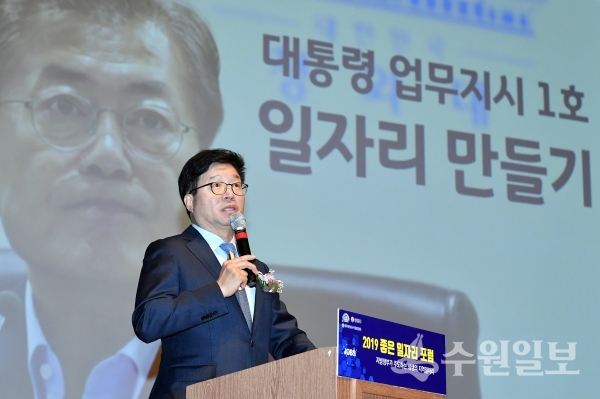
[Suwon Ilbo = Reporter Seo Dong-young] Yeom Tae-young, chairman of the Korean Association of Mayors and Governors and mayor of Suwon, stressed during a keynote speech at the 'National Public-Private Cooperation Open Forum' held on the 7th at the South Chungcheong Northern Chamber of Commerce in Cheonan, South Chungcheong Province that "local autonomy is the greatest driving force of governance for resolving social conflict."
Chairman Yeom evaluated the government-led public deliberation process on Shin-Gori Nuclear Power Plant Units 5 and 6 as a significant step in deliberative democracy where citizen input shapes national policy decisions. However, he noted that the lack of nuclear energy experts and the decision of recommendations within just three months made it difficult to hold anyone accountable.
In contrast, regarding the conflict over lifting restrictions on Gwanggyo Mountain as a water source protection area in Suwon, he introduced how the 'Gwanggyo Mountain Coexistence Committee,' which promotes public-private cooperation, made a decision on partial lifting through direct democracy over 17 months and presented a solution.
Chairman Yeom explained that "the greatest driving force for such successful conflict resolution governance is local autonomy," adding, "There must be accompanying legislative authority and bold financial transfers so that regions can solve problems on their own and ultimately take responsibility."
Chairman Yeom also delivered a keynote speech at the '2019 Good Jobs Forum' held at the Korea Arts Center in Yangcheon-gu, Seoul that afternoon, with the theme 'Job creation is also decentralization,' presenting the view that "regions should be able to play a greater role in establishing job creation policies."
Chairman Yeom confessed, "Over the past two years, serving as a private member of the first Jobs Committee, I received the Jobs Award for five consecutive years and created 200,000 regional jobs, but I am a failed Jobs Committee member."
He explained that job projects followed central government guidelines, failing to reflect regional demographics, industrial structures, and residents' needs, and proceeded through matching methods, which inevitably resulted in the shrinking of jobs projects that reflect regional characteristics.
Moreover, similar policies operating under different names in different departments caused problems with compartmentalized policies, so he argued that integrated approaches and comprehensive budget transfers are necessary.
In particular, he introduced cases where France and Japan in the early to mid-2000s significantly transferred central authority to local governments, implementing independent regional-led policies and overcoming economic downturns and recessions, presenting regional-led job creation policy as an alternative.
Chairman Yeom stressed, "Local governments that know their regions well and can implement solutions must be recognized as partners and consulted together, as citizens are consumers of policy and are closest to local governments," emphasizing once more that "job creation is also decentralization."
Meanwhile, the Korean Association of Mayors and Governors and other local four councils are raising their voices regarding the passage of local autonomy-related bills. They are releasing statements and urgent appeals urging bill processing, engaging in activities such as meetings with party leaders, and aiming for passage within the remaining six months of the 20th National Assembly.