



International Israeli Opposition Builds 'Anti-Netanyahu' Coalition…End of 19-Year Long Rule and Power Transfer in Sight
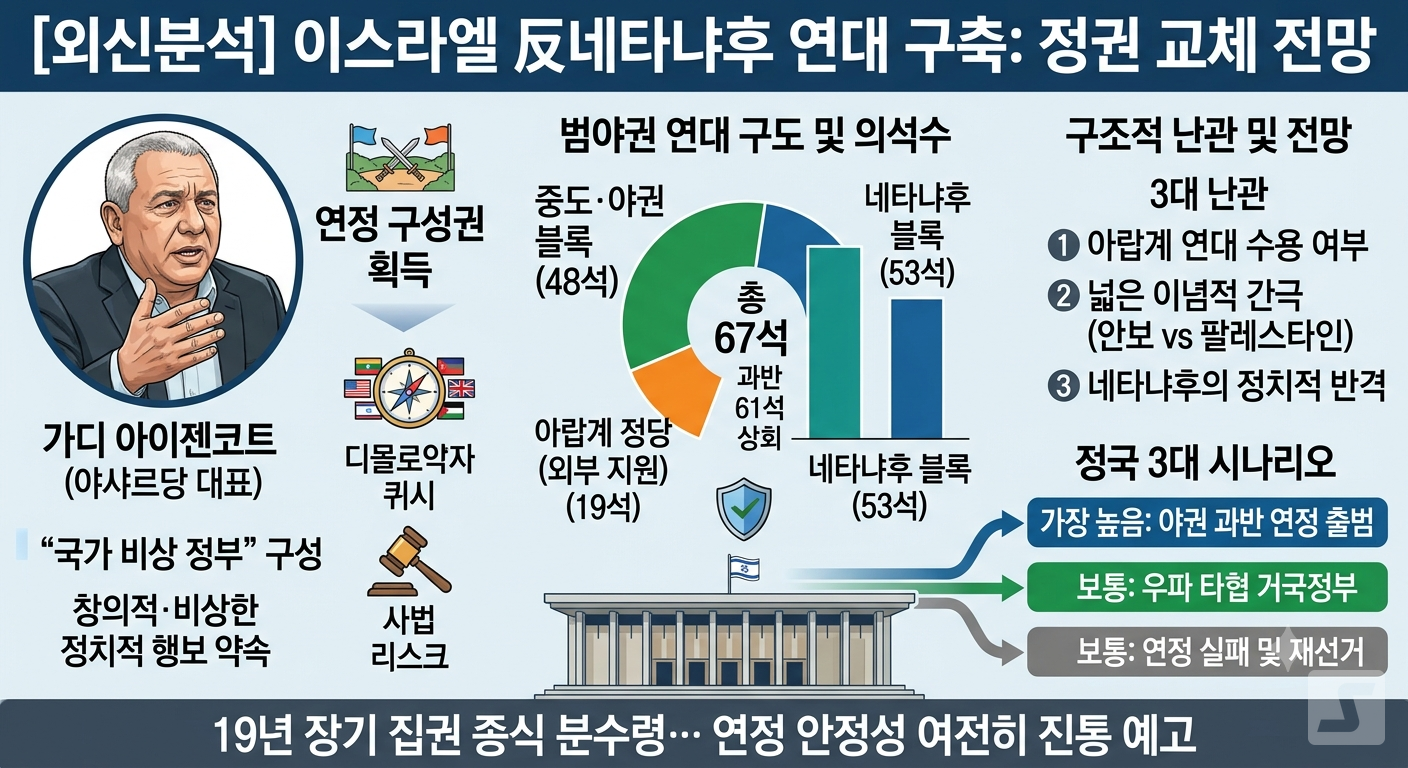
Prime Minister Benjamin Netanyahu's 19-year long rule in Israel has reached a critical juncture. Israeli President Isaac Herzog has granted coalition formation authority to Gadi Eisenkot, chairman of the opposition Yesh Atid party who leads the opposition bloc, marking a turning point in Israeli politics toward a power transfer. Based on major foreign media analysis, the possibility of opposition coalition success and various future political scenarios are being raised.
Netanyahu Fails to Secure Majority…Opposition's Eisenkot Gains Authority with Arab Party Support
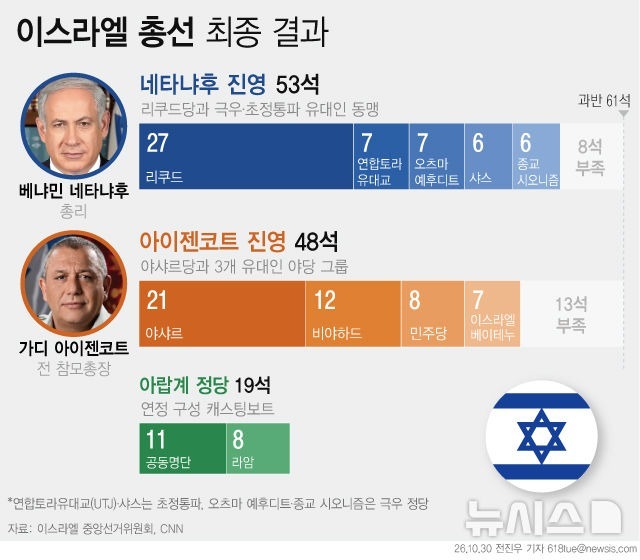
In recent elections, the right-wing and religious coalition led by Netanyahu's Likud party secured only 53 seats, falling short of the 61-seat majority. Meanwhile, Eisenkot, a former military chief of staff, led the centrist and opposition bloc to 48 seats but secured the backing of the Arab party holding the casting vote—19 seats—establishing a total of 67 seats of support, first obtaining coalition formation authority.
"In the Midst of War and Diplomatic Crisis"…Eisenkot Declares 'National Emergency Government'
On the 8th local time at the President's residence in Jerusalem, Eisenkot officially received coalition formation authority and defined the current situation as a national emergency. He diagnosed that the battlefield remains open and the country is in the midst of a fatal diplomatic crisis, emphasizing he would lead the formation of a 'national emergency government' through creative and extraordinary political measures. Accordingly, Eisenkot faces the task of producing a cabinet agreement guaranteeing a majority within the legal deadline of 28 days.
Arab Coalition and Ideological Gaps…Structural Obstacles to Overcome
However, foreign media point out that several structural hurdles exist before the opposition coalition is formed and passes parliamentary confidence votes. First, Arab party support is based on the common cause of Netanyahu's departure, with an external support format of 'confidence and supply' rather than direct cabinet participation being the most likely scenario. This raises concerns that the coalition could easily shake on security and Gaza-related policy issues.
Moreover, the anti-Netanyahu rainbow coalition comprising centrist, left-wing, security-oriented right-wing, and Arab parties has a wide ideological spectrum and low policy unity. In particular, there are stark differences of opinion between right-wing parties within the opposition and Arab parties on issues surrounding military exemptions for ultra-Orthodox Jews and Palestinian policy. Additionally, Prime Minister Netanyahu himself is strengthening political counterattacks to thwart the opposition coalition by defining the coalition with Arab parties as a security threat and proposing the formation of a national emergency grand coalition.
From 'Broad Opposition Coalition' Formation to 'Early Snap Elections'…Three Major Political Scenarios
Future politics is expected to unfold in three scenarios. The most likely scenario is Eisenkot successfully forming a broad opposition coalition by leveraging external support from Arab parties. In this case, Netanyahu's political downfall would be accompanied by a renewal of his judicial risks and a realistic recalibration of Gaza and Middle East policy.
Next is the possibility of forming a grand coalition through compromise between right-wing forces within the opposition and some parties in the Netanyahu camp. In this case, Prime Minister Netanyahu's political footing could be partially maintained, but major state affairs would likely face policy deadlock. Finally, should coalition negotiations fail within the deadline, early elections could be held again, in which case Israel's political uncertainty and governance vacuum are expected to be prolonged.
Watershed Moment for End of 19-Year Long Rule…Policy Stability Challenges Remain Even if Coalition Succeeds
Taken comprehensively, Israeli politics currently stands at its highest point where Prime Minister Netanyahu's 19-year long rule faces the possibility of ending. However, given that the opposition bloc's character is closer to an anti-Netanyahu coalition than a solid policy community, even if the coalition is successfully formed, considerable challenges are expected in securing stability in state governance and policy implementation capability.


Loading comments…