



Health 1 in 2 Men in Their 30s and 40s Obese…3040s Males 'Mistaken' Neglect Weight Management
With 1 in 3 domestic adults in an obese state, a survey found that a significant number of men perceive themselves as not obese despite having body mass index (BMI) values that actually qualify as obese.
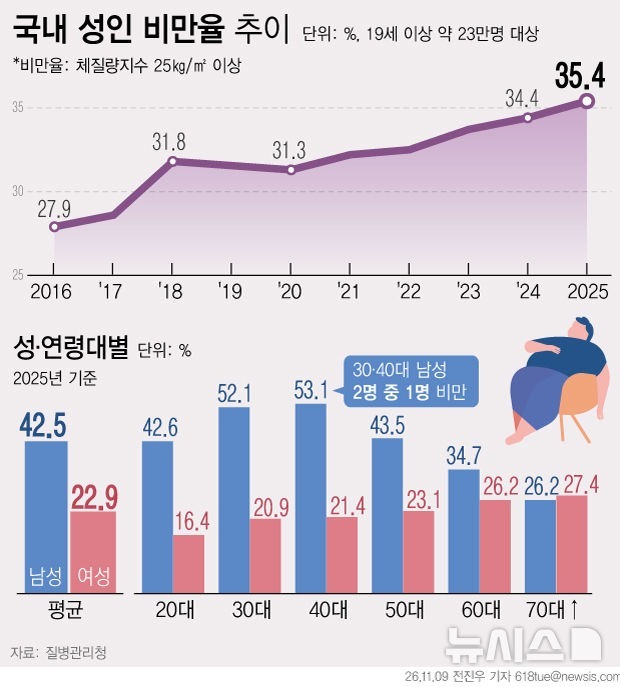
According to results of the '2025 In-Depth Analysis of Community Health Survey' announced by the Korea Disease Control and Prevention Agency on the 9th, the obesity rate (BMI 25 or higher) among domestic adults last year was recorded at 35.4%. This represents a 7.5 percentage point increase from 27.9% in 2016, a decade earlier.
By gender, the male obesity rate was 42.5%, approximately 1.9 times that of women at 22.9%. In particular, more than half of men in their 30s (52.1%) and 40s (53.1%) were in an obese state.
The problem is that the phenomenon of 'subjective obesity perception error'—neglecting weight management despite being obese—is notably pronounced among men. Among those who are actually obese but responded "I am not obese," 36.0% made no attempt at weight control whatsoever.
Among those who failed to recognize their obese state, 77.4% were male, concentrated among office workers in their 30s and 40s and those aged 60 and older.
Conversely, the distorted phenomenon of those with a lean body type (underweight) mistaking themselves for being obese was concentrated among women. Among the underweight population who perceived themselves as obese, 80.6% were women (primarily in their 30s and 40s), and 39.0% of them were found to be attempting unnecessary weight loss.
Deteriorating lifestyle habits, including sleep deprivation and lack of exercise, also drove the rise in obesity rates. Adults who did not engage in strength training had a 1.3 times higher obesity risk, and those who slept 6 hours or less per day also had a 1.2 times higher obesity risk. Skipping breakfast, alcohol consumption, and lack of walking practice were each analyzed as factors that increased obesity risk by 1.1 times.
In the top 10 cities, counties, and districts with high obesity rates, the diagnosis rate for hypertension and diabetes reached 40.6%, revealing relatively higher risk of metabolic disease complications compared to lower-ranked regions (24.1%).
An official from the Korea Disease Control and Prevention Agency stated, "We plan to strengthen customized public health policies by local governments to improve obesity awareness among men in their 30s and 40s and to provide proper weight management support."
Loading comments…