



Kim Chung-young's Suwon Microscope (127) Suwon Has Developed Through the Meeting of 'Auspicious Sites' and 'Talent'
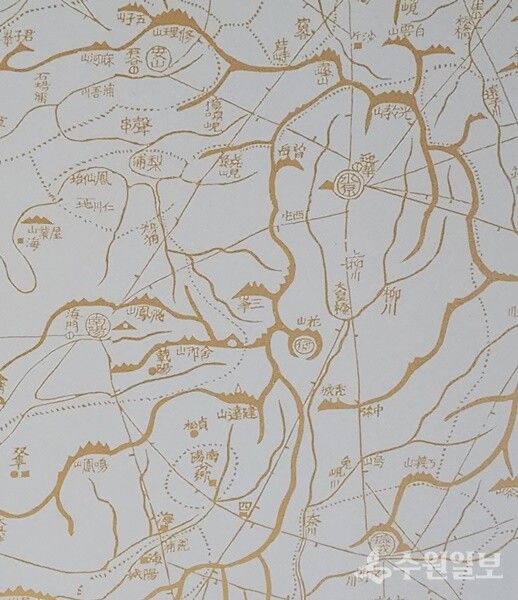
Suwon is geographically located in a favorable place. Moreover, it has developed through encounters with outstanding talent.
First, Gwanggyo Mountain, the main peak of the Hannam Jeongmaek originating from the Baekdudaegan, created Hwasan (Flower Mountain) on its branch mountain range. Suwon's Old Hwasan was called the finest auspicious site in Joseon, surrounded by 800 mountain peaks.
The mountain range of Suwon emanating from Gwanggyo Mountain encircles the area from east to west, forming a basin. This allowed Suwon to form a single water system, a topography where water from other regions does not flow in. In other words, since only the water from the land itself needs to be managed, the city became safe from water-related hazards, unaffected by surrounding influences.
Second, Suwon is geographically located at the gateway to the capital Seoul. In 1794 (the 18th year of King Jeongjo's reign), Hong Yang-ho, the Minister of Rites and Chief Scholar of the Gwanmun Institute, wrote in the inscription for the gate of Jang'an: "Hwaseong is a great capital and land to be protected. The land faces the sea with its back, overlooks the Han River, sits at the boundary thirty ri from Seoul, pulls Yeongnam and presses down Honam, with major roads extending in all directions." This revealed that Suwon was geographically a strategic location.
In geomancy, the burial site of the deceased is called "umneck" (negative site) and the residence of the living is called "yangtaeck" (positive site).
It was Ki Ja-heon, Left Premier during the Seonjo reign, who recognized Suwon as an auspicious site. Ki Ja-heon argued that the tomb of King Seonjo should be placed at Hwasan in Suwon. During the Hyojong reign, Yoon Sun-do also stated that Hwasan in Suwon was the finest location for King Hyojong's tomb. Banggye Yu Hyung-won said that for Suwon to develop, if the county seat were moved to the slopes of Paldalsan in Bukpyeong (Northern Plain), it could eventually develop into a major city of ten thousand households.
It was King Jeongjo, the great sovereign, who recognized Suwon's outstanding geographic advantages. The person who represented King Jeongjo's intention was Park Myeong-won, Lord of Geumseong. At a court conference on July 11, 1789 (the 13th year of King Jeongjo's reign), he submitted a memorial stating that Your Majesty's lack of a prince was because Yeonguwon, the tomb of Crown Prince Sado, was an inauspicious site, and therefore the tomb should be relocated to an auspicious site.
King Jeongjo accepted these arguments and took full advantage of Suwon's geographic strengths. He placed his father Crown Prince Sado's tomb in the auspicious "umneck" (negative site) and constructed a new city and fortress in the auspicious "yangtaeck" (positive site). To carry out this, he employed the finest talents of the era.
He entrusted Jung Yak-yong with the design of Hwaseong, having him establish the basic plan for the fortress construction. He appointed Chae Je-gong as Prime Minister and inaugural Suwon Magistrate of Hwaseong, giving him overall responsibility for the creation of Hyungnungwon, the new city, and Hwaseong construction. Jo Sim-tae was appointed Suwon Prefect and entrusted with the practical affairs of Hyungnungwon, the new city, and Hwaseong construction. Through these appointments, King Jeongjo achieved the construction of Hyungnungwon and Hwaseong, which would be remembered for generations in history.
King Jeongjo ordered: "Since the history (public works) we have accomplished is not a private matter, leave detailed records to serve as a lesson for posterity." Numerous records were preserved from that time, including records of the creation of Hyungnungwon, the construction of Hwaseong, records of the sixtieth birthday celebration of Hyegyeong Princess Hong, and many documents such as 'Hongjae Jeonjeo' and 'Seungjeongwon Ilgi.'
Those who participated in the construction of Hyungnungwon, the new city, and Hwaseong also left many records. These include Jung Yak-yong's 'Yeoyudang Jeonjeo,' Chae Je-gong's 'Beonam Jip,' and Jo Sim-tae's 'Suwon Puha Jirogo,' among others. In addition, many who served as Suwon Magistrates left collections of writings and cultural relics.
Hwaseong, constructed through favorable geographic conditions and the efforts of outstanding talents, fell into ruins through Japanese colonial rule and the Korean War. National Assemblyman Lee Byung-hee lamented this. He included the Hwaseong Restoration Project in the National Defense Historic Site Restoration Project, which the Park Chung-hee government promoted as a priority initiative.
He judged that the Gyeonggi Provincial Government would be a driving force for Suwon's development and succeeded in attracting it to Suwon in 1963. In 1969, he induced Samsung Electronics to relocate to Suwon, followed by attracting Sungkyunkwan University to Suwon. These became the foundation for Suwon's development.
Subsequently, Shim Jae-deok, director of the Suwon Culture Center, took interest in Hwaseong and engaged in activities. When the Gyeonggi Provincial Hospital (Suwon Medical Center) located at the site of Hwaseong Haenggung announced plans to construct a modern building there, he formed a restoration promotion committee for Hwaseong Haenggung.
He persuaded Governor Lim Sa-bin to relocate the Gyeonggi Provincial Hospital to a site next to the tobacco manufacturing plant. As the first elected mayor, he devoted himself to the restoration of Hwaseong Haenggung. Subsequently, he focused on having Hwaseong inscribed as a World Cultural Heritage site.
With utmost dedication, he succeeded in attracting the 2002 FIFA World Cup matches to Suwon. In doing so, stating that he could not show foreign tourists shameful restrooms, he threw himself into the toilet culture movement. This was a remarkable achievement that transformed Korea's restroom culture at once. This activity became an opportunity to promote the world's toilet culture improvement movement, extending beyond the Republic of Korea.
Suwon is a region with outstanding geographic advantages. In Suwon, outstanding talents such as King Jeongjo, the brilliant leader of the Joseon dynasty, Prime Minister Beong'am Chae Je-gong, Hwaseong Magistrate Jo Sim-tae, National Assemblyman Lee Byung-hee, and Suwon Mayor Shim Jae-deok demonstrated outstanding wisdom at important inflection points.
Suwon has grown into a major city nationwide, surpassing the population of Ulsan, a metropolitan city.
However, today's Suwon has a narrower administrative district compared to adjacent cities. It is a time when role-sharing is needed with adjacent developing cities such as Yongin, Hwaseong, Osan, and Pyeongtaek. Strategies in administration, education, culture and tourism, and research and development are necessary. It is time to take our ancestors' outstanding wisdom as a cautionary tale.


Loading comments…