



Electronic Tax Return Credit Renamed to "Taxpayer Cooperation Cost Deduction," Deduction Amount Should Be Increased
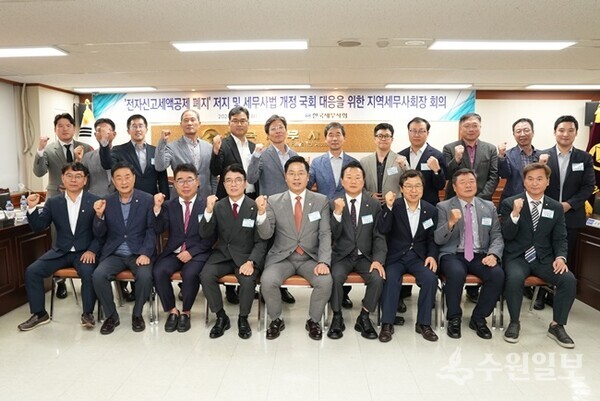
[Suwon Ilbo=Reporter Um In-yong] A bill has been submitted proposing that taxpayer cooperation costs transferred to those filing electronic tax returns to reduce the administrative expenses of the tax authorities, such as inputting tax return documents, should be fully compensated, permanently supported, and further expanded for small-scale business operators.
The government has submitted an amendment to the Special Tax Treatment Limitation Act, stating it will completely abolish the electronic tax return credit, which 5.8 million people currently participate in annually and receive 10,000 to 20,000 won per year, citing the reason that electronic tax filing has become established.
Rep. Kim Young-hwan (Democratic Party, Goyang City), a member of the Tax Subcommittee of the National Assembly's Planning and Finance Committee, has sponsored the bill amending the Special Tax Treatment Limitation Act (Bill No. 2204758) that changes the name of the "electronic tax return credit," which deducts a portion from the tax amount owed when taxpayers file taxes through electronic filing, to "taxpayer cooperation cost deduction," and raises the deduction amount specified in the Enforcement Decree to a law level.
In addition to Rep. Kim Young-hwan, who sponsored the bill, a total of 24 National Assembly members have participated as co-sponsors.
Furthermore, the current system provides for a tax deduction of 20,000 won for income tax, transfer income tax, and corporate tax, and 10,000 won for value-added tax when taxpayers file electronically under the Presidential Decree. The bill ensures the government cannot arbitrarily lower or abolish this by raising it to the law level, and additionally provides additional deductions for small-scale taxpayers such as simplified taxpayers who incur more time and costs in tax compliance.
Rep. Kim Young-hwan explained the reason for the amendment, stating "the electronic tax return credit is a system that deducts a certain amount from the tax owed when taxpayers directly perform the electronic input work of tax return documents that should be done by the tax authorities," and "it is a system that compensates for taxpayer cooperation costs incurred by transferring administrative expenses for inputting and correcting errors in return contents to taxpayers and tax agents."
He further stated, "The deduction amount for the electronic tax return credit for compensating taxpayer cooperation costs has been determined since 2004 and continues to be applied unchanged for 20 years, so for small-scale business operators, support for faithful tax payment and alleviation of the burden of tax cooperation in the face of rising prices such as labor costs and rent, prolonged economic recession, and cooperation with the tax authorities' cost reduction and administrative efficiency should be provided," and emphasized that "it is necessary to increase the tax deduction amount to provide thicker protection for small-scale business operators bearing taxpayer cooperation costs."
Rep. Kim Young-hwan also stated, "I am concerned about the hidden tax cuts for the wealthy in the 2024 Tax Law Amendment and the resulting tax increases on ordinary citizens," and emphasized, "We will do our best to immediately prevent the 'tax cuts for the wealthy' in this tax law amendment bill and block the 'tax increases on common people' hidden in between, such as the reduction of the electronic tax return credit and the reduction of the value-added tax credit from credit card use, etc."
Earlier, in an August full meeting of the Planning and Finance Committee, Rep. Lim Gwang-hyun (Democratic Party) strongly pointed out that "abolishing the electronic tax return credit applied to small and medium enterprises and self-employed merchants is a tax increase on ordinary citizens that ignores the voices from the field of people's livelihoods and must be reconsidered," and Representatives Park Hong-geun (Planning and Finance Committee) and Oh Se-hee (SME and Startups Committee) jointly held a press conference at the National Assembly, calling it a "tax increase on ordinary citizens and self-employed merchants and taxpayers by abolishing the electronic tax return credit," strongly demanding its withdrawal.
\r:Meanwhile, against the government's plan to abolish the electronic tax return credit, business organizations including Park Hun, President of the Korean Federation of Small and Medium Enterprises, and Song Chi-young, President of the Alliance of Self-Employed Merchants, as well as organizations including Park Hun, President of the Korean Taxpayers Association, have stated, "The electronic tax return system requires considerable effort and costs, and if abolished, taxpayer cooperation costs will increase further, and with skyrocketing financial costs and management difficulties, removing even 10,000 to 20,000 won of support per person would compound the difficulties of taxpayers," urging the government to withdraw the abolition amendment.
Goo Jae-yi, President of the Korea Association of Tax Accountants, who has expressed firm opposition to the government's plan to abolish the electronic tax return credit, stated, "Although tax cooperation is being achieved at the cost and burden of taxpayers and tax agents in the self-reporting tax system, we greatly welcome this innovative solution that can dispel the repeated claims to abolish the electronic tax return credit," and added, "16,000 tax accountants and 3 million small and medium businesses and self-employed merchants managed by tax accountants will always stand together."

Loading comments…