



Gwang-gyo Column: Kim Woo-young I'm Proud—My 45-Year Friend Poet Jeong Soo-ja Receives the 'Musan Culture Prize'
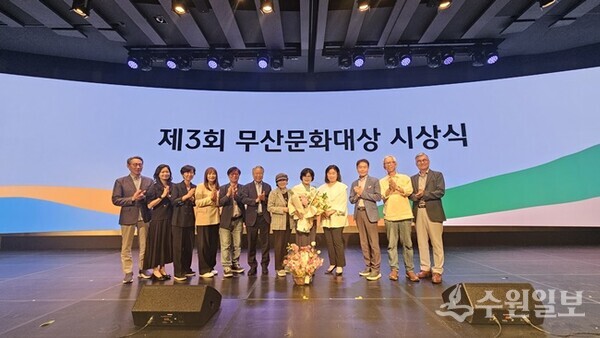
After the Hwaseong Research Association meeting last month ended, a few of us who were reluctant to part ways gathered. At that gathering, Poet Jeong Soo-ja mentioned that she was receiving some award.
Over the years, Poet Jeong has won the Korea Sijo Awards, the Garam Sijo Literature Prize, the Gosan Literature Prize, and the Yi Young-do Sijo Literature Prize, among others—what is known as the "Grand Slam of Korean Sijo Literature Awards."
So when I joked, "Are there still awards left to receive?" she said this one was the 'Musan Culture Prize.' Since I had little interest in prizes and was out of touch with literary circles, I had never heard of such an award.
Then she mentioned the prize money was quite substantial. "About 30 million won?" I asked. "A bit more," she replied with a smile. Privately, I thought, "Then it must be 50 million won," but it turned out to be 100 million won.
The saying goes, "My cousin buys land and my stomach aches," but my stomach didn't ache.
Perhaps it started after I turned fifty. When people around me did well, I felt fulfilled. When I see an empty restaurant on the street, my heart aches, and when I see long lines of customers at cafes or roasted chicken restaurants in Haenggung-dong, my own stomach feels full.
Poet Jeong Soo-ja is receiving the award, not I—the prize money is not going into my pocket—so why do I feel so happy?
There is a reason. Between us lies a bond that spans 45 years. We met in our mid-twenties and have maintained our friendship ever since. Of course, being strong-willed individuals, we squabbled with each other several times in between.
Yet our mutual respect never wavered. On the day Poet Jeong received her doctoral degree from Ajou University after what was truly painstaking work, standing outside the convocation hall watching the monitor, I unconsciously murmured, "Jeong Soo-ja, you've done well!" (I later learned her brother was standing behind me and heard those words.)
Every time she received various awards, I was there with her, and she never missed an important moment in my life either.
At some point, we even made such a promise: "Jeong Soo-ja, if you go first, I'll take care of your funeral rites." Of course, no one knows who will leave this world first.
On the evening of June 9th, the 3rd Musan Culture Prize ceremony was held in the Grand Ballroom of the Western Chosun Hotel in Seoul. (Related article: Suwon Ilbo, May 21st, 'Poet Jeong Soo-ja Receives the 3rd Musan Culture Prize')
The prize is established and administered by the Seorak·Manhae Ideals Promotion Foundation to carry on the artistic spirit and spirit of mutual prosperity of Venerable Musan Cho O-hyun, who was also a poet.
Venerable Musan Cho O-hyun, who served as the head abbot of Shinheungsa Temple, the main temple of the 3rd District of the Jogye Order of Korean Buddhism, showed keen interest and affection for culture and the arts during his lifetime.
When Venerable Musan was the head abbot at Shinheungsa Temple on Seorak Mountain, that was decades ago—I must have been in my early thirties. When literary seminars were held in Gangwon Province, I had the opportunity to visit and converse with him. In the pre-recorded dharma lecture screened at this awards ceremony, I could hear his words: "My thoughts are my own koan," which left a deep impression.
As Board Chairman Kwon Young-min of the Seorak·Manhae Ideals Promotion Foundation mentioned in his remarks, Venerable Musan was a great virtue who "personally demonstrated a life of coexistence and harmony that broke down walls between people and society, between religion, transcending the boundaries of ideology and values."
The ceremony proceeded with opening remarks, video screening, announcement of judging results, award presentations, and congratulatory performances.
The congratulatory performances by "Gimpo Wizards Choir," the winning team of the '2025 Seorak Musan Cultural Festival National Children's Choir Competition,' and "Under Control," the award-winning team of the 'National Youth Street Dance Festival,' drew thunderous applause.
Poet Jeong Soo-ja's selection as the recipient of the Musan Culture Prize in the literature category is due to her consistent publication of substantial works beginning with her first sijo collection "Setting Out on the Road at Dusk" (2000), followed by "The Back of Evening," "Empty Well," and "When Pronouns Become Increasingly Frightening" (2024), through which she has maintained the frontlines of Korean sijo literature.
The judges' evaluation emphasized that while pursuing the aesthetics of restraint and compression inherent in the formal nature of traditional sijo, she has continuously innovated in both content and form in diverse ways.
I deeply resonated with the judges' evaluation: "As the 'present' of Korean sijo literature, she has secured both depth and breadth of lyricism and offered profound engagement with and trustworthy comfort to contemporary life, based on expansive contemplation of nature, the world, and humanity."
Her acceptance speech also touched my heart: "Taking Venerable Musan's words as my wake-up call, I have come this far. I hope that restraint, the basic spirit of sijo, becomes an effective aesthetic that puts a brake on an age rife with violence and greed. I wish to seek and use language that examines our problems."
After the ceremony ended, I returned to Suwon around 9 p.m. Despite the late hour, everyone gathered again to savor the lingering emotion of the awards ceremony.
"Jeong Soo-ja, don't spend the prize money carelessly. Keep it well and use it to pay back loans and save for your retirement." As an old friend, I couldn't resist offering some unsolicited advice.

Loading comments…