



Exclusive Head of Food and Drug Administration Says Yakju Regulation "Set Conservatively"…Food and Drug Administration Report from 13 Years Ago Says the Opposite

"When the Food and Drug Administration was elevated to an agency in 2013, it examined the possibility that microbes in yakju and takju could survive better and affect safety, and I understand the shelf life was set conservatively." This was the answer given by O Yu-gyeong, Commissioner of the Food and Drug Administration, on the 13th at a National Assembly Health and Welfare Committee audit when asked why pasteurized yakju carries a consumption deadline. The commissioner stated, "Since time has passed, we have accumulated statistics, and we will comprehensively review overall opinions and safety to conduct a detailed analysis and improvement." Those statistics need not be newly accumulated. The Food and Drug Administration's 2016 self-commissioned research already stated that liquor with alcohol content of 10% or higher "would be estimated to have no safety issues even if shelf-life exemptions were provided." The Food and Drug Administration kept that report in a drawer for 10 years, and only after a YouTuber investigated why the liquor featuring BTS member Jin contained vitamin C did the agency mention "review."
One Line of Vitamin C Changed the Food Category
When vitamin C is added to liquor made with rice, koji, and water and then filtered, the spirit category becomes "other liquor" and the consumption deadline disappears from the label. On the Ramp is a 12.4-degree, 375-milliliter rice fermented liquor launched on August 4 by Genie's Ramp, jointly invested by Jin and The Born Korea of Baek Jong-won. It sold out one minute after its domestic release, and 3,000 units of its first batch sold in Japan were completely sold out. The label's ingredient list shows purified water, short-grain rice, regular rice, koji, and vitamin C. If one looks only up to vitamin C, the ingredients are exactly those of traditional yakju, but the food category is marked as "other liquor."
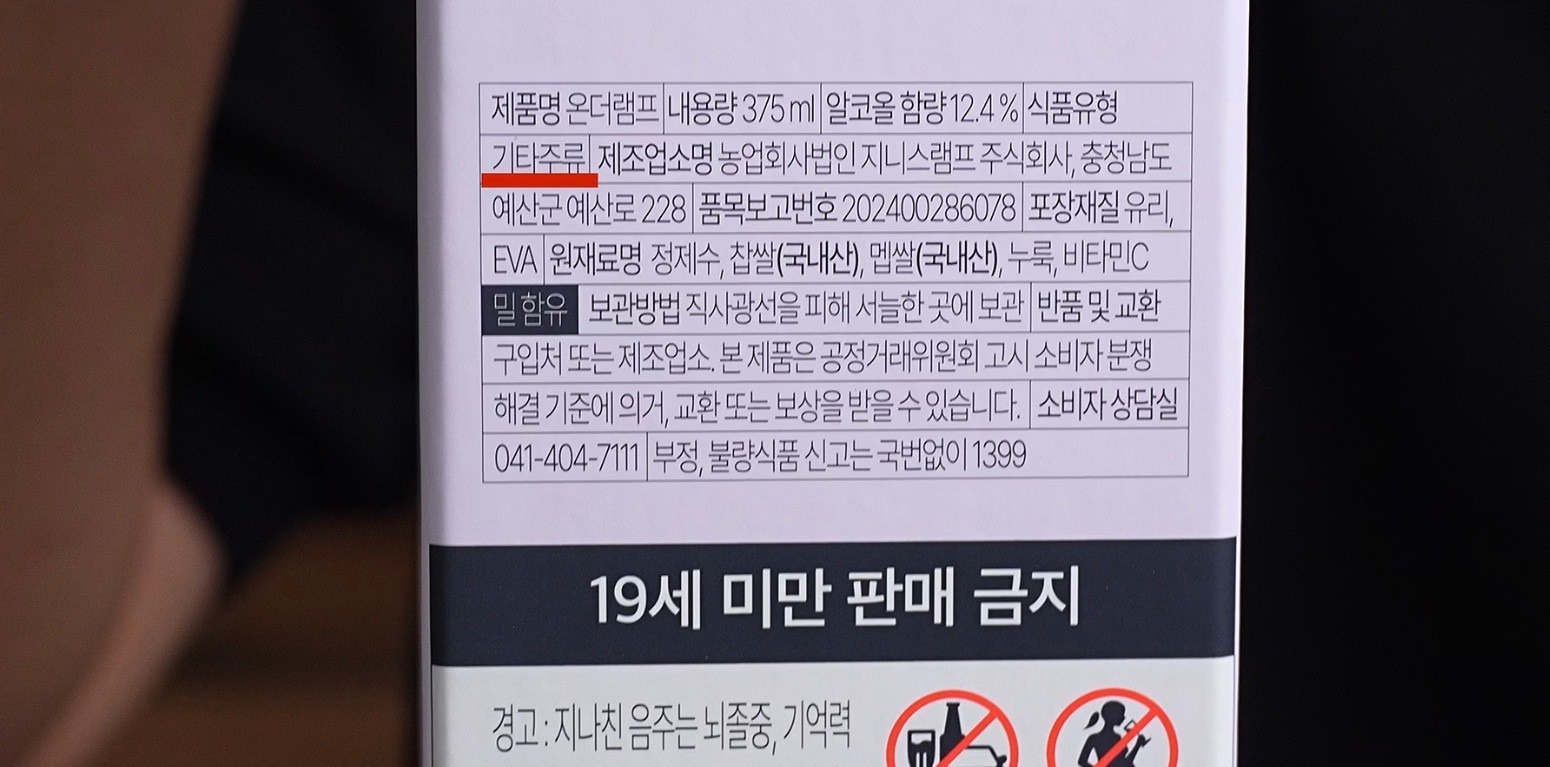
The Food and Drug Code defines yakju as liquor made and filtered from starch-based ingredients, koji, plant-based ingredients, and water, with separate permitted additives including sugars, fruits, and alcohol. Aspartame, lactic acid, and citric acid may be added while still being yakju, but vitamin C is not on the list. When even one unapproved ingredient is added, the liquor becomes "liquor not belonging to fermented liquor," or other liquor. The Food and Drug Administration's notice "Labeling Standards for Foods" mandates consumption deadline labeling for takju and yakju regardless of pasteurization status, while requiring only manufacturing date for seishu, fruit liquor, and other liquor. One line of vitamin C changes the food category, and with the food category changed, the obligation to label consumption deadline disappears.
Same 15 Degrees, Same Pasteurization…Only Yakju Bears a Date
Why manufacturers want to abandon the yakju name becomes clear on retail shelves. Many liquors sold in stores lack consumption deadlines. Wine has antioxidants added and sake undergoes pasteurization in its final process, and both escape date marking because they exceed 12 degrees. Whisky and soju have no dates either. Domestically produced seishu and fruit liquor bear only the bottling date without consumption deadlines. Yet pasteurized yakju of the same 15 degrees that underwent the same heat treatment carries a consumption deadline. Labels of representative traditional spirits like Hansan Sogok-ju read "pasteurized yakju, consumption deadline two years from manufacturing date," while seishu right next to it bears no date. Seishu and yakju differ only in whether koji starter or koji is used as the saccharifying agent; they are essentially the same rice wine.
Even that distinction line is drawn by regulations. Current liquor tax law recognizes only liquor using less than 1% koji relative to rice as seishu, so clear liquor brewed with traditional koji is classified as yakju despite containing no medicinal ingredients. This reflects the colonial-era liquor tax system that distinguished Joseon's clear liquor from Japanese seishu by grouping it as yakju, a system that continues unchanged. The name seishu cannot be used, yakju brewed carries a consumption deadline, and vitamin C must be added for the date to disappear—three paradoxes layered in a single bottle.
The weight of one date line is not light. When a consumption deadline is marked as one to two years, unsold inventory within that period must be discarded, and in overseas distribution networks, it becomes an entry barrier in itself. Only yakju bears the burden that seishu and fruit liquor undergoing the same process do not.
Manufacturer: "Considered the Point of Having No Consumption Deadline"
It was a YouTuber, not the regulator or the National Assembly, who brought this structure into public discourse. The operator of the liquor channel "Spirits Aging House" with 870,000 subscribers published results on the 2nd from directly inquiring with the manufacturer using the label's back-side number. The producer answered by text: "As overseas distribution is an important matter of stability, we utilized vitamin C's antioxidative effect and are also conducting separate pasteurization," and "we additionally considered the point that by being classified as other liquor, there would be no consumption deadline." The video surpassed 3.26 million views as of the 14th.
The operator did not criticize this choice. He said, "Within the current regulatory framework that our law doesn't fit in terms of fairness, they really chose a smart method," and "I would have done the same." He aimed not at the manufacturer but at the regulations. He argued that either "all consumption deadlines should be labeled—seishu, yakju, wine, other liquor—or none should be."
Regulation Loosened in 2010, Reversed When Transferred in 2013
This gap did not exist from the beginning. The Liquor Tax Law Enforcement Decree implemented in July 2010 excluded pasteurized takju and yakju from shelf-life or quality maintenance deadline labeling on grounds that they could be stored long-term. This was a measure by the National Tax Service, regarded as the most knowledgeable agency on liquor, to correct equity with other pasteurized spirits. This exception disappeared when liquor safety management transferred to the Food and Drug Administration in 2013. The Food and Drug Administration's notice lacks the phrase "excluding pasteurized yakju," and manufacturers began marking dates on pasteurized yakju again.
The Food and Drug Administration showed no intention of reversing this. The agency has explained that it marked dates on yakju and takju due to additional fermentation potential during distribution, alcohol content, and packaging characteristics, that a 2016 research project on shelf-life display improvements produced results stating "it is appropriate to mark shelf-life on takju and yakju," and that industry also wanted to maintain this. On the 7th, a Food and Drug Administration official stated, "Currently, the date-marking method is regulated by liquor type" and "we plan to review date-marking improvement measures considering consumer and industry opinions and food safety management." Talk of reviewing was also mentioned in 2016.
National Audit Response: Not Evidence but "Conservatism"
Six days later at the national audit, the Food and Drug Administration failed to present safety grounds. Kwon Chil-seung, Policy Committee Chairman of the Democratic Party (Hwaseong, Gyeonggi Province), pointed out that "a 2010 press release from the Ministry of Economy and Finance included content exempting pasteurized takju and pasteurized yakju from liquor categories requiring shelf-life or quality maintenance deadline labeling," and "yet in 2013, labeling changed to require consumption deadlines for takju and yakju." He added, "Japanese seishu has no shelf life," and "please review ways to prevent regulations from dampening the industry." Fellow party member Lee Su-jin noted, "The shelf-life management improvement research report commissioned by the Food and Drug Administration states that if alcohol content is 10% or higher, microbial contamination or proliferation of fermentation microbes is impossible at that alcohol concentration, making additional shelf-life labeling unnecessary," and "overseas systems also operate by exempting liquor with 10% or higher alcohol content from shelf-life or consumption deadline marking requirements." She added the point that "On the Ramp abandoned the export promotional effect of the yakju image due to consumption deadline marking issues and registered as other liquor."
Commissioner O's answer was three sentences. In 2013, they examined the possibility that microbes could survive better, the shelf-life was "set conservatively," and they would review because "statistics are accumulated." As the commissioner himself said "I understand," no document establishing the 2013 decision's safety grounds was presented at the audit. If they "examined" safety, there should be results from 13 years of observation. The Food and Drug Administration's only output was the 2016 research project, and that research points in the opposite direction from the commissioner's answer.

Safety Rationale Undermined by the Food and Drug Administration's Own Report
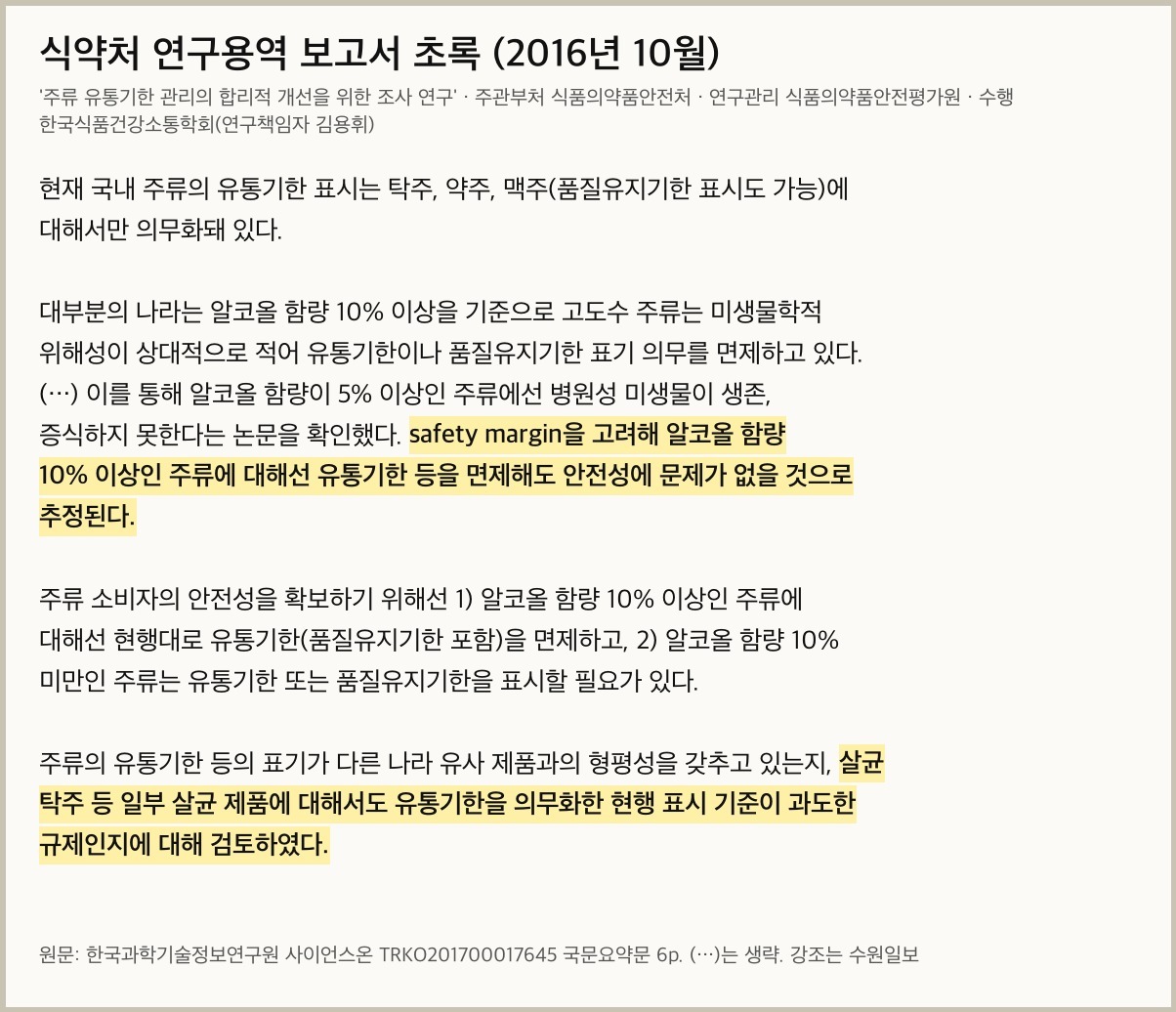
Additional fermentation potential applies to live takju and live yakju with living yeast. However, it does not apply to pasteurized yakju, as demonstrated by the Food and Drug Administration's own research. The "Investigation and Research for Rational Improvement of Liquor Shelf-Life Management" completed in October 2016, commissioned by the Food and Drug Administration, managed by the Food and Drug Administration Evaluation Institute, and conducted by the Korean Food-Health Communication Society (Research Director Kim Yong-hwi), stated in its abstract: "Literature was found confirming that pathogenic microorganisms do not survive or multiply in liquor with 5% or higher alcohol content," and "considering safety margins, liquor with 10% or higher alcohol content is estimated to have no safety issues even with shelf-life exemptions." The conclusion was "liquor with 10% or higher alcohol content should continue to exempt shelf-life, while liquor below 10% should display shelf-life or quality maintenance deadline." The report noted that "it examined whether current display standards mandating shelf-life for certain pasteurized products such as pasteurized takju constitute excessive regulation," and also included international cases: "Most countries use 10% alcohol content as the standard, exempting high-alcohol liquor from microbial hazard risks and exempting shelf-life or quality maintenance deadline marking obligations." Whether pasteurized product regulation was excessive was a question the Food and Drug Administration had already paid to answer 10 years prior. The public recommendation in the very research the Food and Drug Administration cited as justification for maintenance pointed to alcohol content, not spirit type.
This standard is international. The European Union's Food Information Labeling Regulation (1169/2011) Annex X exempts "beverages with 10% or higher alcohol" and wine-category products from quality maintenance deadline marking. On the Ramp is 12.4 degrees. In Europe, such liquor can be sold without dates; in Korea, the yakju name requires date marking. The Food and Drug Administration's own notice does not require dates on seishu, the same pasteurized rice liquor. This means the Food and Drug Administration is not questioning the safety of pasteurized rice liquor.
Thus the vitamin C the manufacturer acknowledged is not a safety loophole but a scene revealing regulatory dysfunction. Two 12-degree pasteurized rice liquor bottles are equally safe. What differs is the last line of the ingredient list and the Food and Drug Administration's standard reading that last line to distinguish "yakju" from "other liquor." Regulation sees names, not risks. Safety remains the same; only the yakju name disappears from the label.
Another opportunity for review existed. When the Food and Drug Administration implemented its consumption deadline system on January 1, 2023, replacing shelf-life display, it required takju and yakju manufacturers to completely reprint labels. It was a complete overhaul, timing the heat marking on the same day. Even in that moment of comprehensive revision, the line "excluding pasteurized yakju" never entered. The Food and Drug Administration missed all three opportunities: the 2013 omission, the 2016 report, and the 2023 comprehensive revision.
Export Answer Reversed Within a Week; That Data Already Exists
The export answer flipped within a week. On the 7th, a Food and Drug Administration official answered that date marking is a hurdle for exports by stating, "Export food must follow the regulations of the importing country." Since the manufacturer added vitamin C for domestic distribution and inventory, not export labeling, this response skirted the issue. On the 13th, the commissioner said, "We will comprehensively review current field opinions and what actual export problems exist, along with safety concerns." The agency that blamed the importing country's regulations reversed within six days to say it would review export issues.
That review results already exist. According to data obtained by Policy Committee Chairman Kwon Chil-seung from the Ministry of Agriculture, Food and Rural Affairs, last year yakju exports totaled $593,000, only 1/58th of other liquor's $34,155,000. Yakju exports fell three consecutive years: $821,000 in 2023, $709,000 in 2024, and $593,000 last year, representing 0.1% of total liquor exports of $356,724,000 last year. Other liquor accounted for 9.5%, takju 4.1%. The statistics clearly show a pattern where liquor closer to traditional methods abandons yakju for other liquor categorization. Chairman Kwon stated, "While sufficiently securing consumer safety, labeling standards should be rationally improved to reduce unnecessary manufacturing and distribution burdens by reflecting changed manufacturing environments and product characteristics."
The "Spirits Aging House" operator said in the video, "I'm not criticizing the Food and Drug Administration; it's more likely they didn't know." The commissioner's response shows this assessment was wrong. The Food and Drug Administration did not overlook it but set it conservatively with knowledge, and neither reviewed that decision when its 2016 report reached opposite conclusions nor when it required complete label reprinting in 2023. What is needed is not new statistics or new research. The phrase "excluding pasteurized yakju" that existed in the 2010 enforcement decree but vanished in the 2013 notice simply needs revival. It took 13 years, 3.26 million video views, and a national audit to extract the word "improvement" from the Food and Drug Administration's mouth. The remaining question is whether the "review" the Food and Drug Administration mentioned will end with a report like 2016 or with a single line in a notice.




Loading comments…