



'When Going Up' and 'When Coming Down'...Changed Meaning of Lee Jae-myung's KOSPI 5000
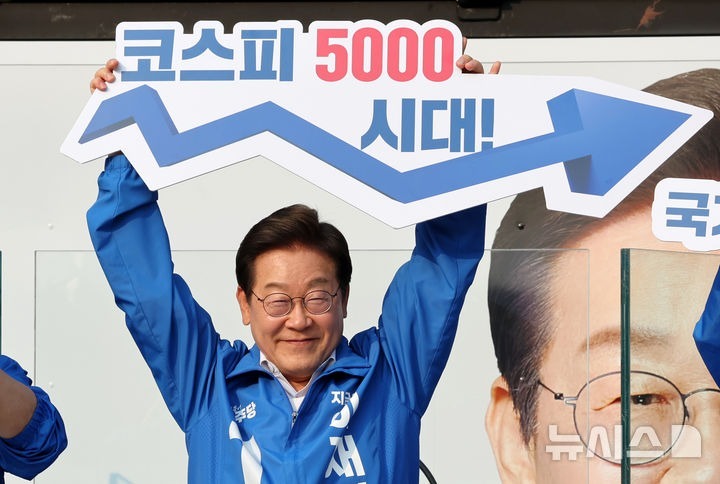
The KOSPI 5000 level, which was President Lee Jae-myung's presidential campaign pledge, barely held up amid U.S.-originated artificial intelligence (AI) shock. However, analysis suggests that the 5000 level breached during the early-year rally and the 5000 level reached again after a sharp decline from the peak have significantly different meanings in the market.
According to the Korea Exchange and others on the 7th, the KOSPI closed at 5,059.69, down 324.11 points (6.02%) from the previous trading day on the 6th.
During the session, the index fell to 4,911.28, breaking through the 5000 line, and a circuit breaker was triggered due to the sharp decline. Subsequently, as buying interest from individuals and institutions flowed in, the index recovered part of its losses, and the 5000 line was maintained on a closing basis.
The problem is that despite the same 5000 level, the market direction is completely opposite.
The KOSPI first broke through the 5000 level in history on January 22. At that time, the KOSPI continued a steep uptrend from the beginning of the year, surpassing the 5000 line during the session, and closed at 5,084.85 on the 27th, establishing itself above the 5000 line on a closing basis.
Just three months earlier, the index, which had been lingering around the 4000 level, rose to new heights, and it was assessed that the president's campaign pledge had become a reality.
Of course, there were crises during the upward process. On February 2, the KOSPI fell to 4,949.67 due to uncertainty in U.S. monetary policy and concerns about global financial market instability.
However, the very next day it rebounded 6.84%, rising to 5,288.08, and subsequently continued its upward trend, breaking through the 6000 level. At that time, the breach of the 5000 line was ultimately close to a temporary adjustment within the uptrend.
In contrast, the 5000 line encountered this time has a different character.
The KOSPI reached a record intraday high of 9,385.59 on June 19 and set a new closing record at 9,114.55 on the 22nd of the same month.
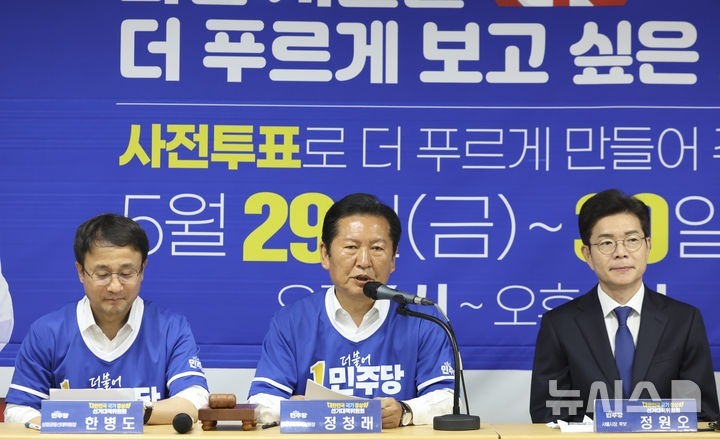
This went beyond a simple economic indicator and connected to political evaluation.
During the June 3 local elections, Jung Cheong-rae, Democratic Party chairman, said at a central election strategy committee meeting on May 29: "If there are those who made profits in their stock accounts as KOSPI rose, or who feel good when looking at their stock accounts, I hope you will vote for Democratic Party number 1."
However, the market subsequently entered a downtrend and began to give back gains. Although rebounds recovering to the 7000 level appeared in September and October, after closing at 7,003.74 on October 2, another sharp decline followed, with the index falling nearly 2000 points in just over a month.
The closing price of 5,059.69 on the 6th represents a decline of 4,054.86 points (44.5%) from the June closing peak. Compared to October 2, it has dropped 1,944.05 points (27.8%).
The KOSPI, which had briefly exceeded the 9000 level, now faces the threat of falling below the 5000 line in just over four months.
Differences also appear in supply and demand.
When the KOSPI broke through the 5000 level in early January, buying interest from foreign investors and institutions supported the index rise. In contrast, on the 6th, foreign investors sold a net 2.769 trillion won in the securities market, while institutions and individuals bought a net 1.704 trillion won and 601 billion won respectively, defending the decline.
Unlike early January when both foreign investors and institutions made joint purchases, the situation has now become one where domestic investors absorb foreign selling volumes and sustain the index.
The direct background to this decline is cited as the sharp fall in U.S. technology stocks.
As concerns about strengthened AI data center regulations following Democratic control of Congress after the U.S. midterm elections spread, the Nasdaq index fell 5.52% and the Philadelphia Semiconductor Index fell 12.25% on the 5th local time.
In the aftermath, in the domestic stock market, Samsung Electronics fell 6.35% and SK Hynix fell 10.44%, with selling pressure concentrated on large semiconductor stocks that had led the index rise.
Nevertheless, the market's perspective on the KOSPI 5000 level has changed.
If the 5000 level at the beginning of the year was a milestone showing how high it could go, the 5000 level at year-end has become a defense line measuring how far it could fall.
Particularly, as the ruling party cited the stock price rise as the Lee Jae-myung administration's economic achievements during the June 3 local elections to appeal to voters' support, the recent sharp stock price decline also has the potential to become a political issue in evaluating the government's economic policies.
Based on this, it is pointed out that the KOSPI 5000, which symbolized the president's achievements, could become a symbol of a different meaning going forward.
A political circle official said, "If the stock market downturn is prolonged, the decline in investors' asset values and the contraction of investment sentiment could affect government approval ratings," and added, "For political stability, the government needs to take market-economy-friendly policy approaches to reduce market uncertainty and restore the trust of businesses and investors."


Loading comments…