



Historical Column October 26: The Light and Shadow Cast by Two Gunshots in Korean History and Their Lessons
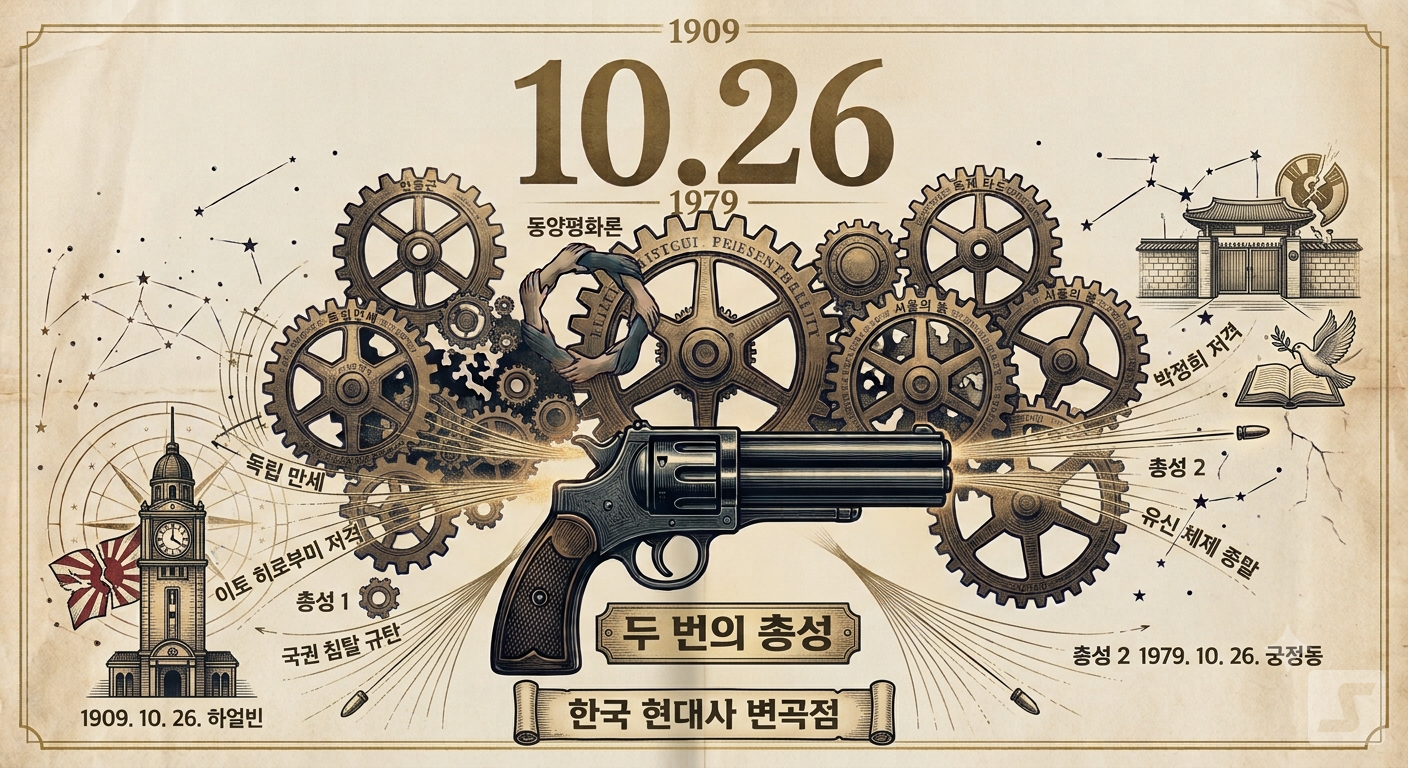
October 26 is an extraordinary yet pivotal turning point in modern and contemporary Korean history, layered with multiple historical transitions. The gunshot that rang out on the platform of Harbin Station in China in 1909 was an event that called out for East Asian peace and independence amid an unprecedented crisis of national sovereignty, and the gunshot at a private residence in Gyeonggi Palace, Seoul 70 years later in 1979 was an event that brought down the curtain on 18 years of authoritarian long-term rule. These two gunshots that resonated on the same date brought profound repercussions to Korean history within entirely different contexts—national sovereignty recovery and political change, respectively.
The Gunshot in Harbin: An Chungeun's Vision and the Theory of East Asian Peace
On October 26, 1909, An Chungeun shot and killed Ito Hirobumi at Harbin Station, who was a symbolic figure of Japanese imperial invasion and the first Resident-General of Korea. This act was carried out amid a phase of national sovereignty dissolution, characterized by the loss of Korea's diplomatic authority and the forced dissolution of the military through the Eulsa Protectorate Treaty (1905) and the Treaty of Taft-Katsura (1907). As an act performed by An Chungeun in his capacity as General and Chief of Staff of the Korean Independence Army, it possessed the character of legitimate armed struggle and military action based on laws of war, rather than mere personal terrorism.
From an ideological perspective, On East Asian Peace, a work An Chungeun wrote while imprisoned, defines this incident as transcending mere retaliation or nationalist violence. He presented a progressive ideal wherein Korea, China, and Japan would cooperate as equals to respond to invasions by Western powers and establish peace in East Asia. This was a pioneering resolve aimed at demonstrating that Ito Hirobumi's claimed "theory of East Asian peace" was in fact nothing more than imperialistic invasion that infringed upon neighboring states' sovereignty.
Though the Harbin Incident failed to immediately halt Japanese imperial invasion of Korea and is noted as having accelerated Japan's harsh policies, culminating in the 1910 Korea-Japan Annexation Treaty, it provided powerful moral and spiritual momentum to independence movements at home and abroad, inspired China's Xinhai Revolution forces and the manifestos of the March First Movement, and fostered a spirit of anti-Japanese solidarity across East Asia.
The Gunshot at Gyeonggi Palace: The End of the Yushin Regime and the Challenge of Democratization
Seventy years after the Harbin gunshot, on October 26, 1979, at a private residence in Gyeonggi Palace, Seoul, Kim Jae-gyu, Director of the Central Intelligence Agency, shot President Park Chung-hee, bringing an abrupt end to the Park Chung-hee regime that had lasted 18 years since the May 16 Military Coup of 1961 and the Yushin regime that was launched in 1972. At the time, Korean society was experiencing extreme political and social conflict, including the YH Trading Incident, the expulsion of Kim Young-sam, the New Democratic Party chairman, and the Busan-Masan Democratic Uprising, with internal fractures in the system reaching their peak.
Historical evaluations of the October 26 Incident remain divergent from multiple angles. On one hand, assessments credit it with providing a physical catalyst for moving toward democracy by ending 18 years of authoritarian long-term rule. On the other hand, it is criticized as a constitutional tragedy and a limitation, as it constituted the assassination of a head of state through gunfire from within the highest seat of power rather than through legitimate parliamentary procedures or civil society's democratic processes, thereby interrupting state affairs.
The most tragic paradox left by this incident is that the dismantling of the Yushin regime did not lead to an immediate establishment of democracy. The neo-military forces that filled the power vacuum inaugurated another authoritarian regime through the December 12 Military Coup and the suppression of the May 18 Democratic Uprising in 1980. The frustration of the "Seoul Spring" brought about by the non-institutional dissolution of power reminds us of the harsh price that must be paid when changes in power are not achieved through legitimate democratic procedures and the power of citizens.
The Message That Two Gunshots Impart to Us Today
The October 26 dates of 1909 and 1979 each resonated with tremendous explosions amid different historical tasks. If An Chungeun's gunshot was a protest aimed at establishing the 'sovereignty of the nation' against foreign invasion, the gunshot at Gyeonggi Palace posed a question about how 'the sovereignty of the people' and democratic procedures should function amid excessive concentration of power.
For historical acts or decisions to be properly evaluated, cold-headed reflection must accompany not only the values toward which the action is directed and the legitimacy of the means, but also its consequences. An Chungeun's feat was premised on a clear cause of East Asian peace and a vision of peace, and the Gyeonggi Palace Incident paradoxically demonstrated the importance of regime change through institutional procedures.
Reflecting upon October 26 today must not merely end in praising and criticizing figures and events of the past. Rather, the true lesson that these two gunshots have left for us today lies in remembering the weight of sacrifice in safeguarding sovereignty while simultaneously affirming that the core values of peace and democracy must be sustained and developed through mature institutions and civic consensus, not through extreme violence.

Loading comments…