



"Greater demands for government, less for municipalities"…the paradox of Gyeonggi Province's finances
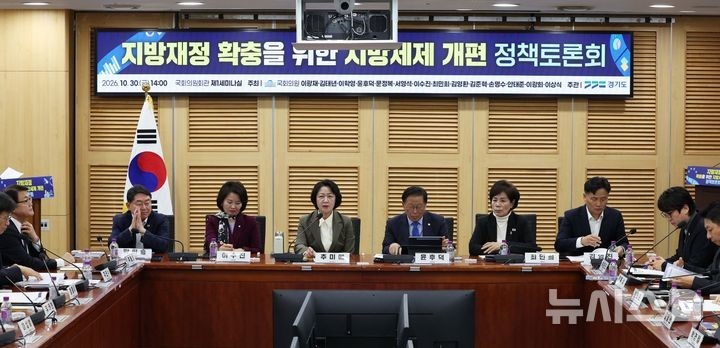
While Gyeonggi Province demands expanded financial support from the central government citing a fiscal crisis, it is simultaneously reviewing reduced provincial subsidies to municipal governments within the province.
According to Gyeonggi Province and municipalities within the province on the 30th, Governor Choo Mi-ae visited the National Assembly on the 27th and met consecutively with Chairman Lee Kwang-jae of the National Assembly Budget and Accounts Committee and Democratic Party Floor Leader Han Byeong-do to request expansion of national responsibility for firefighting finances, reform of the local tax system, and increases in national funds for major projects.
Governor Choo explained that while the province collects 16.1 trillion won in local taxes annually, after allocating 54% to municipal coordination grants, Seoul metropolitan region mutual development funds, and education-related resources, only 46% of available resources can actually be utilized.
In particular, emphasizing the burden of firefighting personnel costs and project expenses, she argued that the nation and local governments should share firefighting costs in a 55-to-45 ratio.
She also proposed phased increases in the local consumption tax rate from the current 25.3% to 40.3% and transferring 5% of the national corporate tax as a regional tax. She also recommended approximately 240 billion won in additional national funding for 10 projects including metropolitan transportation, childcare, and disaster prevention.
Previously, Governor Choo forecasted that the province's available resources next year would decrease by 2 trillion won, from 3.5 trillion won this year to 1.5 trillion won. The position is that maintaining projects and budgets at current levels would be difficult even with local bond issuance and fund utilization.
The problem is that while the province demands financial support from the central government, municipal governments within the province are also concerned about increased financial burdens due to provincial fiscal tightening.
On the 3rd of last month, the province notified 31 municipalities within the province of its policy to apply the standard subsidy rate of 30% in principle to projects whose provincial subsidy rates exceed 30% in next year's subsidy projects.
Based on the figures at that time, 421 projects (43.8%) out of 961 total municipal subsidy projects were found to be affected.
If a 30% provincial subsidy rate is applied to projects that existing provincial and municipal governments had previously split costs equally, municipal burden increases from 50% to 70%.
Based on a total project cost of 1 billion won, provincial burden decreases from 500 million won to 300 million won, while municipalities must additionally secure 200 million won.
Even if provincial support decreases, maintaining existing projects requires municipal governments to compensate for the shortfall, creating a structure where municipalities with limited financial capacity face the prospect of expanded project downsizing or suspension.
In response, the Gyeonggi Province Mayors and Governors Council raised concerns about uniform subsidy rate adjustments that do not consider the fiscal conditions and project characteristics of each municipality and demanded reconsideration.
In the Gyeonggi Province Assembly, concerns were also raised that reduced support for livelihood and welfare projects could lead to increased financial burdens on municipal governments.
As backlash continued, the province explained through a meeting with municipal vice-heads on the 8th that it would apply subsidy rates differentially considering project necessity and fiscal conditions. Related discussions also continued at a meeting between Governor Choo and the Mayors and Governors Council leadership on the 21st.
Financial conflict between the province and municipalities extends beyond subsidy projects.
In August, the province's Financial Innovation Task Force proposed setting a 35% ceiling on the provincial government's burden rate for coordination grants. The aim was to impose certain ceilings on resources distributed to municipalities while reforming the fiscal distribution system by combining national compensation, regional shared needs, and municipal loss ceilings.
Meanwhile, four special-status cities within the province—Suwon, Yongin, Hwaseong, and Goyang—are demanding expanded coordination grants.
The Council of Special-Status City Mayors of the Republic of Korea decided at its regular meeting on August 13th to jointly promote raising the general coordination grant composition standard from the current 47% to 67% and increasing the provincial tax collection payment rate from 3% to 7%.
While the province's Financial Innovation Task Force proposed setting a ceiling on the provincial government's burden for coordination grants, special-status cities maintain that resource distribution should be expanded to match administrative needs.
However, comparing the province's 35% total ceiling and the special-status cities' 67% composition standard is difficult as the calculation methods differ.
Special-status cities' demands have continued recently.
Suwon announced on the 27th that it has secured 27 special-status city affairs including 8 existing ones and 19 new ones to be implemented on June 3rd next year under the Special Law on Support for Special-Status Cities. Including 6 affairs under individual laws, the total is 33.
As a result, the prior approval procedure of Gyeonggi Province for large-scale buildings of 51 stories or more or with a total floor area of 200,000 square meters or more is omitted, and certain metropolitan administrative authority, such as approval of basic remodeling plans for apartment complexes, transfers to special-status cities.
However, separate fiscal privileges were not secured, unlike the transfer of administrative authority.
Suwon explained that it is recommending to the government raising the proportion of coordination grant composition resources from 47% to 67% and increasing the provincial tax collection payment rate from 3% to 10%. If institutional improvements are implemented, the city estimates it could secure approximately 40 billion won in additional annual resources.
Differences in positions over financial authority are also evident in the issue of local tax distribution.
The province has been reviewing a common tax source plan to share and redistribute a portion of corporate local income tax paid by semiconductor companies and other businesses between metropolitan and municipal governments.
The argument is that since provincial finances are invested in semiconductor industrial complex development and metropolitan transportation network construction, it is necessary to reasonably distribute tax revenues concentrated in specific municipalities.
However, regions where semiconductor industries are concentrated, such as Yongin, Hwaseong, Pyeongtak, and Icheon, are opposed.
Yongin Special-Status City Mayor Lee Sang-il opposed the plan to attribute half of the corporate local income tax, a unique tax source of municipalities, to the province, arguing that it weakens the financial autonomy of municipal governments and runs counter to fiscal decentralization.
Hwaseong Special-Status City Mayor Jung Myeong-geun also stated opposition, saying municipal governments' finances are insufficient and he opposes taking existing tax sources. The Icheon City Assembly also adopted a resolution opposing the common tax source plan in August.
Suwon Special-Status City Mayor Lee Jae-jun opposed the method in which the province takes half of existing tax revenues and instead proposed alternatives such as utilizing increases in the corporate local income tax rate or creating a joint fund among semiconductor-related local governments.
In fact, the province's Financial Innovation Task Force also had divided internal opinions on the corporate local income tax common tax source plan and did not include it in the final priority tasks.
The firefighting finance issue the province demands from the central government and the financial authority issue municipalities raise to the province have in common the distribution of administrative authority and cost burdens.
Although firefighting personnel became national civil servants in 2020, the province is demanding improvement of the structure where it bears a significant portion of firefighting personnel costs and facility and equipment expenses.
Meanwhile, municipalities question who would bear the costs if provincial support decreases or metropolitan administrative authority is transferred.
Of course, the province itself bears substantial costs from metropolitan administration such as metropolitan transportation, firefighting, and welfare. If coordination grants and provincial support are expanded, the province's financial capacity decreases, and the impact of fiscal privileges for special-status cities on resource distribution to other municipalities must also be considered.
Ultimately, the issue remains how the province, which demands fiscal decentralization from the government, will divide financial burdens with municipal governments within the province that make similar demands.
Related to this, Governor Choo stated at a meeting with the Mayors and Governors Council leadership on the 21st that the provincial subsidy rate was not uniformly determined, and that it can be individually reviewed and modified through consultation considering municipalities' conditions and project priorities.
Governor Choo also emphasized at the local tax system reform policy forum for expanding local finances held at the National Assembly: "This is not a problem unique to Gyeonggi Province. Local governments must have a financial foundation befitting their role so they can take responsibility for residents' lives and prepare for the region's future".
Loading comments…