



Choi Hyung-guk's Swordsman's Tale (19) The Swordmaster Baek Dong-su of Joseon Meets King Jeongjo
Ya-noe (野餒) Baek Dong-su (白東脩): The Reality of a Rough and Starving Swordmaster
When times turn dark, one yearns for exceptional people. When good people gather and pursue good endeavors, a good world opens. When a king recruits talented individuals and implements good policies, the people's lives improve. Yet creating such a truly good world is difficult. It was the same in the Joseon period. If people fail to recognize the value of talented individuals, every era becomes equally burdensome.
Immediately upon ascending the throne, King Jeongjo compiled a military treatise called "Byeong-hak-tong" (兵學通) in 1776 to reform military training. It embodied his wish that soldiers of the Five Military Camps (오군영), the central military forces of late Joseon, would be unified through more stable tactical training. However, when attempting to implement unified tactical training, he discovered that individual soldiers possessed varying levels of martial arts proficiency. Naturally, the next step was to unify the martial arts that individual soldiers needed to master. Thus in April 1790, "Muye-dobo-tongji" (武藝圖譜通志), a martial arts manual designed to standardize the martial arts practiced by soldiers, was created.
The swordmaster responsible for the practical martial arts instruction at that time was Ya-noe (野餒) Baek Dong-su (白東脩). The pen names (號) used by people in Joseon carried much meaning. Among them, the name that best expressed Baek Dong-su was "Ya-noe (野餒): wild (野) and starving (餒)," meaning a person who would not bend his will even while starving in the rough wilderness. It aligned with his other pen name "In-jae (靭齋)," suggesting resilience and toughness...
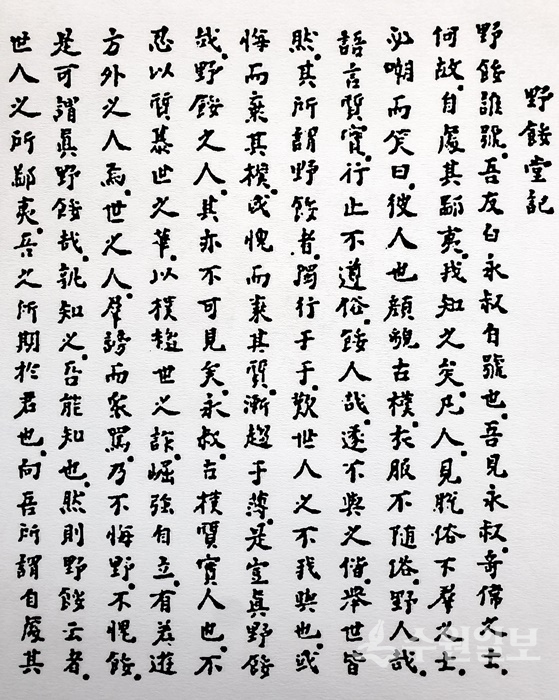
Baek Dong-su's relationship with Yi Deok-mu was that of brother-in-law and brother-in-law by marriage. Cheong-jang-gwan Yi Deok-mu, who married Baek Dong-su's elder sister, explained in his collected writings with a short essay titled "Ya-noe-dang-gi (野餒堂記)" the true meaning of his pen name. Although both were of humble illegitimate yangban origins, one can glimpse how they deeply empathized with each other's lives.
"Who does the pen name Ya-noe (野餒) belong to? It is the self-chosen name of my friend Baek Young-suk (白永叔; Young-suk being the courtesy name of Baek Dong-su (白東修)). Observing Young-suk, he is a remarkable and excellent scholar, yet why does he deliberately present himself as foolish and base? I know the reason for this. Generally, when scholars see someone who departs from worldly conventions and does not mingle with the crowd, they inevitably mock them, saying: 'That person's face is pure and simple, his clothing does not follow worldly fashion, so he is surely a wild man (野人). His speech is crude and sincere, his conduct does not follow worldly fashion, so he is surely a starving man (餒人).' For such reasons, they do not deign to associate with such a person.
Since the entire world is thus, the one called 'Ya-noe' acts alone and suffers difficulties, and sighs and regrets that worldly people do not wish to associate with him. Many discard their simplicity or feel shame, abandon their sincerity and gradually pursue what is shallow—how could this be truly Ya-noe? A truly Ya-noe-like person is hard to find.
Young-suk is a person of ancient simplicity and sincerity, so he does not covet the world's splendor through sincerity, nor does he follow the world's deceitfulness through simplicity, standing firm and upright as if wandering in another world entirely. Therefore, even though all worldly people criticize and disparage him, he does not regret his wildness in the slightest nor feel shame in his starvation—is this not what can be called truly Ya-noe? Who else would understand such a thing? Only I understand it well, so when we speak of 'Ya-noe,' though worldly people regard it as contemptible, I harbor hope for you without abandoning it, waiting with such heart."
Baek Dong-su was a "wild man (野人)" and a "starving man (餒人)." He resembled a seeker of truth walking alone through rough fields, enduring hunger. In some ways, he reflected the sorrowful reality of his time. The sorrow of being half a yangban, of being illegitimate, would not have been forgotten even in death.
His great-grandfather was Baek Si-gu (白時耉), a renowned general who served as provincial military commander of Hamgyong, Hwanghae, and Pyongan provinces. His grandfather was Baek Sang-hwa (白尙華), who was born of a concubine. Naturally, his father Baek Sa-hong (白師宏) was also illegitimate, as was Baek Dong-su. That blood was hereditary, and that bondage naturally gave rise to "Ya-noe (野餒)."
Sometimes Separation Brings Opportunity
In 1771 (the 47th year of King Yeongjo's reign) at the age of twenty-nine, Baek Dong-su passed the regular military examination (식년무과). However, the world recognized him not at all. Clutching only his examination certificate, he waited for the day to enter official service, but the world offered no opportunity. Thus Baek Dong-su quietly departed with his family to the Kilin Gorge in Inje, Gangwon Province, hoping to shake off, at least temporarily, the burdensome chains of the world.
A wandering life is filled only with regret. Yeonam Park Ji-won (연암 박지원), the mentor-figure of the Baek-tap School who knew Baek Dong-su's abilities better than anyone, heard this news and left behind a brief letter. Reading it, deep sorrow permeates every word.
"In-jae (靭齋) Baek Dong-su (白東修) is descended from a general's house. Among his ancestors, there were those who dedicated themselves to loyalty and sacrificed their lives for the nation, and to this day literati grieve for him. Baek Dong-su writes seal script and clerical script well, is thoroughly familiar with protocols and institutions, and at a young age proved an excellent horseman and archer, passing the military examination. Though he has not enjoyed the fortune of the times to gain rank and position, his determination to remain loyal to the king and die for the nation proves worthy of inheriting his ancestors' achievements, bringing no shame to the literati.
Alas! Why should such a Baek Dong-su now depart to the lands of Gangwon with his entire household? Baek Dong-su once surveyed a homestead for me at Yeonam Gorge (燕巖峽) in Geumcheon (金川), Hwanghae Province, a place where the mountains run deep and the paths are treacherous, where one could walk the entire day without meeting another soul. Standing together in the reeds, we set boundaries with our words and raised our whips, dividing that high ridge, saying, 'There we could build a fence and plant mulberry trees; if we set fire to the reeds to till the fields, we could harvest a thousand bushels of millet in a year.' Testing this notion, we struck a flint and set the fire to the wind's course—pheasants cackled in alarm and flew away, and a young deer fled right before us. Rolling up my sleeves, I chased after them until a stream blocked my way and I turned back, when Baek Dong-su looked at me and laughed, saying, 'Human life lasts not even a hundred years—why settle morosely between trees and stones, farming millet and hunting pheasants and rabbits?'
Now Baek Dong-su says he will live at Kilin Gorge, carrying a calf on his back to raise it to till the fields, and lacking even soy paste, he will make soy sauce from caperberries to eat. In its roughness and remoteness, how could it be reckoned the same as Yeonam Gorge? And yet I myself am now wandering at a crossroads, unable to decide my course decisively—how much less can I dissuade Baek Dong-su's departure? Rather, I regard his determination as admirable, not viewing his poverty with sorrow.
That his departure is such as to merit sorrow, yet I view it not with sorrow—from this one can infer that there exists in one who cannot depart cleanly a circumstance all the more worthy of sorrow. The pitch is bold and grand, as if hearing the sound of a zither played by Gao Jianli (高漸離)."
—A preface presented to Baek Dong-su entering the mountain valley of Kilin-myeon (麒麟面), Inje—
<From "Yeonam-jip (燕巖集)" Volume 1, Yeonhyang-gak Selected Edition (煙湘閣選本)>
A skilled individual recognized even by Park Ji-won. Baek Dong-su, whose literary talent was outstanding and whose martial arts skill was even more exceptional, faded from the world like his pen name "Ya-noe (野餒)." Without need of further lengthy explanation, the exchange of letters between them suffices to convey complete understanding.
The person who ended Baek Dong-su's self-imposed seclusion and brought him back to the world was none other than King Jeongjo. Of course, the genuine and sincere recommendation by his brother-in-law Yi Deok-mu must have played a role as well. Thus Baek Dong-su became an early commander of the Jangyong Camp (장용영) and worked with his friends on "Muye-dobo-tongji" (武藝圖譜通志), Joseon's final martial arts manual. How thrilling such an opportunity must have been! For the world becomes a blessed life simply because someone recognizes one's worth. That is enough.
Loading comments…