



Choi Hyung-kook's Sword (27) The Black Dragon's Tail Swing in Hyeop-do and the Cicada-Cutting in Weol-do
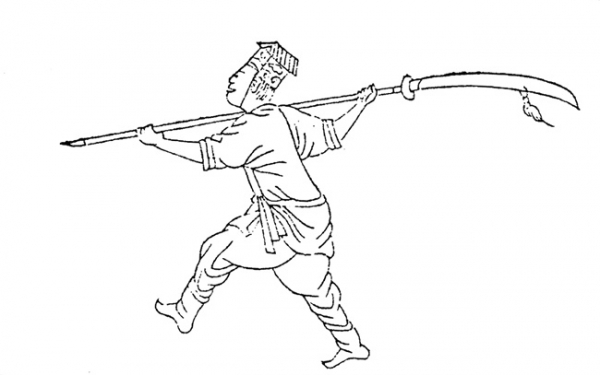
- Interesting Metaphors Embedded in Martial Arts Stances
A praying mantis front-leg attack! An eagle's talons raised!
This is one of the lines frequently heard in classic Chinese martial arts films. The Tanglangquan (螳螂拳), or Praying Mantis Fist, named after resembling the hunting movements of a praying mantis, and Yingzhaoquan (鷹爪拳), or Eagle Claw Fist, a representative form derived from how eagles use their talons to catch prey, are typical Chinese martial arts evoking insects and predatory birds. Interestingly, among the 24 martial techniques recorded in the Muye Dobo Tongji (武藝圖譜通志), many stances incorporate such metaphors and symbolic references.
There exists a martial art called 'Hyeop-do (挾刀)' in the Muye Dobo Tongji. Hyeop-do resembles a blade attached to a long handle. Initially, Hyeop-do was distributed under the name Hyeop-do-gon (夾刀棍). After the publication of the Muye Jebo (武藝諸譜), the Muye Jebo Beonyeok Sok-jip (武藝諸譜飜譯續集) was published in 1610 (Year 2 of King Gwanghae's reign) as a reinforcement of military martial arts, and it is recorded therein.
This martial arts manuscript compiled martial arts, including boxing (拳法) and Japanese swords (倭劍), which had been continuously trained as anti-Japanese warfare tactics during the Imjin War but had not been formally organized in specific forms. Additionally, large blade-type weapons such as the Blue Dragon Halberd (靑龍偃月刀) and Hyeop-do-gon (夾刀棍) were added as part of anti-Hu defensive tactics (防胡) to counter the well-mounted cavalry forces from the north.
Hyeop-do (挾刀) retained the characteristics of Jang-do (長刀), a cavalry defense weapon from the early Joseon period, which connects to the characteristics of Hyeop-do-gon (夾刀棍) and Hook Spear (鉤槍), established for cavalry defense after the Imjin War. These weapons were used to cut the legs of approaching enemy cavalry horses and to use hooks attached to spear tips to drag mounted cavalry officers off their horses.
Two key martial characteristics define Hyeop-do. First, like Hyeop-do-gon, Hyeop-do centers on 'il-ja (一刺)', the basic spear technique of thrusting. The movements of Hyeop-do were created drawing motifs from spear techniques centered on thrusting.
Second, there is the intentional sophistication and bilateral symmetry of Hyeop-do forms that evolved after the 18th century. In particular, 'yin-yang hand (陰陽手)', a unique characteristic appearing when using long-handled grips, manifests regularly and symmetrically. This symmetrical characteristic can be viewed as an expression of modern body consciousness aimed at achieving balance in physical activity during form composition.
Left-right symmetrical training emerged as a phenomenon through the establishment of modern body concepts for balanced individual physical development. The modern nature of body culture can be observed in Hyeop-do forms and training methods established in the late Joseon period. Through analysis of Hyeop-do stances, one can discuss the awareness and emergence of the so-called 'modern body'.
Among Hyeop-do stances, there is a posture called 'Uurongpamiise (烏龍擺尾勢)', or Black Dragon Tail Swing Stance. This movement is called 'joa-hui-mi (左揮尾)', swinging the mi (grip end) toward the left to strike the opponent. It corresponds to a posture in which the thrust Hyeop-do is withdrawn and the lower part, namely the bun (grip end) section, is swung diagonally to strike. It pairs with the 'Dan-bong-jeon-si-se (丹鳳展翅勢)' to the rear (Left Swing Tail / Right Swing Blade). It resembles the motion in bayonet techniques of striking sideways with a rifle butt. The 'Uurong (烏龍)' appearing in this stance serves as a metaphor for a dog. Thus, when instructing Hyeop-do, the author occasionally explains this as the 'dog tail-swinging' stance.
Uurong (烏龍) is the name of a loyal dog appearing in the story of Zhang Ran (張然) from the Chinese tale collection Soushen Ji (搜神記). During the Jin Dynasty of ancient China, Zhang Ran, who lived in the Kuaiji region in southern Zhejiang Province (near Shohong County), was conscripted for forced labor and left his home for a time. During his absence, his wife became involved with a servant, and fearing discovery upon his return, the servant plotted murder. Fortunately, a dog named 'Uurong (烏龍)' that Zhang Ran kept threw itself in front of the servant and saved its master from death.
Subsequently, in China, loyal dogs came to be called 'Uurong (烏龍)'. For this reason, in other historical records, Uurong also symbolized loyal dogs. According to the entry on "Dogs (狗)" in Bencao (本草), it is said that in common parlance, dogs were called 'hui (휘)' and 'yong (용)'. And in volume 20 of the Dongguok Isang Guk Jeonjip (東國異象國傳集), in the miscellaneous writings section on rhyming language, in the <Decree to Ban'ao (班獒)>, dogs are described as follows:
'You have patterns in your fur—are you descended from Pan Hu (槃瑊), hero of Chinese mythology regarding the ancestors of southern tribal peoples, the name of a fierce dog kept in the imperial palace? You are nimble and clever—are you a descendant of Uurong (烏龍), the name of a loyal dog appearing in the Soushen Ji (搜神記))? Your paws are bell-like, your snout jet black, your joints are broad, and your sinews are taut. Your affection in yearning for your master is touching, and your responsibility in guarding the gate is admirable. For these reasons, I regard your valor with respect and cherish your spirit, keeping you at home with favor. Though you are a lowly beast, you have received the essence of the Big Dipper, so who among all creatures compares to your wisdom and intelligence? Your master has commands for you—so perk up your ears and listen. If you bark constantly without restraint, people will not fear you, and if you bite indiscriminately, you will bring calamity.'
Moreover, Bai Juyi (白居易: 772-846), a poet of the mid-Tang Dynasty, wrote, 'The black dog lies undisturbed (烏龍卧不驚), and blue crows fly in succession (靑烏飛相逐).' depicting the relaxed appearance of a dog resting comfortably as an ordinary scene of a languid spring day.
-Cicada-Cutting on a Moonlit Night in Weol-do
There is a martial art that stands as an equal to Hyeop-do: Weol-do. Weol-do received its name because the shape of its blade resembles a crescent moon. Weol-do was first trained in the Joseon military beginning when it was disseminated by Ming forces during the Imjin War. Subsequently, during the reign of King Gwanghae, it was officially distributed to military camps when recorded in the Muye Jebo Beonyeok Sok-jip (武藝諸譜飜譯續集).
Examining Weol-do in official historical records following the Imjin War, it appears in a memorial (啓文) from the 5th year of King Injo's reign (1627), in which six instructors from the Huryungdogam were transferred to the Eoyeongcheong to conduct martial arts training. At that time, the Eoyeongcheong lacked qualified personnel to teach new martial arts, and thus found it necessary to recruit instructors from the Huryungdogam to train Eoyeongcheong soldiers.
The content is as follows:
The Eoyeongcheong reported, "On the 25th of this month, when Chief Administrator Yi Seo (李曙) presented a night audience, there was a direct royal order that among the Eoyeong troops, elite soldiers be selected to practice the techniques of short weapons such as iron hammers (鐵椎), crescent moon blades (偃月刀), and whip-staffs (鞭棍). We consulted with General Commander Kim Ja-jeom (金自點) and began to select and instruct them. However, the techniques of crescent moon blades and whip-staffs can only be taught if there are instructors. We request that six skilled instructors from the Huryungdogam be exempted from normal duties and transferred, to conduct mutual rotation training limited to the period until the soldiers are dismissed and return." In this manner, instructors dispatched to other military camps demonstrated that the martial arts proficiency of Huryungdogam soldiers was superior in the late Joseon period.
Among the stances of Weol-do, there is 'Weol-ya-cham-seon-se (月夜斬蟬勢)'. Translated literally, it means 'the stance of cutting a cicada on a moonlit night'. However, this stance is explained as 'using the right hand and left leg to strike twice (以右手左脚 再叩)'. Striking twice with the Weol-do refers to continuous downward striking motions.
Here, the cicada (蟬) symbolizes rebirth or immortality. With the Weol-do, the cicada, an insect symbolizing rebirth (再生), is struck twice in succession (再叩). An identical stance appears in the whip-staff, likewise featuring a movement of striking or hitting twice (再叩).
The cicada, through its transformation from a nymph that emerges from the ground, sheds its shell, spreads its wings, and becomes an adult, has been primarily used in Buddhism as a symbol of 'liberation'. Taoism accepts it as a symbol of 'rebirth' because it sheds its shell and obtains an entirely new body. In Confucianism, too, the cicada was regarded as a symbol of virtue and integrity.
Particularly in ancient China, the cicada was understood as signifying resurrection and rebirth. Most notably, jade cicada ornaments called Yu-seon (玉蟬) were widely used. Generally, the form attached to hats is called Guan-seon (冠蟬), those worn or attached to clothing are called Pei-seon (佩蟬), and those placed in the mouths of the deceased to signify resurrection are called Han-seon (含蟬). All these jade cicadas carry meanings of rebirth and eternal life.
In this manner, attacking a cicada that has been reborn is conveyed metaphorically in the stance name. Without understanding the culture of that time, one cannot comprehend the original meaning of martial arts stances. Besides these, in Japanese sword techniques, there are stances such as 'Mountain Shower (山時雨)', instructing rapid attacks like sudden downpours in mountains, and 'Meteor Descent (流星出) Left Strike (左一打)', slashing diagonally swiftly like a shooting star.
In this way, martial arts stances also incorporate the metaphors and similes found in poetry. In some sense, is not our human life itself like a piece of poetry? Let us live today like a poem.
Loading comments…