



46.2% of Suwon Citizens Say City Is "Like a Hometown Despite Not Being Born There"
[Suwon Ilbo=Reporter Jung Jun-sung] Nearly half of Suwon citizens perceive the city as a hometown despite not being born there, and they trust public institutions more than their neighbors, according to a survey.
The results come from an online survey conducted by the Suwon Metropolitan Institute of Research (Director Kim Sung-jin) over five days starting November 18 last year, with 1,703 respondents from a citizen panel of 3,307 participating in the "Survey on Suwon Citizens' Residential Awareness, Social Trust, and Inclusivity."
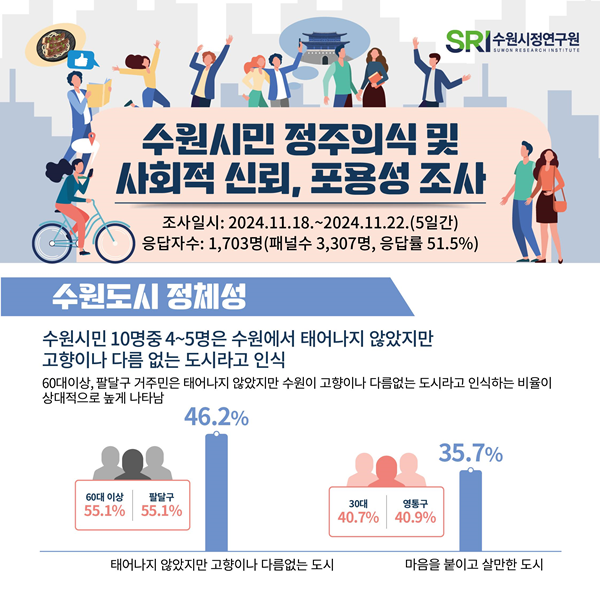
When asked about residential awareness regarding "what kind of city Suwon is," 46.2% responded that it is "a city like a hometown despite not being born there," the highest percentage.
This was followed by "a city worth settling down in" at 35.7%, "city where I was born and raised" at 13.4%, "a city I want to leave if I had the chance" at 2.5%, and "a city where I'm temporarily staying" at 1.9%.
In detail, the response "a city like a hometown despite not being born there" was higher among males (48.1%), those in their 60s and older (55.1%), those in their 50s (53.4%), and by district in Paldal-gu (55.1%) and Yeongtong-gu (44.7%).
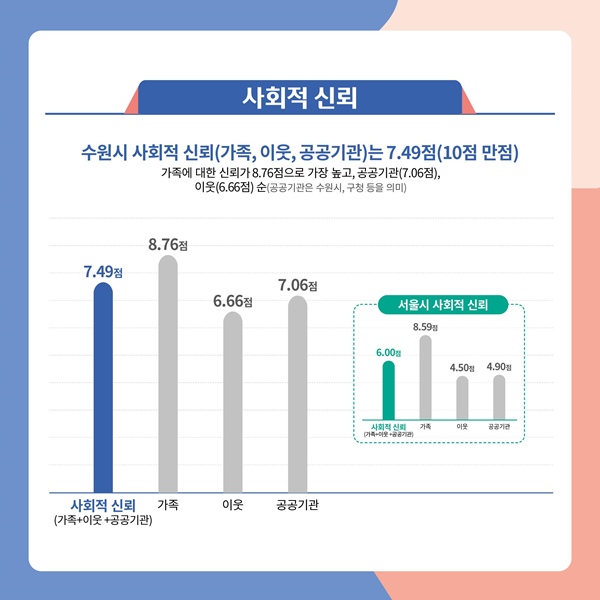
Suwon citizens showed greater trust in public institutions than in their neighbors.
In the survey asking "how much do you trust people or institutions," Suwon citizens' social trust scored 8.76 out of 10 for family, the highest. This was followed by friends (8.01 points), public institutions such as city hall and district offices (7.06 points), neighbors (6.66 points), foreign residents in Suwon (5.69 points), and people met for the first time (5.47 points).
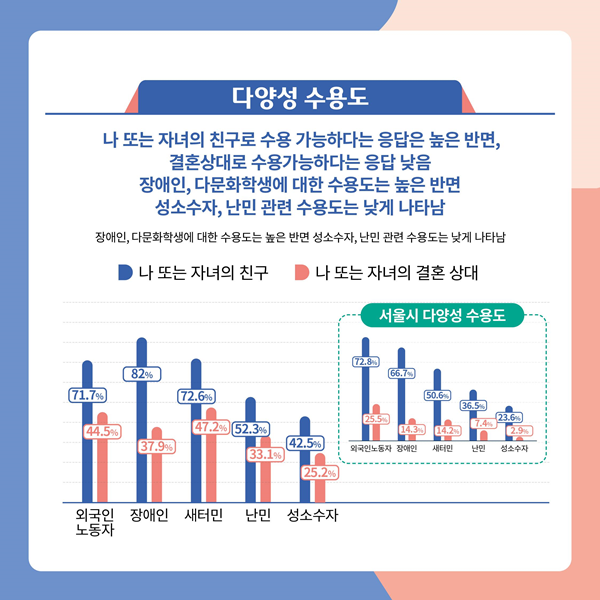
About three out of four Suwon citizens believe they could accept foreign workers and migrants as neighbors or friends.
In a survey measuring diversity acceptance regarding living as neighbors or friends of oneself or one's children, multicultural students (82.2%), people with disabilities (82.0%), foreign migrants (76.4%), North Korean defectors (72.6%), and foreign workers (71.7%) showed positive perceptions in that order.
On the other hand, regarding potential marriage partners for oneself or one's children, multicultural students (63.9%), foreign migrants (54.7%), North Korean defectors (47.2%), and foreign workers (44.5%) were seen in that order.
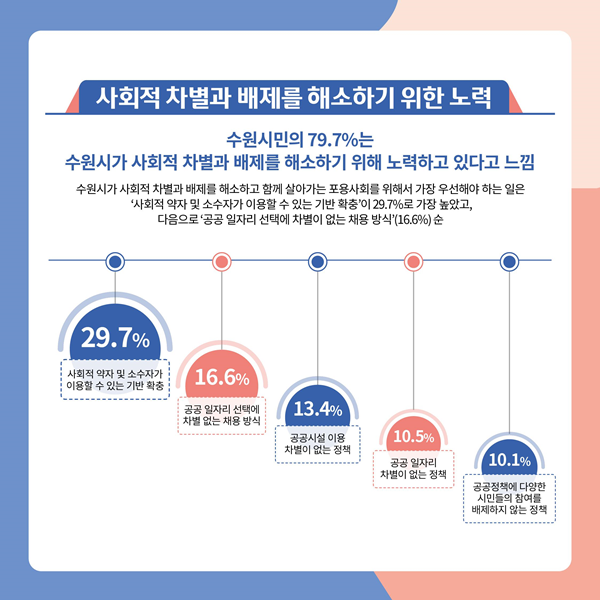
Regarding Suwon city's efforts to eliminate social discrimination and exclusion, 79.7% of citizens evaluated that the city is making efforts. Conversely, 20.3% assessed that the city is not making efforts.
Regarding what Suwon should prioritize to create an inclusive society, "expansion of infrastructure facilities available to socially disadvantaged and minority groups (29.7%)" was the top response, followed by "non-discriminatory hiring methods for public jobs (16.6%)," "policies ensuring no discrimination in use of public facilities (13.4%)," "policies ensuring no discrimination in public jobs (13.4%)," and "policies that do not exclude diverse citizens' participation in public policy (10.1%)".
Kim Sung-jin, director of the Suwon Metropolitan Institute of Research, stated, "Through this survey, we were able to confirm Suwon citizens' high residential awareness, social trust, and diversity acceptance," adding "We will make greater efforts in various policy monitoring to enhance citizens' pride while expanding social trust, diversity, and inclusivity."

Loading comments…