



Analysis Hwaseong Gets 'A,' Suwon Gets 'C,' Seongnam Gets 'D'...Population Report Cards for Gyeonggi Province's 31 Cities and Counties
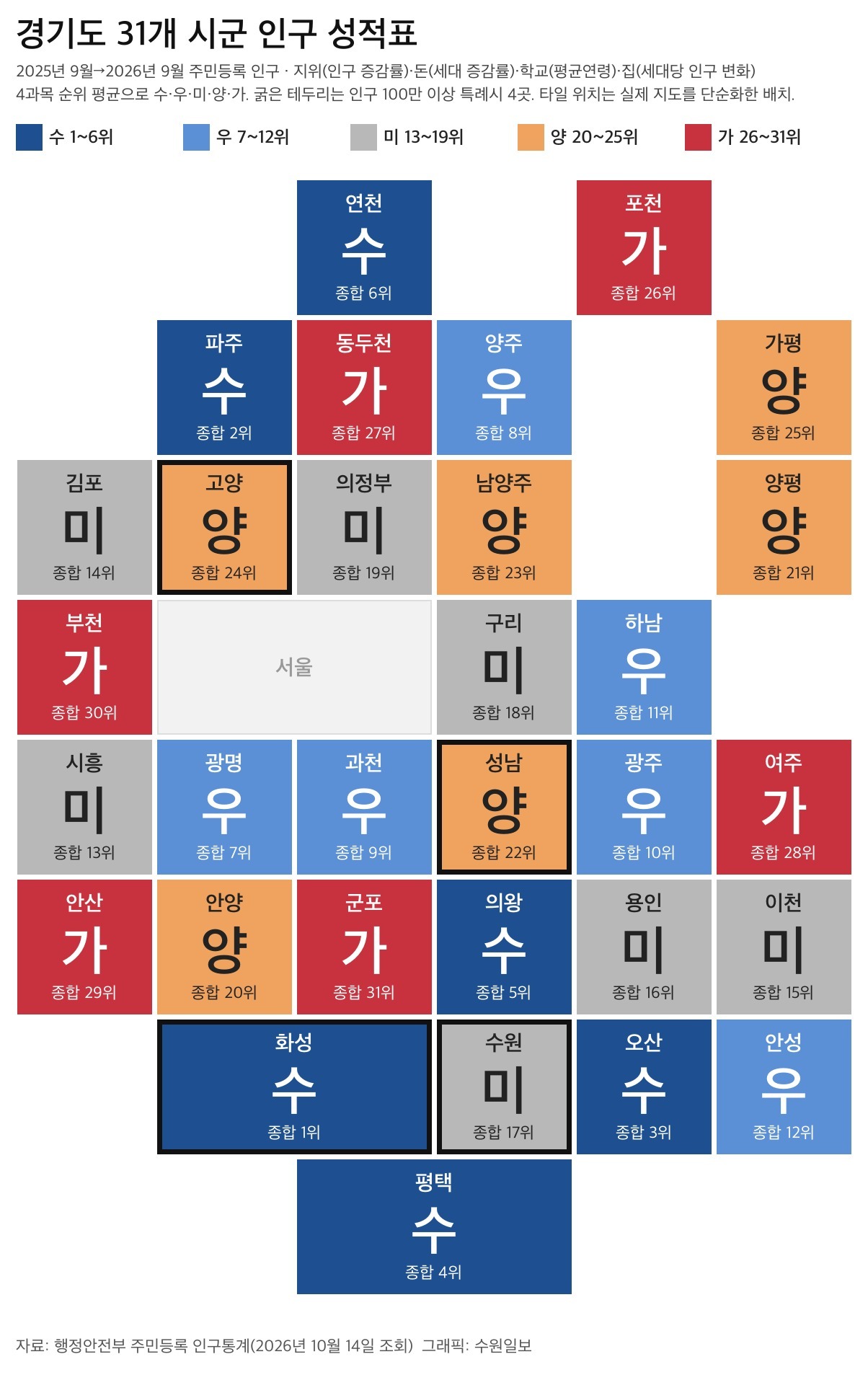
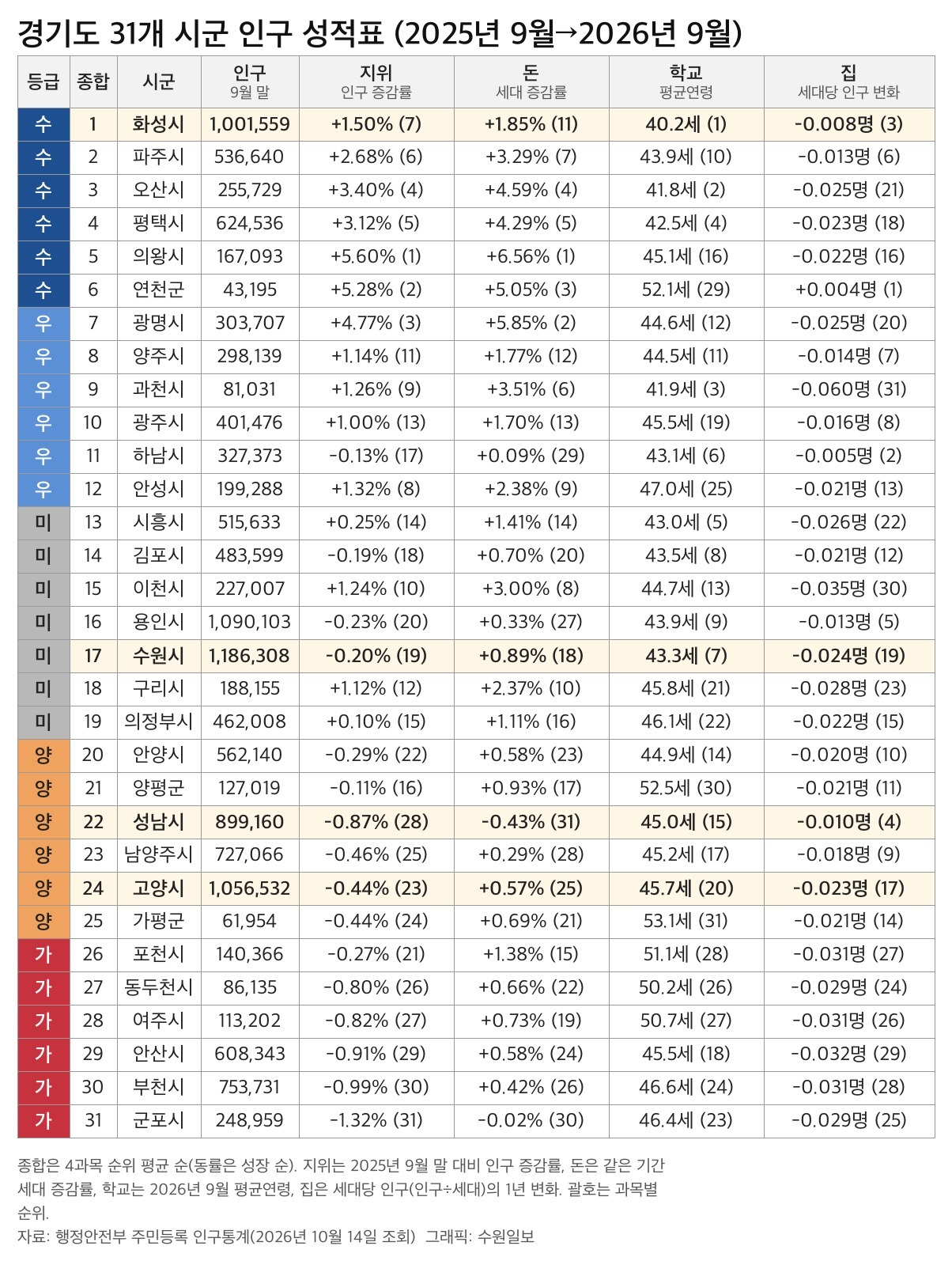
We've graded the one-year population report cards for Gyeonggi Province's 31 cities and counties. Using Ministry of Interior and Safety registered population statistics from September 2025 to September this year—13 months total—we scored them on four subjects: status, finances, schools, and housing. Six received A's, and six received F's. Among the four cities with over 1 million residents, only Hwaseong received an A. First-place Suwon scored C (17th), third-place Goyang scored D (24th), and fifth-place Seongnam scored D (22nd). The ranking has remained the same for a year—Suwon, Yongin, Goyang, Hwaseong, Seongnam—yet the grades below the rankings diverged like this.
Why is population a grade?
Population numbers change four things. First, a city's administrative status changes. The Local Autonomy Act designates cities with populations over 1 million as special cities and those with over 500,000 as cities eligible to establish district offices. Second, a city's finances change. General transfer taxes are allocated by population, individual resident tax is assessed by household, and depopulated regions receive local population decline response funds. Third, schools change. Young neighborhoods lack classrooms; aging neighborhoods lack school enrollment. Fourth, housing changes. New apartments bring people; without new apartments, families break apart and only households increase.
So there are four subjects. Status is measured by one-year population growth rate, finances by one-year household growth rate, schools by average age as of September this year, and housing by how much less the population per household decreased over a year. We averaged subject-by-subject rankings and divided the top six as A, next six as B, next seven as C, next six as D, and final six as F. A grades went to Hwaseong, Paju, Osan, Pyeongtaek, Uiwang, and Yeoncheon; F grades to Pocheon, Dongducheon, Yeoju, Ansan, Bucheon, and Gunpo. The complete table is at the end of the article.
Status: Uiwang ranks first, Gunpo last, only Hwaseong crossed the threshold
Uiwang leads in growth rate. A year ago it had 158,229 residents; now it has 167,093—a 5.60% increase. Yeoncheon (5.28%), Gwangmyeong (4.77%), Osan (3.40%), Pyeongtaek (3.12%), and Paju (2.68%) follow. By raw numbers, Pyeongtaek added the most at 18,911 people, followed by Hwaseong (14,847), Paju (13,986), and Gwangmyeong (13,816). Gunpo ranks last, declining 1.32% to 248,959, with Bucheon (-0.99%), Ansan (-0.91%), and Seongnam (-0.87%) above it. By raw numbers, Seongnam lost the most at 7,908 people.
Status is determined by thresholds. Hwaseong surpassed 1 million residents in January 2024 when including foreigners, becoming a metropolitan city in January this year and opening four district offices—Mansei, Hyo-haeng, Byeongjeom, and Dongtan—in February. It was in August of this year (1,000,464 residents) that it first exceeded 1 million in pure registered population, reaching 1,001,559 by late September. Gwangmyeong's population fell below 300,000 in December 2020, but recovered to 300,000 in February this year after redevelopment projects—the first recovery in 5 years and 2 months.
Seongnam crossed the threshold in the opposite direction. By late September, it had 899,160 residents, falling below 900,000 for the first time in August (899,806), and has remained below that mark for two months now. The departing areas are Jungwon-gu (-6,844 people) and Bundang-gu (-3,287 people). A city that stood at 996,524 residents in 2010, just shy of 1 million, has fallen below 900,000 for the first time in 16 years. Seongnam previously demanded a revision of the 1 million standard, arguing that administrative demand reached 1.4 million when including industrial park workers and foreigners, but failed to qualify while Suwon, Yongin, Goyang, and Hwaseong took turns becoming metropolitan cities. Mayor Shin Sang-jin said in 2024, "Is population growth really that important?" The numbers moved in the opposite direction, and Seongnam ranks 28th in this subject.
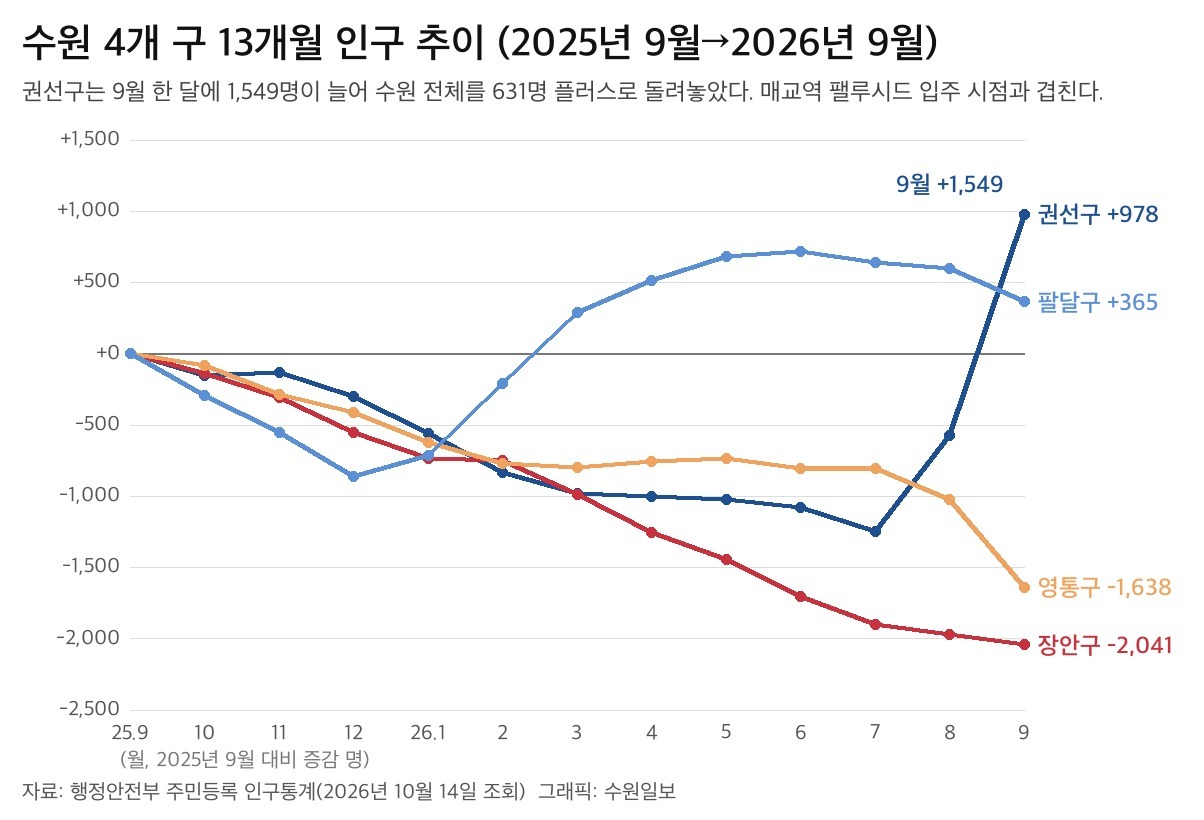
Thresholds will continue to shift. The gap between Goyang and Hwaseong narrowed from 744,800 residents a year ago to 549,730—a reduction of 195,070. At this pace, Hwaseong will surpass Goyang and become Gyeonggi Province's third largest city in the first half of 2029. The gap between Suwon and Hwaseong is 1,847,490 residents and closes by 171,830 annually, so at the same rate their order will reverse in 2037. Dongtan-gu alone has 430,828 residents, larger than Suwon's Gwonseon-gu (360,000), approaching Bundang-gu (467,000) within 36,000 residents. Suwon ranks 19th in this subject, maintaining first place but losing 2,336 residents.
Finances: Only Seongnam and Gunpo lost households
Uiwang also leads in household growth rate at 6.56%. Gwangmyeong (5.85%), Yeoncheon (5.05%), Osan (4.59%), and Pyeongtaek (4.29%) follow, with Pyeongtaek adding the most households at 12,436. Of the 31 municipalities, only two lost households. Seongnam ranks 31st, losing 1,775 households; Gunpo ranks 30th, losing 18 households. Hanam ranks 29th with a gain of 128 households. Suwon gained 4,799 households but ranks 18th with a 0.89% growth rate—showing that added households don't guarantee financial growth if population declines.
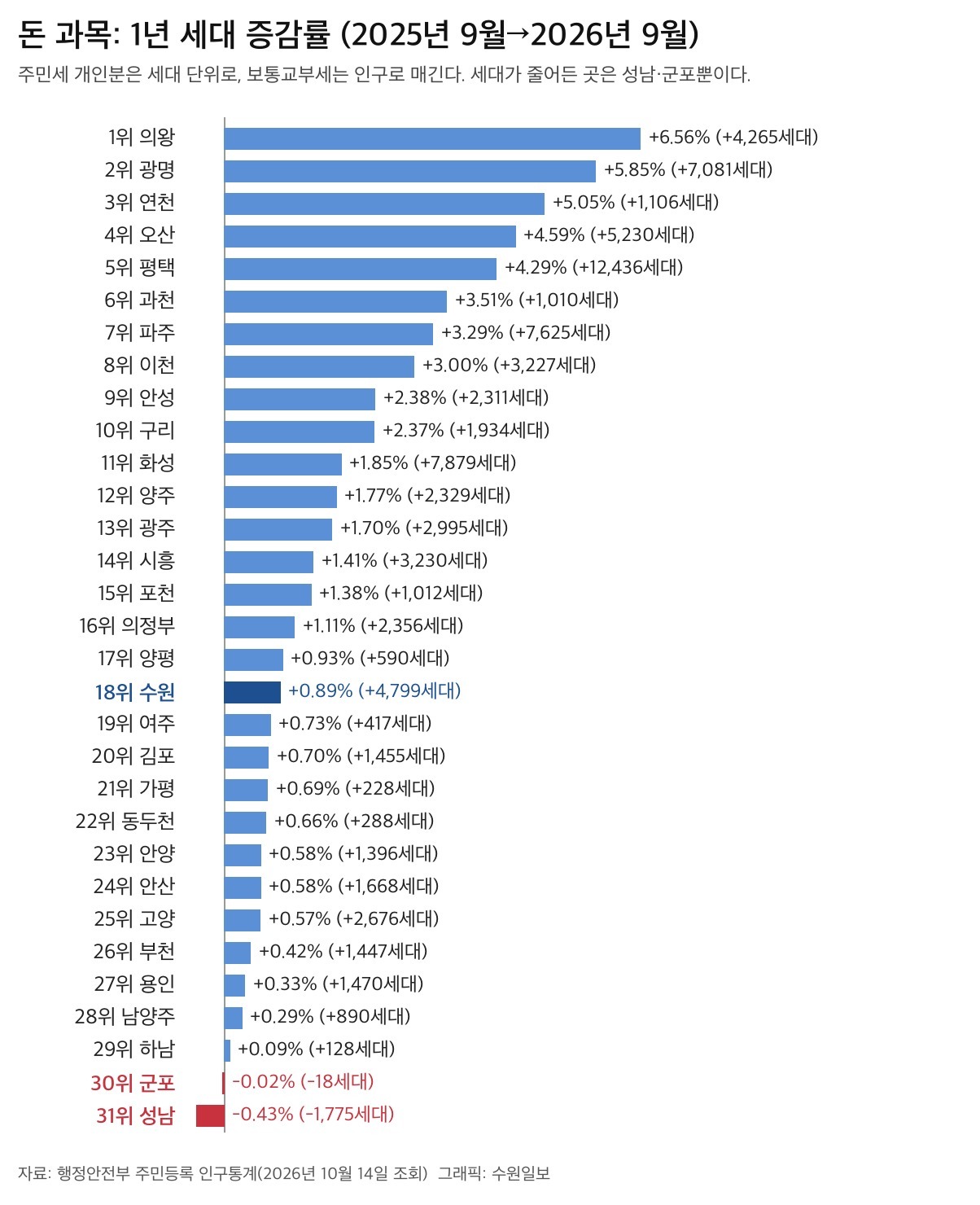
Finances flow through two channels. General transfer taxes calculate standard financial demand based on population, so municipalities receiving transfer taxes lose funding when population declines. Cities like Seongnam and Hwaseong with abundant finances that don't receive transfer taxes are exceptions. Individual resident taxes are assessed per household, so declining households mean declining tax revenue. Seongnam saw both population and households decline, closing both revenue streams.
Some revenue derives from decline. Dongducheon was newly designated as a depopulated area by the Ministry of Interior and Safety on the 7th, becoming Gyeonggi Province's third after Gapyeong and Yeoncheon. This year comes with 6 billion won in local decline response funds and 44 special exemptions including local second home tax provisions and an expanded 3 million won cap on acquisition tax exemption for first-time home buyers. Of the six F-grade cities, only Dongducheon became a depopulated area. Gunpo, Bucheon, and Ansan continue declining without receiving anything yet. Money also drew people elsewhere. When Yeoncheon began a rural basic income pilot program paying residents 150,000 won monthly this year, people transferred in from neighboring cities like Yangju, Paju, and Pocheon, growing from 41,027 to 43,195 residents.
Schools: 35.7 students per class in Dongtan, 300 fewer freshmen in Suji
Gyeonggi Province's average age rose from 44.0 years a year ago to 44.5 years. All 31 municipalities aged, and except for Yeoncheon (+0.1 year) and Gwacheon and Gwangmyeong (+0.2 years), they aged 0.3 to 0.8 years. The youngest municipalities are Hwaseong (40.2 years), Osan (41.8 years), Gwacheon (41.9 years), and Pyeongtaek (42.5 years). The oldest are Gapyeong (53.1 years), Yangpyeong (52.5 years), Yeoncheon (52.1 years), Pocheon (51.1 years), Yeoju (50.7 years), and Dongducheon (50.2 years)—six northern and eastern municipalities in their 50s. The 12.9-year gap between Hwaseong and Gapyeong is nearly a generation within the same province. Suwon ranks 7th at 43.3 years; Seongnam ranks 15th at 45.0 years; Goyang ranks 20th at 45.7 years.
Youth's value lies in classrooms. Dongtan-gu, at an average age of 36.7 years, is the youngest among all Gyeonggi municipalities and added 5,361 residents in seven months since opening its district office in February. Education ministry data reported to the Gyeonggi Provincial Assembly estimated Dongtan 2-1 middle school district's current middle school enrollment at 7,060 students, or 35.7 per class, and last month's provincial assembly-education office coordination identified 102 additional classrooms and 179 more teachers needed for overcrowded middle schools in Dongtan, Osan, Suwon, Gimpo, and Paju. Age's value lies in empty classrooms. Yongin's Suji-gu lost 6,160 residents in a year—the second-largest decline among all districts in Suwon, Yongin, Goyang, Seongnam, and Hwaseong after Jungwon-gu. Reconstruction and remodeling relocations in the Poongdeokcheondong area coincided. According to Yongin Citizen News, Suji-gu's elementary school enrollment dropped from about 2,900 in 2024 to about 2,600 in 2025, and five schools now enroll fewer than 50 freshmen. Suwon's Yeongtong-gu, despite being Suwon's youngest district at an average age of 40.1 years, lost 1,638 residents.
Housing: Where new apartments appear, people come; where they don't, families scatter
Only Yeoncheon saw population per household increase over a year (1.87 to 1.88 residents). Hanam (-0.005) and Hwaseong (-0.008) are next, with Seongnam in fourth. Seongnam's population per household remained virtually unchanged—not because it left one person behind but because entire families departed, with original downtown redevelopment relocations as the backdrop. Gwacheon ranks last, declining 0.06 residents per household from 2.78 to 2.72—yet 2.72 remains Gyeonggi's highest. Icheon (-0.035), Ansan (-0.032), and Bucheon (-0.031) are above it.
Suwon fell from 2.19 to 2.17 residents per household, ranking 19th. Over a year, it lost 2,336 residents but gained 4,799 households—families fragmenting and single-person households increasing. This phenomenon isn't unique to Suwon. Fourteen of the 31 municipalities lost population while gaining households. Goyang (-4,660 residents, +2,676 households), Bucheon (-7,534, +1,447), and Ansan (-5,571, +1,668) show the same pattern.
The difference lies in new apartments. Among the 13-month data, all places with increases are exceptions to where new apartments appeared. Pyeongtaek increased consistently for 12 months thanks to Godeok International New City occupancy; Gwangmyeong recovered 300,000 residents through Gwangmyeong and Cheolsan redevelopment occupancy. Uiwang, which lost 4,382 residents in 2024, reversed course gaining 5,882 in 2025 with new apartment occupancy. Suwon's Gwonseon-gu gained 1,549 residents in September alone, turning Suwon's total positive by 631 residents in September, coinciding with when Palucid 2,178 units at Maegyo Station in Seryudong began occupancy in late August. Yongin's Cheoin-gu gained 3,993 residents straddling the semiconductor cluster. Conversely, Bucheon, Ansan, and Gunpo never had a positive month in 12 months. Where new apartments don't appear, people depart and remaining families scatter.
The report card's standard, and numbers it doesn't answer
This report card was graded by percentage. To apply the same standard to 40,000-resident Yeoncheon and 1.18 million-resident Suwon, there's no other way, but it has the weakness of favoring smaller denominators. Regraded by raw numbers, Suwon rises to 11th place B, and Yeoncheon falls to 15th place C. The schools subject, using only current average age as a single time-point figure, fails to capture that Yeoncheon, aging at 52.1 years, barely aged 0.1 year over a year. However, Seongnam and Goyang's D's and Gunpo, Bucheon, and Ansan's F's remain unchanged by any standard. Which is correct rests with the reader's judgment.
This report card also fails to answer certain numbers. Uiwang, Osan, and Paju show that new apartments drew people, but statistics don't reveal where those people came from or whether people leaving Gunpo, Bucheon, and Ansan would have stayed had new apartments existed. Residents of those neighborhoods will know. We also receive objections that one's district shouldn't be a D. Grades change if subjects are weighed differently. Suwon Ilbo will follow up on your neighborhood's circumstances in the next edition. Send your stories via article comments or email (suwon@suwonilbo.kr).


Loading comments…