



Land Transaction Permit Zone One Year Later Apartment Price Surge Continues...Questions Over Effectiveness
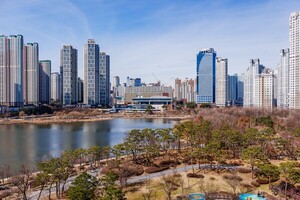
![[Seongnam=Newsis] Reporter Lee Young-hwan = On the 7th, apartments in Bundang-gu, Seongnam-si, Gyeonggi Province are visible from Bulgosk Mountain in Seongnam, Gyeonggi Province. According to Zigbang's analysis of nationwide apartment sales prices over the past year (September 2025 to August 2026), Bundang-gu in Seongnam-si, Gyeonggi recorded the highest rate of increase at 29.5%. With continued expectations for redevelopment and remodeling projects, upward momentum centered on Yatap, Seohyeon, and Gumi-dong has been strong. 20](https://www.suwonilbo.kr/img/write/p6802fd83e9ba3aca945573d95244c3d28bda0881.jpg)
As the land transaction permit zone designation approaches its first anniversary, apartment prices in southern Gyeonggi are expanding upward instead, raising controversy over the government's real estate regulation effectiveness.
According to the weekly apartment price trends for the second week of October (based on the 12th) announced by the Korea Real Estate Board on the 17th, apartment sales prices in Gyeonggi Province rose 0.26% compared to the previous week. This represents a 0.08 percentage point expansion from the previous week's 0.18%, marking the highest rate of increase in approximately 4 years and 11 months since November 2021.
During the same period, Seoul rose 0.16% and the nation rose 0.10%. Gyeonggi Province's apartment price increase rate was 0.10 percentage points higher than Seoul and 0.16 percentage points higher than the national average.
In particular, the upward trend in key areas of southern Gyeonggi stood out.
Bundang-gu in Seongnam recorded the highest rate of increase at 0.79% compared to the previous week among all cities, counties, and districts nationwide. Expanding the rise from 0.56% the previous week by 0.23 percentage points, it surpassed Youngtong-gu in Suwon to rank first in nationwide appreciation rates.
Youngtong-gu in Suwon also saw its rise expand from 0.62% to 0.69% compared to the previous week. While yielding the top position to Bundang-gu, the price increase actually became steeper.
Both areas were designated as land transaction permit zones according to the government's housing market stabilization measures announced in October last year.
At the time, the government expanded regulatory areas and land transaction permit zones to include the entire Seoul and 12 areas in Gyeonggi Province. Areas in Gyeonggi Province included Gwacheon-si and Gwangmyeong-si, Bundang, Sujung, and Jungwon districts in Seongnam-si, Youngtong, Jangan, and Paldal districts in Suwon-si, Dongan-gu in Anyang-si, Suji-gu in Yongin-si, Uiwang-si, and Hanam-si.
To purchase an apartment designated as a land transaction permit zone, one must obtain permission from the relevant local government. Real occupancy requirements also apply, restricting so-called gap investments where properties are purchased with jeonse (long-term lease deposits).
When announcing the measures on October 15 last year, the government stated it would block speculative demand through the expansion of land transaction permit zone and regulated area designations. The intention was to suppress housing market overheating and stabilize prices.
However, approximately one year after the land transaction permit zone designation, the highest levels of nationwide appreciation rates are appearing in Bundang-gu and Youngtong-gu.
House price increases also stand out outside regulated areas.
Gunpo-si rose 0.72% compared to the previous week, recording the second-highest rate of increase nationwide after Bundang-gu. Compared to the previous week's increase rate of 0.27%, the upward momentum expanded by 0.45 percentage points.
Kwonseon-gu in Suwon also recorded a 1.87% increase in apartment sales prices for September, ranking fifth nationwide. During the same period, Youngtong-gu rose 3.12%, recording first place nationwide.
Unlike Youngtong-gu, Kwonseon-gu was excluded from the land transaction permit zone designation targets under the October 15 measures last year. High price appreciation rates appeared in both regulated Youngtong-gu and adjacent non-regulated Kwonseon-gu.
With price increases appearing simultaneously in regulated and non-regulated areas, observers point out that the government's transaction regulations should be scrutinized for how much they have contributed to the policy goal of housing price stabilization.
Transaction volume declines are confirmed in some areas. According to private tallies based on the Ministry of Land, Infrastructure and Transport's actual transaction reports, apartment sales transaction volume in Bundang-gu for September was around 160 transactions, significantly lower than the same period the previous year.
While transactions decreased, the upward price momentum expanded instead.
This draws attention to the point that even when purchase demand is restricted through transaction regulations, if price-pushing factors such as housing supply shortages in preferred areas or redevelopment expectations are not resolved, the price stabilization effect may be limited.
In particular, first-generation new town redevelopment projects are accelerating in Bundang-gu. On the 29th of last month, Seongnam-si selected five areas including Model District 1 and Parktown, totaling 13,429 units, as special maintenance zone designation targets.
The current designation deadline for the land transaction permit zones designated by the government in October last year is December 31 of this year.
With apartment price increases in key southern Gyeonggi areas expanding as the designation approaches its first anniversary, attention is focused on whether the government will decide to extend regulations and whether transaction regulation-centered policy can lead to housing market stabilization.
Loading comments…