



Kim Min-seok Seeks Breakthrough with Choo Mi-ae Disciplinary Action After "Deliberation and Measures"
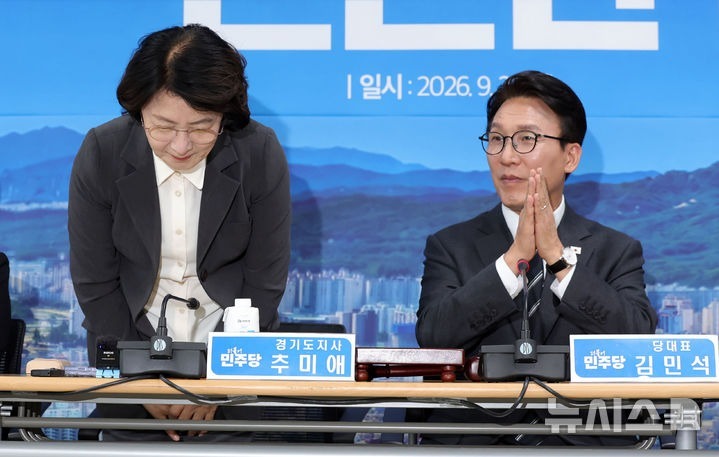
The Democratic Party faces a comprehensive crisis as a series of controversial statements by party member Choo Mi-ae, governor of Gyeonggi Province, internal party conflict, and protocol controversies involving the party chairman overlap. With Chairman Kim Min-seok apologizing on behalf of the party and hinting at follow-up measures, attention is focusing on Kim's decision amid calls from both inside and outside the party for emergency disciplinary action against Governor Choo.
According to political circles on the 18th, Chairman Kim expressed in a condolence statement on the 17th regarding the death of firefighter Kim Jin-seok, "I offer a deep apology on behalf of the party to firefighters and the public who have been hurt by the statements of a provincial governor from our party."
He continued, "I have requested a deep and reflective apology from the person concerned," and emphasized "the party will take measures following deep deliberation to ensure that such inappropriate statements from our party's public officials do not happen again."
Governor Choo eventually apologized, but the controversy only grew in the process. On the 16th, when asked by reporters about her intention to apologize, Governor Choo responded, "Don't say such things." The next day, she visited the bereaved family's place to offer condolences and said, "If an apology is what you desire, I sincerely apologize," which sparked further criticism about the authenticity of her apology.
The controversy began on the 13th during a provincial audit. At that time, Governor Choo described the fire service as "the biggest, most annoying fiscal straw" while explaining a firefighting finance issue.
After firefighter Kim's death on the 16th in a Bucheon factory fire, criticism intensified over the statement. When asked by reporters at the accident scene about her intention to apologize, Governor Choo said, "Don't say such things." The next day, she visited the place of mourning and said, "If an apology is what you desire, I sincerely apologize," prolonging the controversy.
When it became known that 100 million won budgeted for a memorial event for the deceased firefighter in the provincial supplementary budget had been entirely cut, criticism expanded to overall firefighting finance policies.
On the 17th, President Lee Jae-myung visited the place of mourning, posthumously awarded the Order of Civil Merit to Firefighter Kim, and consoled the bereaved family. Following this, Chairman Kim also apologized on behalf of the party, which contrasted with Governor Choo's response.
This is not the first time Chairman Kim has hinted at a party-level response to Governor Choo.
On the 12th, in response to party opposition over the nomination of Kim Ji-yong as the inaugural head of the Serious Crimes Investigation Office, he said he would make a "political judgment" if necessary after the confirmation hearing.
At that time, Governor Choo publicly opposed the nomination and criticized President Lee's personnel decision. After President Lee approved the nomination, the personnel issue was temporarily resolved, but the matter of the leadership's response to internal party conflict remained.
Meanwhile, Democratic Party members and supporters are also promoting an emergency disciplinary petition against Governor Choo.
The "Emergency Disciplinary Petition for Governor Choo Mi-ae" includes four grounds for disciplinary action: budget cuts for people's livelihood, statements related to the president's personnel rights, disputes over official residences and official vehicles, and statements regarding firefighting finances.
The petitioners argued that Governor Choo's actions are creating political burdens for both the government and the Democratic Party, and demanded swift emergency disciplinary action from the central party. However, the scale of petition participation and whether the central party received it could not be confirmed.
Within the Democratic Party, there are calls for the leadership to actively step forward to prevent successive controversies from spreading into negative public opinion about the entire party. In fact, some party leaders speculate that the issue of Governor Choo could be discussed at the Supreme Council meeting scheduled for the 19th.
One party leader in the National Assembly said, "So far, the party chairman has not directly mentioned the word 'discipline,' but voices within the party calling for a decision are growing," and "Emergency discipline is possible at the Supreme Council level, so it is the responsibility of the leadership."
On the other hand, another party leader took a cautious stance, saying, "Discipline is a different matter from an apology," and "It could become a political fight (if actual discipline is imposed)."
Article 32 of Regulation No. 7 of the Democratic Party, the "Rules for the Ethics Tribunal," establishes an emergency disciplinary system that allows the Supreme Council to decide on discipline without going through the general ethics tribunal review process.
It can be applied in cases of serious and prominent disciplinary grounds during elections or other emergency periods, or when there is concern that serious problems for the party may arise if urgent action is not taken.
In 2023, the Democratic Party applied this provision to former lawmaker Choi Gang-wook, who sparked controversy over sexist remarks, and decided on a six-month party membership suspension as emergency discipline.
Additionally, protocol controversies involving Chairman Kim himself are continuing, and the crisis management capability of the party leadership is also being questioned.
On the morning of the 30th of last month, when Chairman Kim visited the Seoul Gangseong Fire Station, it became known that firefighters not on duty also attended the meeting, drawing controversy about its appropriateness.
On the 15th, at a festival in Sunchang, Jeollabuk-do, during a celebratory performance, Chairman Kim took the stage to make remarks, prompting criticism that politician protocol was being prioritized over the performance. Chairman Kim explained that he had indicated he would not give remarks during the performance but took the stage due to the sudden call from the master of ceremonies, and apologized to the singer and audience.
This situation is also connected to the tasks of party unity and stable party-government relations that Chairman Kim emphasized at the August National Convention.
At that time, Chairman Kim emphasized that he would resolve conflicts that arose during the National Convention and support the success of President Lee's government. However, just two months after taking office, he faces the need to respond to public conflict over the president's personnel authority and controversy over statements by a provincial party leader.
With allegations of mass entry by Shincheonji members, which were raised during the National Convention, resurfacing, managing internal party conflict remains a major task.
The declining party approval rating is also a burden. This is different from the trend when Chairman Kim pledged at the National Convention to raise the party's approval rating by 10 percentage points within 100 days of taking office.
Ultimately, the key is whether the "political judgment" and "party-level measures" announced by Chairman Kim will actually lead to discipline.
If discipline is decided, it could be interpreted as a measure to establish party discipline, but it could also face criticism for controlling internal party dissent through discipline. Conversely, if the matter is concluded without significant measures, questions may arise about the effectiveness of the follow-up response directly promised by the party chairman.
The People Power Party is also intensifying its offensive.
Party Chairman Jang Dong-hyeok visited Firefighter Kim's place of mourning and posted on SNS, "The real fiscal straw is Choo Mi-ae herself," calling for her resignation. Floor Leader Jeong Jeom-sik also criticized Governor Choo's remarks in a National Assembly press briefing, saying they belittled the sacrifice of firefighters.
Loading comments…