



Exclusive Suwon Hwaseong Protection Zone Caught in Vicious Cycle of Budget Cuts When Compensation Lags, Delayed Compensation When Budget Shrinks
The Cultural Heritage Protection Zone improvement project for restoring the original form of the UNESCO World Heritage Site Suwon Hwaseong has fallen into a vicious cycle of delayed compensation and budget cuts, making it difficult to even promise when the project will be completed.
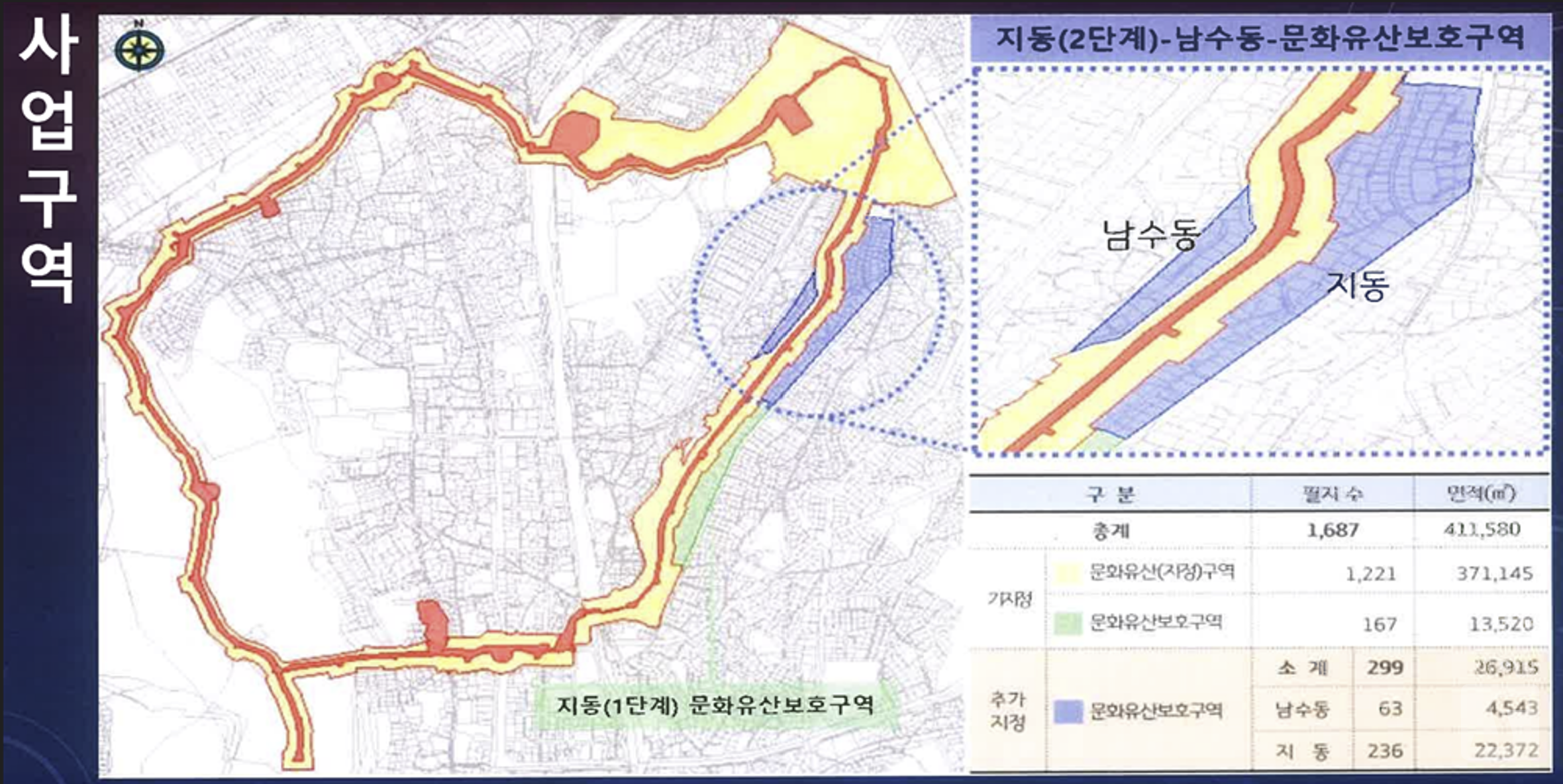
According to the Cultural Heritage Administration and Suwon City as of the 3rd, the Jidong and Namsudong Cultural Heritage Protection Zone improvement project for Suwon Hwaseong is being pursued targeting 299 parcels and 26,915 square meters that were additionally designated through a Cultural Heritage Administration notice on January 20, 2021.
The project involves purchasing and demolishing land and buildings around the Suwon Hwaseong fortress walls, which is a UNESCO World Heritage Site, and restoring the original topography around the walls based on historical evidence.
Project costs are shared as 70% national funds, 15% Gyeonggi Province funds, and 15% Suwon City funds. The Cultural Heritage Administration provides national funds while Suwon City implements compensation and improvement projects.
However, in the sixth year of project implementation to date, land acquisition performance has fallen far short of original plans.
Of 228 private parcels in the Jidong project area, only 54 parcels have been purchased to date, accounting for only 23.7% of the total.
Even this year, compensation was pursued for 44 parcels, but only 9 parcels were actually purchased.
Project funds needed for compensation are a burden. The appraised value of 27 parcels in the 4th compensation area being pursued by the city is approximately 9.8 billion won, and approximately 8 billion won is required for 28 parcels in the 5th compensation area.
The estimated compensation cost for approximately 140 parcels that have not yet begun compensation is reportedly about 80 billion won based on desktop appraisal standards.
The problem is that while massive compensation funds are needed, the annual budget that can be secured is actually shrinking.
The city initially secured approximately 78 to 100 billion won in annual national funds in the early stages of the project, but has recently faced difficulties in securing budgets. In 2025, no new national funds were reflected, and approximately 3 billion won was provided this year.
Next year's situation is even more challenging.
The city requested approximately 7 billion won in project funds for 2027, but the national funds related to Suwon Hwaseong currently reflected in the government budget proposal is 1.7 billion won. Excluding 1 billion won in fortress wall repair costs, the national funds allocated for actual land acquisition amount to only 700 million won. Even with an additional 150 million won each from the province and city for a total of 300 million won, the related budget for next year is around 1 billion won.
Compared to the currently estimated 80 billion won in unstarted land compensation costs, this amounts to only 1.25%.
Behind this budget reduction lies the Cultural Heritage Administration's budget execution rate management system.
Through the World Heritage Conservation and Management Support Project, the Cultural Heritage Administration supports not only Suwon Hwaseong but also preservation and improvement projects for world heritage sites nationwide such as Seokguram Grotto, Dolmen sites, and Hahoe Village.
The budget for the project was reduced from 20.9 billion won in 2025 to 19.4 billion won in 2026, and the 2027 government proposal scale announced by the Cultural Heritage Administration is approximately 15 billion won.
This contrasts with the Cultural Heritage Administration's overall budget of 1.6645 trillion won for next year, a 11.2% increase from this year.
An official from the Cultural Heritage Administration said, "We couldn't use even last year's or the year before's budget, so we can't allocate as much as was requested," and "Projects face budget cuts due to poor execution rates pointed out by the National Assembly, and the entire project budget continues to shrink."
He continued, "If we keep allocating budgets to projects with poor execution, other world heritage projects will also be affected," explaining the unavoidable circumstances of encouraging budget execution and applying reduction measures.
In fact, the "2025 Performance Management Implementation Plan" of the Cultural Heritage Administration specifies policies to improve the actual execution rate of the World Heritage Conservation and Management Support Project, reflect execution results in the 2026 budget, and strengthen penalties for projects with poor execution rates.
However, unlike general facility construction or subsidy projects, land compensation projects cannot be executed immediately just because budget has been secured.
Negotiated compensation with landowners comes first, and if negotiation fails, subsequent procedures such as project approval and expropriation adjudication must be followed.
Adding up the expected timeframes for each compensation procedure presented by the city totals approximately three years. Given that the consensus-based compensation success rate is around 30-40%, it is difficult to execute all budgets in the same year even if budgets are secured.
Ultimately, as administrative procedures required for compensation become protracted, budgets are carried over, and the reduced execution rate from carry-overs adversely affects subsequent budget allocation.
A city official said, "Compensation prioritizes negotiation, and if negotiation fails, expropriation adjudication procedures must be carried out, which requires considerable time," and "If budgets cannot be executed, the next year's budget is reduced, and this effect continues over several years, making it inevitable that projects are delayed."
The city has recently adjusted project management by calculating the actual executable amount after considering compensation negotiation and expropriation adjudication schedules, then requesting budgets accordingly.
However, this approach has limitations in resolving long-accumulated uncompensated land in a short period.
Ultimately, the project period has been greatly extended.
The city initially considered completing compensation by 2030, but as budget acquisition became difficult, it has now provisionally set the completion date for the entire project including land acquisition, demolition, and restoration to 2045.
This is 15 years later than the original compensation target timeframe. Moreover, even 2045 is not definitive. The project period can be adjusted again depending on future national fund acquisition levels, and there is also the possibility of increased compensation costs due to land price changes as land acquisition is delayed.
The Cultural Heritage Administration is also aware of this issue, but believes that promoting budget increases through the National Assembly's budget review process is a realistic alternative at present.
An official from the Cultural Heritage Administration said, "In the case of Suwon Hwaseong, we are making efforts to reflect the available budget as much as possible even in situations with poor execution," and "The only way to secure insufficient budgets seems to be through 'National Assembly budget increases.'"
He continued, "Since local constituency representatives tend to look after regional issues, local governments often secure budgets by consulting with their regional National Assembly members."


Loading comments…