



Kim Woo-young's Gwanggyo Column A Person Suwon Should Remember: Lee Seung-eon (Part 2)
'Undesignated National Treasure-Level Human Cultural Asset' Evaluation, Made Significant Contributions to Research on Suwon's Local History
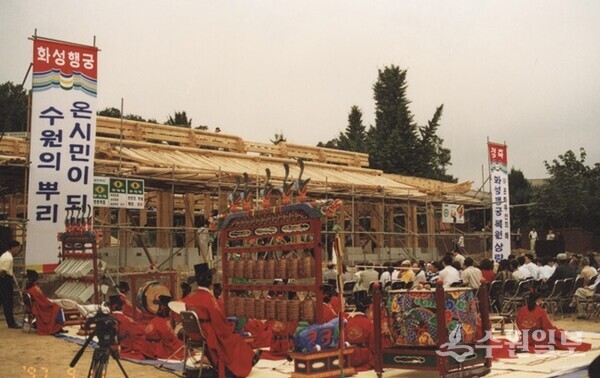
Poet Lim Byung-ho, who worked as a member of the Hwaseong Haenggung Restoration Promotion Committee together with Lee Seung-eon, who was born on April 10, 1945 and passed away at age 57 on January 20, 2002, wrote a reflective piece titled 'Memories Regarding Lee Seung-eon' (October 12, 2010) in the Gyeonggi Ilbo, where he served as a columnist.
"Lee Seung-eon was a ruthless collector of materials," he wrote, adding, "If he determined materials were necessary, he would make phone calls or visit in person until he obtained them, frequently embarrassing the individuals or organizations responsible for publishing those materials. Despite repeatedly being called a 'madman,' his desire to secure materials knew no bounds."
The materials collected and possessed by Lee Seung-eon alone include approximately 40,000 items: administrative records from the late Joseon period, historical documents, certificates, local gazettes and municipal records from the modern and contemporary periods, village and neighborhood records, geographical name origin compilations, stone and metal inscriptions, reports, books related to cultural heritage, and maps. Poet Lim testified: "It is practically unbelievable that a single individual could have collected such an extensive volume. Moreover, since he was familiar with nearly all the content of these materials, he was called a 'walking encyclopedia.'"
He published works on cultural heritage, historical sites, notable figures and their achievements, living culture and natural heritage, and geographical name origins in Ansan, Uiwang, Siheung, and Anyang. After relocating his residence to Suwon, he collected and published a considerable number of materials related to Suwon. He discovered news articles about Suwon from the late Joseon and colonial periods and published indices, presented academic papers centered on Suwon-related materials, and conducted several academic lectures including presentations on materials from Hwaseong Haenggung.
He also left significant marks in correcting place names imposed during the Japanese colonial period, naming school institutions, supervising local textbooks for elementary schools, excavating classical texts, discovering and excavating calligraphy, portraits and photographs, authenticating, excavating and instructing traditional folk games, naming and providing consultation on administrative place names and road names.
Dr. Ju Hyeok, who had a particularly close relationship with him, paid tribute in the autumn 2019 issue of 'Gyeonggi Studies Square,' published by the Gyeonggi Foundation for Cultural Heritage Gyeonggi Studies Center in October 2019, saying, "Though the teacher stood outside the 'citizenship' conventionally recognized in the academic community, he never departed for a single moment from the center of local history research." He characterized his life as "compressed through local history research conducted via an ingrained 'spirit of documentation' and 'material collection.'"
His life's work was consistent. His path is marked by positions such as standing member of the Siheung County Gazetteer Editorial Committee, member of the Historical Materials Research Committee of the National Institute of Korean History, standing member of the Gwacheon Local History Editorial Committee, director of the Seoul Cultural History Association, and planning and research director of the 200th Anniversary Commemoration Project for the Construction of Suwon Castle (Hwaseong).
Dr. Ju describes him as an "undesignated national treasure-level human cultural asset" who "dug deep and wide in the field of material collection and local history research with singular dedication."
Lee Seung-eon was not solely devoted to local history material collection and research.
He was also a passionate collector who amassed thousands of items of living history: vouchers and receipts from public institutions, banknotes and coins, cigarettes, faded postcards and letters from the 1930s, extra editions, October Yusin pamphlets, and inaugural issues of magazines and newspapers (Modern Literature, Sunday Seoul, Hankyoreh Newspaper, etc.).
The year 2002, when he passed away, was the year the '2002 Korea-Japan World Cup' was held, with the entire nation caught up in the fervor.
Coincidentally, that same year, Professor Lee Jong-hak, who played an important role in the Suwon Hwaseong Haenggung Restoration Promotion Committee, also passed away.
Both men were figures I deeply respected, and they shared the common point of dedicating their entire lives to material collection.
I cannot forget the face and voice of him as he would say with a broad smile, "Poet Kim, I discovered something like this at the Gyujanggak this time—what do you think? It seems like it could make a news story?"
He was such a person full of vitality in all matters, but when news of his passing suddenly arrived, the people gathered at the hall could only drink innocent soju.
It has already been 24 years since he passed away.
Yet it feels as though he might call even now and say, "I'm a Siheung person—are you busy this evening? I found some interesting materials I'd like to show you. Can we meet?"
正在加载评论…