



Choi Hyung-guk's Historical Critique (13) King Yeongjo Commands the Offering of Yongdubongmi
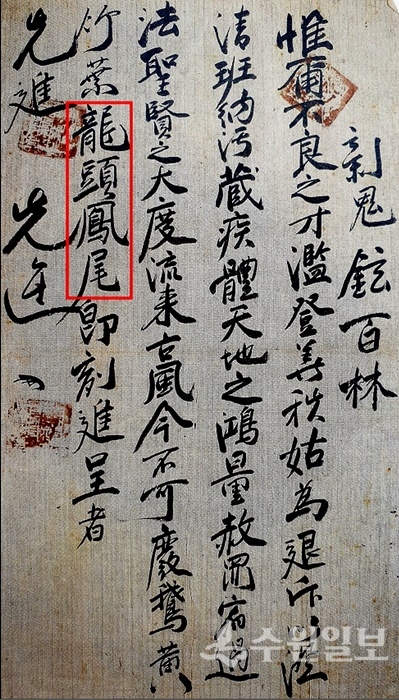
Yongdubongmi (龍頭鳳尾).
Literally translated, it means ‘the head of a dragon and the tail of a phoenix.’ At first glance, it seems like an incredibly precious treasure. In fact, King Yeongjo himself ordered his subjects to offer this, so it would not be surprising if ordinary commoners thought it was an invaluably expensive item beyond their dreams.
However, ‘yongdu’ refers to pork, and ‘bongmi’ refers to chicken. A truly amusing concept. During the Joseon period, meat was precious. Unlike today's large-scale livestock farming, ordinary households raised only a few animals, and even large-scale operations had limited numbers.
To supplement their insufficient protein intake, people roasted grasshoppers as snacks, or caught fish through hunting in streams to relieve their hunger. Beef was unimaginable, and pork and chicken were such valuable foods that they appeared on sacrificial altars and during holidays only. Even oxen were treated as precious animals used for agricultural work, so cattle slaughter was so highly valued that it was managed directly by the state during the Joseon period.
Once, during the wave of modern industrialization, people frequently heard the phrase ‘rice and meat soup (white rice and beef broth),’ which held considerable meaning for people of that time. First of all, one must eat their fill to feel alive. Therefore, it makes sense that a pig’s head placed on a sacrificial table was called the head of a ‘dragon,’ and it would not seem strange to compare a well-fed chicken to the tail of a ‘phoenix.’
In the "Military Techniques Overview" (兵技總敍) section of the ‘Illustrated Manual of Military Training,’ there appears content related to King Yeongjo:
“In the second lunar month of the 45th year of Yeongjo’s reign (1769), the king went to the Inner Garden and personally shot arrows at targets, shooting five times and hitting all of them. Then the king’s father-in-law (Kukgu), the king’s son-in-law (Uibin), royal relatives (Jongchin), officials from the Six Ministries (Yukcjo Dangnang), the governor of Seoul (Kyeongjo Yun), military commanders, administrative officials, and royal historians all shot arrows. [Those who hit the targets had their official rank elevated or were given horses that the king had been raising for his own use, while the military commanders and son-in-law who missed were ordered to voluntarily offer yongdubongmi (pork and chicken).]”
In simpler terms, the above record describes how King Yeongjo held a friendly archery competition and ordered underperforming officials and his sons-in-law to ‘voluntarily’ offer ‘yongdubongmi.’ Since they failed to shoot their arrows properly, the meaning is essentially: treat everyone to a meal of pork and chicken. In this way, ‘yongdubongmi’ carries a humorous meaning. A lavishly prepared meal allowed people to joke around, calling each other ‘dragon,’ ‘phoenix,’ ‘king,’ and ‘subject,’ as they enjoyed conversation and laughter at friendly gatherings.
King Yeongjo was particularly fond of archery meetings with royal relatives, and frequently conducted political activities through archery, even holding the Daesarye (大射禮), an archery ritual between the king and officials that had not been actually practiced in the late Joseon period. At this time, the king shot arrows at a target called the ‘Wunghoo’ with a bear’s face drawn on it, and after the king finished shooting, officials replaced the target and shot arrows at the ‘Mihoo’ with a deer’s face. During military training, soldiers used the ‘Sihoo’ with a wild boar’s face as their target. Different targets needed to be marked according to rank.
The Daesarye was a type of military ritual and the most political ceremony for announcing the king’s military accomplishments. At such ceremonies, officials who failed at archery had to drink penalty wine. So if archery skills did not improve, drinking skills might increase instead. The reason why King Jeongjo was called the ‘divine archer’ may also be because such scenes were imprinted in his mind from having frequently witnessed them since childhood.
However, there was one place where the word yongdubongmi appeared most frequently: documents related to the ‘Myeonsinrye’ (Face-showing ceremony for new officials). The Myeonsinrye was a Joseon-period ritual in which a newly appointed official, having passed the civil service examination, showed courtesy to senior officials.
This was because the new official would now formally receive a stable salary, so it was customary to treat senior officials with respect beforehand. Usually, on the first day of work, a simple self-introduction and greeting ceremony called the ‘Heocharye’ was held, during which simple refreshments were provided. Then the full-fledged Myeonsinrye took place about ten days later with an elaborate spread of food and drink.
The period between the Heocharye and the Myeonsinrye, approximately ten days, was the ‘Myeonsin’ period—when the newcomer shed their greenhorn status. During this time, senior officials found fault with newcomers and harassed them, because this meant that the number of side dishes and varieties of alcohol at the Myeonsinrye feast would be more abundant. After successfully completing the Myeonsinrye, the newcomer became a member of the organization, sharing hardships and joys together.
However, the Myeonsinrye of newly appointed military officials (Mugwan) was particularly notorious for being harsh during the Joseon period. Perhaps this was because the military was a unique organization where officials had to carry guns, bows, spears, and swords daily and lead a rough life.
For example, in the case of the Tiger-Catching Army (Chakhogun), which specialized in hunting tigers, seniors and newcomers directly engaged in combat with weapons, and the newcomers were beaten to near death as a common occurrence. If the newcomer could not endure such treatment, they were likely to become ‘tiger food’ soon after. Therefore, after such harsh hazing, a newcomer would share a hearty cup of strong liquor with the seniors and establish a new bond.
However, just as not everything in life goes smoothly, there were many truly wicked senior officials. Even today, there are people who can only be satisfied by inflicting brutal violence under the guise of ‘hazing’ or providing excessive entertainment. Sometimes sexual harassment issues are even mentioned in newspapers, so such behavior resembles beasts more than mere old-fashioned attitudes.
In fact, there were cases during the Joseon period where junior military officers, unable to endure the harassment of the Myeonsinrye, took their own lives. To officially address such evil practices of the Myeonsinrye, there were discussions in court about establishing laws to prevent them. In fact, official directives were issued prohibiting harsh violence and excessive financial demands related to the Myeonsinrye, but such evil practices continued in secret.
Im Baek-hyeon’s Myeonsinchaeop (a certification document for completing the Myeonsinrye), an official appointed as a military officer in the late Joseon period, captures this well. Senior officials wrote personal messages and stamped their seals on it as proof of passing the Myeonsinrye. The content reads:
“To the newly arrived present-day Baek-hyeon Im (read from bottom to top—quite humorous indeed), thinking deeply, despite your poor talent, you have risen to a noble post. ...(middle section omitted)... Immediately offer yongdubongmi (pork and chicken). From your seniors.”
To remedy these abuses, King Jeongjo created a sort of rule code called the ‘각청면신절목 (Rules for Newcomer Ceremonies in Each Bureau)’ and officially distributed it to all military-related institutions. The opening sentence of this rule code states: ‘The unnecessary expenditures on newcomers in the Inner Three Divisions (the king’s personal elite guards—the Inner Forbidden Guard, the Guard of Honor, and the Right Forest Guard) are severe. While I have long wished to address this thoroughly, old evil practices have been followed, and due to urgent circumstances, this has continued to the present.’ The highest-ranking commanders are urged to remember not to let such matters occur again.
Such hazing ceremonies for newcomers continue today in various forms, each organization showcasing its own characteristics. The ‘evil practice’ goes around and around, donning another mask of ‘tradition,’ harassing someone. From now on, we must break these chains of oppression. Just as King Jeongjo did...
Loading comments…