



Choi Hyung-guk's Historical Blade (26) A Hero Who Must Die to Live: Di Qing and Horseback Whip-Staff
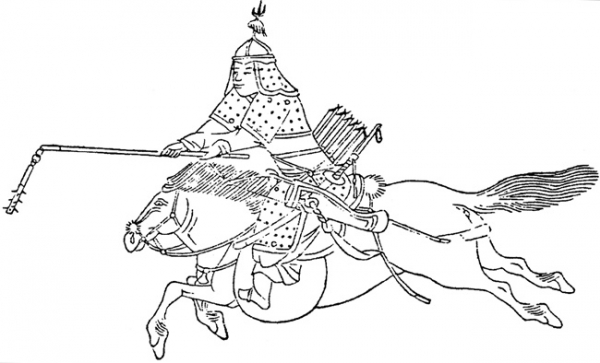
- Horseback Whip-Staff: An Essential Weapon of Late Joseon Cavalry
A flail. An agricultural tool used for threshing beans in rural areas during childhood. It evolved into a military weapon called the whip-staff. A farming tool that was always familiar became a weapon. Within the transformation of that weapon, one can also read the vast currents of history.
After the Japanese invasions of Korea (Imjin War), Joseon recognized the limitations of cavalry tactics and established a close-combat system (短兵接戰) adopted from Ming China. However, as the era progressed into the Qing period, rapid cavalry tactics became necessary again in attacks and defense against northern foreign invaders, including the Manchu invasions. This trend also appeared in the Gwanmujae (觀武才), a type of civil service examination during the Joseon period. In the late Joseon Gwanmujae examinations, unlike earlier periods, practical cavalry skills (騎芻) and whip-staff (鞭棍) and various equestrian techniques were tested.
Examining the formations of the Dragon-Tiger Camp (龍虎營) and cavalry tactics in battle among the formations in the "Byeonghak-tong (兵學通)" published in late Joseon, one can confirm that the horseback whip-staff (馬上鞭棍) was recognized as the core striking weapon of late Joseon cavalry. Furthermore, looking at the diverse cavalry-exclusive formations in "Byeonghak-tong" that did not appear in existing formation manuals (陣法書), one can infer that cavalry still held an important part of tactical doctrine in late Joseon.
Through this, the changes in Joseon equestrian martial arts can be understood as follows. In early Joseon, the cavalry lance (騎槍) was mainly recognized as the core technique in preemptive charge tactics. However, in late Joseon, due to faster recovery speed and portability of the horseback whip-staff, it was recognized as the core of cavalry charge techniques over the cavalry lance (騎槍). This is clearly evident in the basic equipment of late Joseon cavalry. The basic armament of cavalry at that time was explicitly codified to include the ring sword (環刀) as a basic defensive weapon, the bow and arrows (弓矢) as a long-range attack weapon, and the horseback whip-staff as a charge weapon.
Therefore, the horseback whip-staff was recognized as both an essential weapon and technique of late Joseon cavalry. For this reason, the horseback whip-staff became a standard-issue weapon provided by the government to cavalry. Looking at "Mangi Yoram (萬機要覽)," regarding basic equipment provided to cavalry units of the Dragon-Tiger Camp, it states: "The military equipment supplied by the government per gold-armored soldier includes one battle helmet (戰笠), one tube case (筒箇), twenty long arrows (長箭), fifteen short arrows (片箭), one ring sword (環刀), one horse whip (馬鞭), one bucket (桶兒), one hook clasp (要鉤金), one school bow (校子弓), one armor suit (甲冑), and one whip-staff (鞭棍), which are replaced every first month as they become damaged."
Additionally, when the Dragon-Tiger Camp, composed of professional cavalry units, conducted independent cavalry tactical operations, the weapons employed demonstrate the importance of the horseback whip-staff at the time. Looking at the methods of utilizing the horseback whip-staff recorded in "Byeonghak-tong (兵學通)," a representative formation manual of the Jeongjo era, one can understand how important the horseback whip-staff was in contemporary cavalry tactics. The content is as follows.
"When the Dragon-Tiger Camp (龍虎營) deploys operations and the enemy is 100 paces (步) away, each soldier mounts (上馬) and upon hearing the signal cannon, they raise the first (一) and second wing flags (二羽旗), and at the drum beat and flag signal, the rear layer (後層) comes forward and lines up in a single file in front of the front layer (前層). When the enemy approaches within 100 paces (步), upon command, all soldiers fire their bow and arrows (弓矢) at once. When the enemy reaches 50 paces, the drum beats rapidly and the celestial goose cry (天鵝聲) is sounded. At this point, (the cavalry) draw their whip-staffs (鞭棍:horseback whip-staff) and shout as they pursue the enemy. If the enemy is defeated and retreats, the gong sounds and the drum stops, upon which each soldier stands in place. When the gong sounds three times, they immediately turn and following the signal cannon, raise the corresponding flag banner (番旗) and point the flag inward, then return to the original position. Should the enemy come again, the signal cannon fires and the first (一) and second combined flags (二兼旗) are raised. At the drum beat and flag signal, the front layer (前層) lines up in single file, and when the enemy enters within 100 paces, they shoot arrows and pursue, and retreat just as in the previous situation. Once more if the enemy comes, the signal cannon fires, the first (一) and second inner flags (二內旗) are raised, and at the drum beat and flag signal, the middle layer (中層) advances in front of the front layer (前層), lines up in single file, and shoots arrows and pursues exactly as before."
The content is lengthy but simple. One can confirm that when charging toward the enemy, cavalry drew their horseback whip-staffs and advanced at full speed employing this tactic. This is why the horseback whip-staff was newly added to the late Joseon military examination. Changes in Joseon military tactics can be found in changes in weaponry. Furthermore, changes in weapons to counter powerful Qing cavalry were directly connected to international politics. While studying physical changes in soldiers through martial arts, one can broadly observe elements of international diplomacy as well.
- 'Di Qing (狄靑)': A Dead Hero Is Needed, but a Living Hero Is Not
In the horseback whip-staff section of "Muye Dobo Tongji (武藝圖譜通志)," a figure named "Di Qing (狄靑)" appears. When Di Qing suppressed the Nong Zhigao rebellion, in the dead of night, he crossed the Kunlun Pass leading over 2,000 cavalry and marched into battle. However, when the enemy defended from the rear with spears and shields, the situation became difficult. Di Qing drew his horseback whip-staff and charged, breaking through the enemy's defensive wall. Di Qing was born in 1008 and died in 1057, a famous general of the Northern Song (北宋) dynasty of China. He continues to appear in the annals of great Chinese military commanders. The reason is none other than his tragic death.
While Di Qing is not well-known to Koreans, he is quite well-known to Chinese people. He stands as a peer to Judge Bao Zheng (包青天), a Northern Song (北宋) era general who once gained fame through Chinese TV series. In the story of Judge Bao, the legendary official raised fierce dog-shaped and dragon-shaped guillotines, and regardless of rank or status, pursued impartial law enforcement—a civil official who embodied what "true justice" meant to the people of his time through his actions.
Thus, in "Water Margin (水滸傳)," the Chinese martial arts narrative, the passage states: "With the Star of Literary Fortune (文曲星) and the Star of Martial Valor (武曲星), what worry is there!" The Star of Literary Fortune refers to the righteous Judge Bao, and the Star of Martial Valor refers to the valiant General Di Qing.
Examining Di Qing's life more closely, it is as follows. Di Qing was the most honored general of the Northern Song. He was a general who achieved the rank of Director of the Bureau of Military Affairs (樞密使)—in modern terms, Minister of Defense—a position that military men had never reached before. Yet his beginning was humble. Born into a poor family, he did not receive proper education. At age 16, he was even tattooed as a symbol of a criminal in place of his brother and forcibly enlisted in the military. This was conscription by tattooing (刺字充軍).
However, he turned crisis into opportunity. In 1038, a new country called the Western Xia (西夏) emerged around the Northern Song, and another foreign ethnic emperor appeared. At that time, Di Qing was a low-ranking military officer guarding the frontier. In battles with Western Xia, he became a vanguard commander himself and, riding single-handedly, repeatedly crushed the Western Xia vanguard multiple times. During one of those battles, he met a new teacher and began to learn literature. He then committed every military treatise of ancient and modern times to memory.
Subsequently, Di Qing participated in 25 large and small battles. Every battle he led had no defeats. Though he suffered serious wounds, even nearly losing his life to arrows, his subordinates experienced absolute victory. As his accomplishments accumulated, even the emperor began to recognize him. Whenever northern foreign invaders threatened the Northern Song, Di Qing led the charge and cleanly eliminated them all. By age 40 in 1052, he finally rose to the rank of Deputy Director of the Bureau of Military Affairs. Never had a common commoner advanced so rapidly in rank.
After this, the northern frontier was completely pacified. At that time, a rebellion broke out in the Guangzhou region in the south. Di Qing led hundreds of ethnic minority cavalry with whom he had fought against Western Xia southward. The vanguard troops sent by the Northern Song were nearly annihilated, and the military situation was grave. However, Di Qing, in the Kunlun Pass area, broke through the enemy's thick defensive wall, pursued them relentlessly, and slaughtered them. He completely suppressed the rebellion. The weapon used at that time was the horseback whip-staff. Like a triumphant general carrying the horseback whip-staff on his shoulder, he returned confidently to the capital, and Di Qing was appointed Director of the Bureau of Military Affairs. He had reached the highest position related to national defense. However, Di Qing's tragedy began from this point.
Di Qing always humbly demonstrated loyalty to the state, and his conduct and accomplishments were widely praised even by common people of the time. However, the more he did so, the more anxious other power holders became. Particularly, the emperor himself felt fear toward the nearly flawless Di Qing. All manner of rumors flooded in around Di Qing. Rumors even spread that Di Qing was attempting to seize the throne.
Thereafter, the court transferred him to become the Prefect of Zhenzhou (真州知州), a remote frontier region of Northern Song. He was banished. But it did not stop there. Twice a month, the emperor's envoys regularly visited under the guise of sympathy to monitor him. Less than six months after arriving in Zhenzhou, Di Qing died from depression and mental illness. He was 49 years old. The fierce general of the battlefield, the dream of soldiers, had departed unable to endure jealousy and envy.
After his death, the emperor expressed mourning, posthumously conferred the rank of Minister of the Secretariat (中書令), and gave him the posthumous title of "Martial Auspicious" (武襄). All soldiers and common people grieved together. What could be done? That place filled with immature officials was perhaps never meant to be Di Qing's long home. Not long after Di Qing's death, the military strength of Northern Song plummeted to its worst state. Unable to fight properly, they barely survived by presenting silver and silk to neighboring foreign invaders. The brilliant culture of the Han Chinese slowly faded.
Thereafter, the Jurchen people of the north became increasingly fierce and eventually founded the Jin (金) dynasty. The Northern Song, bearing the lineage of the Han Chinese, fell beneath the hooves of horses. And Di Qing became a legendary hero to the Han Chinese.
To some, a living hero is an uncomfortable existence. So that hero is only truly revered once dead. However, the disappearance of such a person also marks the beginning of a nation or organization's ruin. When afflicted with inferiority complex and jealousy, one becomes blind to envy, and everything seems to go wrong. Such is the way of the world. Admiral Yi Sun-sin, a famous general of the Japanese invasions of Korea, if he had not died from enemy cannon fire before the waters of Noryang, perhaps another political cannon would have awaited him.



Loading comments…