



Kim Woo-young's Gwanggyo Column Jeon Hyun-seok, a Supporter of Independence Movement We Must Not Forget
Wife of Suwon's independence fighter Pildong Im Myeon-su, 'Mother of the Great Independence Army'
I recently visited Suwon Metropolitan City Hall. Suwon City is publicly recruiting and selecting companies to supply return gifts for donors to the Love Your Hometown Donation program, and this is my fourth year serving as a review committee member for the gift selection committee.
After the review ended, I stopped by the Olympic Park across from City Hall. There stands a statue of independence fighter Pildong Im Myeon-su.
June 13 is also the birthday of Pildong Im Myeon-su, so I wanted to pay my respects in advance.
I came to know Mr. Im Myeon-su well after meeting Lim Byeong-mu, his grandson and a poet. Shamefully, in my younger days I was ignorant of the activities of our hometown's independence fighters.
"I heard that Suwon gisaeng sang 'Mansei' during the March 1st Movement," "Cheers of 'Mansei' echoed from Paldalsan," "Japanese brutally massacred our people in Jaeam-ri"—that was about all I knew.
Then, from the 1980s onward, I became actively interested in Suwon's independence movement history when I participated in the first compilation of the Suwon City History project.
After that, I grew closer to poet Lim Byeong-mu. We became friends after I wrote an explanation for his first poetry collection, and I frequently spent time with late dramatist Kim Sung-ryeol and others.
One day, poet Lim showed me a bundle of materials related to his grandfather, Im Myeon-su. Those materials were introduced as articles in the media I was involved with, which became a catalyst for my deeper interest in Mr. Im Myeon-su.
Im Myeon-su was a great independence fighter who dedicated his life, entire fortune, and even his family to independence.
He was also an educator who illuminated the darkness of the times.
Born in June 1874 as the second son in a Suwon family of regional influence in Buktae-ri, Suwon-myeon, Suwon-gun.
With the determination to nurture talented people in his hometown of Suwon, he cooperated with local leaders in Suwon to contribute to the establishment of Samil School, and served as vice-principal and principal of Samil School while dedicating himself to educational activities including supporting private school establishment movements. In 1907, he played a central role in spreading the National Debt Repayment Movement, which began in Daegu, to Suwon.
When the Japan-Korea Annexation Treaty was signed in 1910, he fled to Manchuria in February 1912 with his family to build a base for the independence movement.
To secure maintenance funds and military training expenses for Shinheung Military Academy, he traveled among fellow compatriots and worked tirelessly, while also participating in Manchurian Korean autonomous organizations such as Gyeongnyeon-sa and Bumin-dan. He also served as principal of Yangsung Middle School, a national school established in Hap-ni, Tonghwa County in the mid-1910s. It is said that Yangsung Middle School served as a branch of Shinheung Military Academy.
In 1920, he was arrested by a Japanese military patrol unit but escaped during transfer. However, in 1921, he was arrested again in Jilin City and transferred to Pyongyang Prison.
Tortured and left half-paralyzed, he returned home and continued his dedication to social and educational service. However, he passed away on November 29, 1930, at the age of 56, without witnessing liberation.
Great independence fighter Im Myeon-su had a great family.
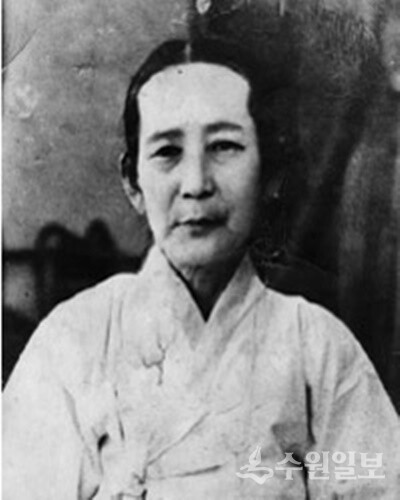
Jeon Hyun-seok (1871-1932), the wife of Im Myeon-su, was called 'the Mother of Independence Activists.' In Manchuria, she supported the independence movement from behind the scenes. While running a trading post business in Tonghwa County and Haeryong County in Manchuria, she cooked 5 to 6 meals in a single evening for independence army soldiers who came and went, and brewed medicine for sick soldiers. She changed bandages for the wounded, mended torn clothes, and even stored weapons for the independence army. It was not merely a trading post but a secret base that became a communication hub for the independence movement.
Records remain stating that 'there were few independence activists who did not sleep at the teacher's house, and none who did not eat the meals Jeon Hyun-seok personally prepared.'
Im Woo-sang (1893-1919), the eldest son of Im Myeon-su and Jeon Hyun-seok, also devoted himself to the independence movement.
At a young age, he helped his father raise military funds and engaged in activities such as supplying military supplies. In 1919, Im Woo-sang returned to Suwon and secretly met with Kim Se-hwan and others to raise military funds. While returning to Seo-gan-do, he succumbed to the bitter cold of the Manchurian plains and passed away.
Im Myeon-su received a Presidential Commendation in 1980 and was registered as a person of merit for independence. In 1990, he also received the Order of Merit for the Founding of the State, Patriotic Decoration.
In 2015, the 'Pildong Im Myeon-su Independence Fighter Memorial Project Promotion Committee' was organized in Suwon centered on academics and civic organizations. With nearly 100 million won in citizen donations, a statue was erected in the Olympic Park across from Suwon City Hall.
In 2018, his name was inscribed on the 'Suwon City Hall of Honor' located in the lobby of Suwon City Hall.
However, the contributions of his wife Jeon Hyun-seok and son Im Woo-sang are still not widely known.
In 1963, what Huh Young-baek compiled from the testimonies of those who worked together in Manchuria in 'A Brief History of Gwangbok Patriarch Late Pildong Im Myeon-su' contains the following account of Jeon Hyun-seok:
"(omitted)...Always with a smiling face, she comforted sick comrades by selecting food for them, encouraged soldiers returning from battle, brewed medicine for those wounded by bullets and tended their bandages while comforting them that independence would not be far off...(omitted)...Cooking meals 5 to 6 times in a single evening for the constantly arriving special detachments and special envoys...(omitted)...How can one describe in words the seemingly unbelievable hardship and suffering of these soldiers who kept their weapons here, mended torn clothes, and personally cared for wet leg wrappings?...(omitted)...Everyone bowed their heads before Jeon Hyun-seok's (全賢錫) patience, gentle heart, and courtesy, and she earned a high reputation as the Mother of Independence. Therefore, among independence activists at that time, there were few who did not sleep at the teacher's house, and none who did not eat the meals personally prepared by Jeon Hyun-seok, so truly the teacher's house was a resting place for independence activists, a weapons storage, a conference room, a staff office, a supply depot, and a maintenance workshop, where she sacrificed and served for ages...(omitted)"
Jeon Hyun-seok passed away in 1932, two years after her husband Im Myeon-su left this world.
There was a great family in Suwon that gave everything.
I earnestly hope that statues of his wife Jeon Hyun-seok and his son Im Woo-sang will also be erected next to the statue of Im Myeon-su in the Olympic Park in front of Suwon City Hall. In this way, I hope that the narrative of this family will be widely known and remembered for a long time.
This is also the final wish of my friend poet Lim Byeong-mu, the grandson of Im Myeon-su and Jeon Hyun-seok.
Loading comments…