



Suwon Battles Autumn Rains of Around 50mm as Urban Roads Turn into Floods
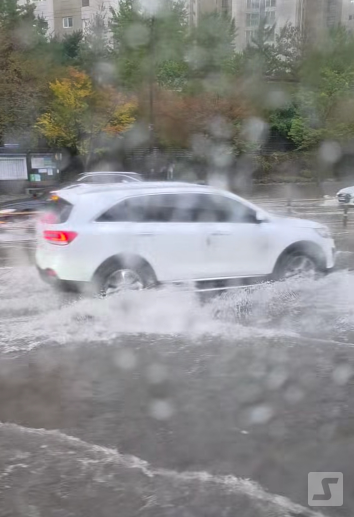
Urban roads throughout Suwon turned into oceans of water due to autumn rains. Although concentrated rainfall was forecasted during the autumn season when fallen leaves accumulate, flooding occurred on some roads, resulting in ongoing traffic control.
According to the Korea Meteorological Administration and fire authorities on the 18th, concentrated heavy rain fell across the southern Gyeonggi region, causing flooding on some roads in Suwon.
As of 8 p.m. that day, cumulative rainfall in major areas of southern Gyeonggi Province was recorded as 57mm in Hwaseong, 52.5mm in Yongin, and 47.5mm in Gunpo. While accurate observed rainfall data for Suwon was not confirmed, with around 50mm of rain falling in adjacent areas, flooding damage continued in Suwon's urban area.
At the Hwasan Underground Underpass in Suwon, traffic on some lanes was controlled from 3:30 p.m. to 4:30 p.m. that day. At the Mangpo Station intersection, some lanes were controlled due to flooding from 4:20 p.m. to 5 p.m., after which traffic resumed following drainage work.
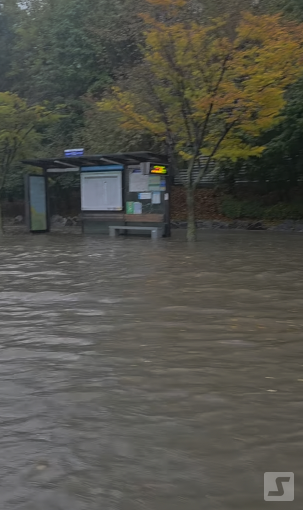
Videos and photos of the flooding situation in Suwon's urban area were posted on social media.
The released videos showed vehicles moving through floodwaters, cutting through the current. Strong water sprays erupted each time vehicles passed, and in some sections, water rose so high that the boundary between the road and sidewalk was difficult to distinguish.
Rainwater even accumulated up to the front of bus stops. As roads around the stops were submerged in muddy water, inconvenience occurred for both vehicle and pedestrian traffic.
Citizens who saw the videos expressed surprise at the flooding situation. One citizen said, "I thought we were sailing a boat," while another said, "I almost became a flooded car," describing the situation at the time.
Particularly among citizens who had lived in Suwon for extended periods, reactions indicated this was exceptional.
A citizen who has lived in Suwon for 20 years wrote, "I came in 2006 and have been here 20 years, but this is the first time I've seen a flood like this," adding, "What kind of management failed so badly that Suwon is flooded?"
Another citizen said, "In 16 years of living here, this is the first time I've seen this. It seems a sewer drain is blocked somewhere," and a reaction also came saying, "I've lived in Yeongdeung for 30 years and saw this for the first time."
Some citizens pointed to fallen leaves accumulated in storm drains as the cause of flooding. One citizen said, "The drainage outlet is clogged with fallen leaves," and another said, "It seems the drainage was blocked."
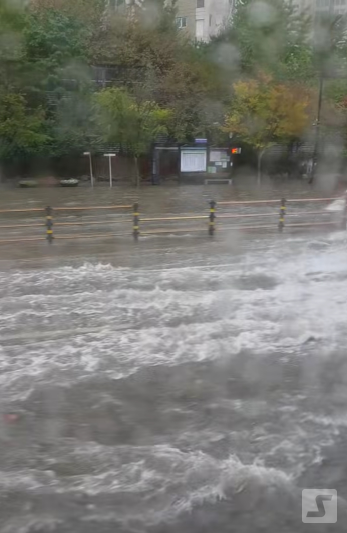
There were also opinions comparing past flooding experiences.
One citizen said, "Seodun-dong, Pyeong-dong, Seryu-dong, and Mangpo-dong sometimes experience flooding when heavy downpours occur," but argued, "If flooding happens with rain like today's, there must be another problem."
Another citizen also said, "That area gets somewhat blocked every rainy season, but for it to burst in just one day without even being monsoon season is a problem," "Mangpo tends to flood easily," among reactions linking the flooding to regional characteristics or rainfall conditions.
During autumn, fallen leaves from street trees can block storm drain inlet openings, reducing drainage functions. However, it has not been confirmed whether this flooding was caused by leaves clogging the drainage outlet or whether concentrated rainfall in a short period exceeded the processing capacity of the drainage facilities.
A Suwon city official said, "We have completed measures and are currently investigating the exact cause."
Meanwhile, Gyeonggi Province activated an enhanced initial response stage of its disaster safety countermeasures headquarters from 10 a.m. that day, deploying 913 officials from the province and 31 municipalities and counties for emergency response.
As of 5 p.m., the province controlled a total of 772 locations including 752 river promenades, 2 riverbed parking lots, 1 riverbed road, 11 stone weirs, and 6 other locations.
A Gyeonggi Province official said, "We will continuously monitor weather conditions and make every effort to prevent loss of life through preemptive safety measures for high-risk areas."

Loading comments…